 Hyperlambda
Part of our database-agents series — the overview lives at Database AI Agents.
If you are a DBA, you are probably a lot closer to building useful AI agents than most people realise.
That might sound strange at first, because most of the conversation around AI agents revolves around models, prompts, frameworks, chat interfaces, and benchmark scores. But once you strip away the hype, the only AI agents that matter in production are the ones that can work with real business data. And the people who already understand where that data lives, how it is structured, and how it should be accessed are usually the DBAs.
This is why I think the jump from SQL database to AI agent is much smaller than people assume. In fact, if your database already models the core parts of the business, then most of the hard work is already done. Customers, invoices, products, orders, tickets, users, roles, permissions, and relationships already exist. The missing layer is often not more data, nor a complete rewrite of the backend. The missing layer is simply a safe and practical way for an AI agent to interact with that existing system.
And this is exactly where things start becoming interesting.
Most AI agents can talk. Far fewer can actually do anything useful.
A lot of AI demos look impressive right up until you ask one simple question. Can it work with live data from an existing system?
Often the answer is no.
Many AI agents are really just polished chat interfaces sitting on top of a language model. They can explain things, summarise things, and generate text about things. But the moment you want them to retrieve a customer record, update an order status, create a support case, or query a legacy SQL database, the illusion starts to crack. Suddenly someone has to build connectors, APIs, wrappers, permissions, filters, and glue code.
That is where most projects slow down.
The problem is not that the model is not smart enough. The problem is that the model is disconnected from the systems where the business actually operates.
For a DBA, this should feel familiar. The truth of the business is usually not in the prompt. It is in the schema.
Your database already contains the business logic that matters
Most organisations do not need to invent a new data layer in order to become AI enabled. They already have one.
Their SQL databases already describe the structure of the organisation in surprisingly rich ways. A CRM database contains customers, leads, activities, and sales status. An ERP system contains products, invoices, stock levels, and suppliers. A support system contains users, tickets, comments, and priorities. Even old line of business systems often carry years of carefully evolved domain knowledge in their schemas.
From a DBA perspective, this means the business is already modelled. The tables exist. The foreign keys exist. The constraints exist. The permissions model often exists. What is missing is a controlled interface between that database and the AI layer.
This is why the fastest path to a useful AI agent is often not to build a new backend from scratch. It is to wrap the existing database in API endpoints the agent can call.
Start with CRUD endpoints, not a rewrite
The simplest way to turn a database into something an AI agent can use is to expose CRUD endpoints on top of the tables that matter.
CRUD is not glamorous, but it is practical.
If an agent can read, create, update, and delete records through clearly defined HTTP endpoints, then it can start working with live operational data immediately. It can look up customers. It can create leads. It can update statuses. It can retrieve invoices. It can support workflows that already exist inside the business.
For DBAs, this is a far more natural transition than most AI discussions suggest. You are not being asked to throw away your schema and rebuild everything around a new stack. You are simply exposing the parts of the database that should become usable capabilities.
This matters because the difference between an impressive AI demo and a useful AI system is often just one thing. Can it safely access the right records in the right way?
Generating CRUD endpoints makes the jump much faster
Traditionally, wrapping a database in an API means a lot of repetitive work. Someone has to inspect the schema, write routes, define input parameters, write SQL, apply access control, decide which fields are writable, validate requests, and then repeat the process for each table.
That is one reason so many teams never get beyond prototypes.
But if your tooling can inspect the database metadata and generate those CRUD endpoints for you, the process changes dramatically. Instead of hand writing every wrapper, you can point the system at the database, choose which tables you want to expose, configure settings where needed, and generate the backend endpoints automatically.
According to the Magic Cloud documentation, the endpoint generator can inspect a database schema and generate Hyperlambda HTTP endpoints around the tables it finds. By default it creates endpoints for CRUD operations and item counting. It also allows you to configure things such as authorization requirements, accepted fields, paging, sorting, logging, cache settings, joins, URL overrides, and whether existing files should be overwritten.
That is exactly the kind of leverage DBAs should care about.
Instead of spending days creating repetitive wrappers around tables, you can get a usable backend surface much faster and spend your attention on the parts that actually deserve human judgment. Which tables should be exposed. Which roles should have access. Which fields should be writable. Which operations should be read only. Which endpoints should be public, private, cached, logged, or restricted.
That is a much better use of DBA level expertise than manually building boilerplate.
The SQL endpoint generator handles the cases CRUD cannot
Of course, not everything maps cleanly to generated CRUD operations.
Sometimes you need a custom read query, a reporting endpoint, or a more advanced SQL statement that joins several tables or filters data in a specific way. That is where custom SQL endpoints become useful.
The SQL endpoint generator described in the documentation solves exactly this problem. Instead of automatically generating SQL from table metadata, it allows you to write the SQL yourself and wrap that SQL inside an HTTP endpoint. You choose the database, select the HTTP verb, define the endpoint URL, optionally apply role based access, define arguments, and reference those arguments inside the SQL using parameter syntax such as @foo.
This is a powerful middle ground for DBAs.
You do not have to choose between full automation and full manual integration work. You can use generated CRUD endpoints for the obvious table level capabilities, then add a few carefully scoped SQL endpoints for the parts that need custom logic.
That combination is often enough to turn an existing database into a genuinely useful backend for an AI agent.
Once you have endpoints, you have tools
This is the step many people miss.
An AI agent does not need direct database access to become useful. In fact, it should not have direct database access. What it needs is a set of callable tools with clear boundaries.
A generated CRUD endpoint is one such tool.
A generated SQL endpoint is another.
Once those exist, the agent can use them to interact with the database through controlled backend capabilities. Instead of giving the model unrestricted SQL access, you give it a finite set of actions it can perform. Read from this table. Insert into that table. Update these fields. Execute this custom reporting query. Count these records. Retrieve this filtered dataset.
This changes the architecture in an important way. The intelligence layer suggests what should happen, but the execution layer remains controlled.
That should be comforting to any DBA.
The model does not need to improvise its own access path into the database. The access path already exists, and it is wrapped in endpoints with explicit behavior.
Why this matters specifically for DBAs
DBAs are often told that AI is coming for everything, as though the database layer will somehow become less important. I think the opposite is true.
The more serious AI systems become, the more valuable structured data and disciplined backend access become.
A schema is not a liability. It is an advantage.
A DBA already understands relationships, constraints, consistency, performance, and authority boundaries. Those are exactly the things that start to matter once an AI system moves beyond chatting and begins interacting with operational systems.
This means DBAs are in a strong position to shape how AI becomes useful inside an organisation.
You can decide which parts of the schema should become callable capabilities. You can keep write access narrow. You can expose read only surfaces first. You can validate how updates happen. You can require roles. You can preserve traceability. And you can do all of that without rebuilding the entire backend stack just to satisfy the AI trend of the month.
In other words, the DBA is not standing in the way of AI adoption. The DBA is often the person who can make it real.
Safety matters more than convenience
This is also where it is worth being explicit.
The right way to connect AI agents to SQL databases is not to let the model generate arbitrary SQL against production and hope for the best.
That may produce a fun demo, but it is not a serious architecture.
The safer model is to wrap database access in explicit endpoints and scoped tools, then let the agent operate through those controlled surfaces. If an endpoint is read only, then the agent cannot write through it. If an endpoint only allows certain fields, then the agent cannot mutate the others. If an endpoint requires a specific role, then access is bounded by the runtime rather than the prompt.
This distinction matters because prompts are not permissions.
A well worded prompt can influence the model, but it does not enforce anything. Runtime boundaries do. For DBAs, this should feel obvious, because the same principle already exists throughout database work. You do not protect critical systems with good intentions alone. You protect them with hard constraints.
That is why wrapping the database in generated CRUD and SQL endpoints is not just convenient. It is structurally better.
A simple workflow from database to agent
In practice, the path can be surprisingly short.
First, connect your existing SQL database.
Second, generate CRUD endpoints for the tables that make sense to expose.
Third, add one or two custom SQL endpoints for reports, joins, or operations that do not fit simple CRUD patterns.
Fourth, attach those endpoints to an AI agent as tools.
Fifth, test the agent against real business tasks such as retrieving a customer, updating a lead, creating a task, or querying operational records.
At that point you already have something far more useful than most AI demos. You have an agent that can work with real systems.
And because the backend capabilities were generated on top of the existing database instead of rebuilt from nothing, the time from idea to working prototype becomes dramatically shorter.
Good places to start
If you are a DBA wondering where this approach makes the most sense, the answer is usually wherever operational data already matters.
CRM systems are an obvious candidate. So are support databases, inventory systems, finance databases, internal operations systems, and older SQL based line of business applications that already carry real business value.
You do not need to expose the whole schema on day one. In fact, you probably should not.
Start with one narrow use case.
Pick a table or a small set of related tables. Generate read endpoints first if you want to be conservative. Add limited writes later. Then connect those capabilities to an agent and see whether the workflow becomes useful.
That kind of small beginning is usually enough to show whether the architecture fits your environment.
The database is already the hard part
One reason I like this approach is that it respects the work organisations have already done.
The hard part was never creating a chat interface. The hard part was building and maintaining the systems that represent the business correctly over time. That work already exists in the database.
So if you want to create a useful AI agent, do not start by pretending the existing backend is obsolete. Start by asking a simpler question.
How quickly can I turn the database I already trust into callable capabilities an AI agent can use?
For many DBAs, the answer is much faster than expected.
And once you see it that way, the path becomes clear. You do not need to rebuild everything. You do not need to hand code every integration. You do not need to choose between legacy systems and AI.
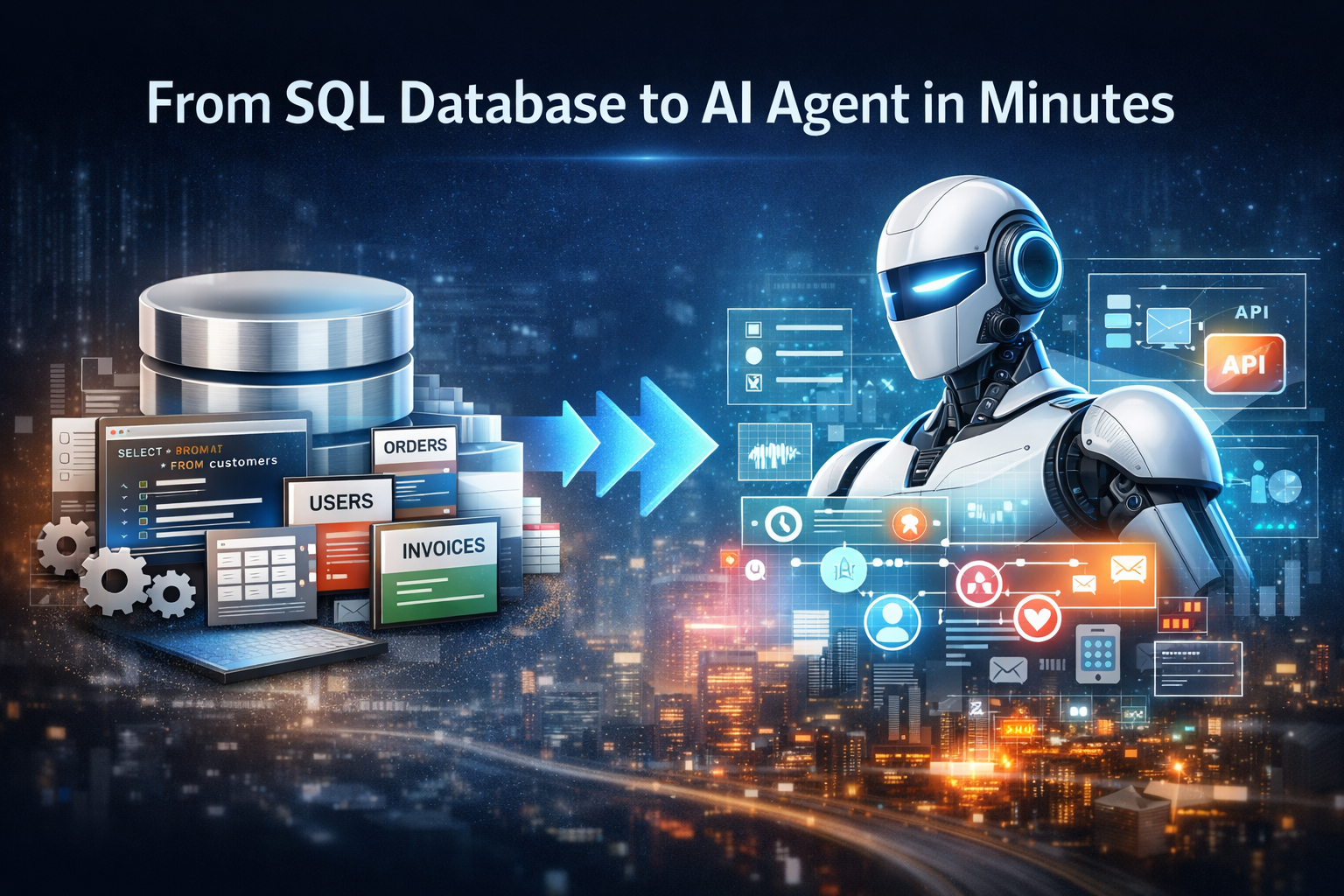
You can start with the schema you already have, wrap it in CRUD endpoints, add custom SQL where needed, and go from SQL database to AI agent in minutes.
Frequently asked questions
How do I turn a SQL database into an AI agent?
Connect the existing database, generate CRUD endpoints for the tables worth exposing, add one or two custom SQL endpoints for reports or joins, attach those endpoints to an AI agent as tools, and test the agent on real business tasks.
Should an AI agent have direct SQL database access?
No. The agent should work through a finite set of callable endpoints with explicit behaviour, so that if an endpoint is read only, limits fields or requires a role, the boundary is enforced by the runtime rather than by the prompt.
What does the Magic CRUD endpoint generator do for a SQL database?
It inspects the database schema and generates Hyperlambda HTTP endpoints around the tables it finds, by default for CRUD operations and item counting, with configurable authorization, accepted fields, paging, sorting, logging, caching, joins and URL overrides.
Where should a DBA start with a database AI agent?
Start with one narrow use case, such as a table or a small set of related tables in a CRM, support or inventory system, generate read endpoints first, and add limited writes later.