 Hyperlambda
Why it can do this safely
From English to safe execution
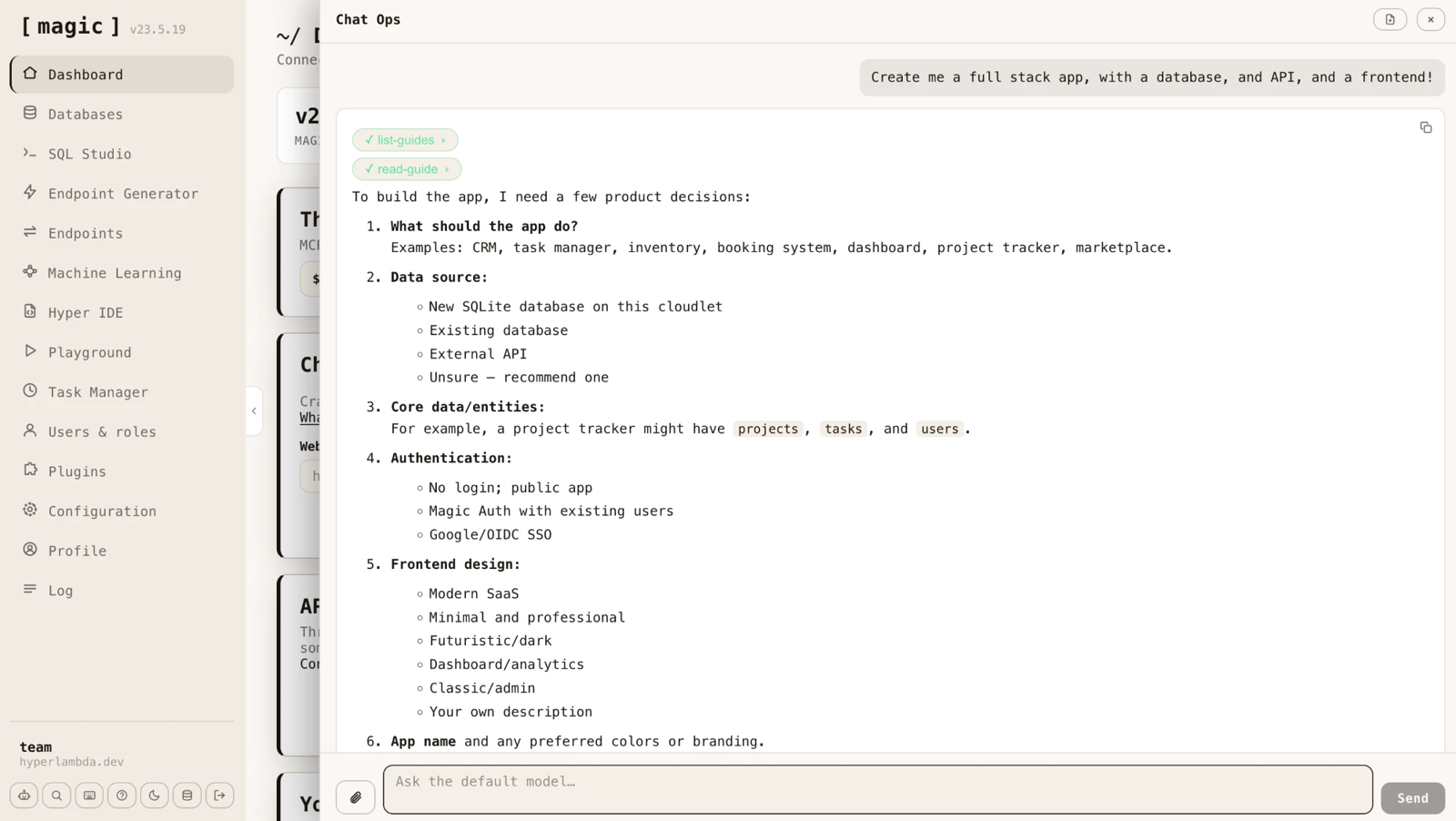
You describe the task, the generator compiles it to Hyperlambda, and the runtime executes it inside a whitelist: a list of the exact operations generated code may perform. Anything not on the list fails before it runs, so the runtime, not the model, is the security boundary. The Natural Language API puts that decision in public: type any sentence and the page shows you the code the model wrote, beside the runtime's verdict on it.
Step 1
Describe the task
Write what you want in natural language
Step 2
Compile to Hyperlambda
The compiler turns your request into Hyperlambda AST
Step 3
Execute safely
Magic Cloud runs the result inside a constrained C# runtime
Concrete example
“Create an endpoint that returns unpaid invoices for a customer.”
Generated Hyperlambda AST
.arguments
   customer_id:long
data.connect:billing
   data.read
      table:invoices
      where
         and
            customer_id.eq:x:@.arguments/*/customer_id
            status.eq:unpaid
   return-nodes:x:@data.read/*
Runtime result
[
  {
    "id": 42,
    "customer_id": 7,
    "invoice_number": "INV-10042",
    "amount": 1299.00,
    "due_date": "2026-05-15",
    "status": "unpaid"
  },
  {
    "id": 57,
    "customer_id": 7,
    "invoice_number": "INV-10057",
    "amount": 249.50,
    "due_date": "2026-06-01",
    "status": "unpaid"
  }
]
What happened
- The model proposed the structure above; it never wrote free-form source code.
- Magic Cloud validated every node against the whitelist before execution.
- A hallucinated or unauthorised operation fails before it runs, instead of running badly.
- The same check runs for a human, an agent, or an agent extending itself.
Why this matters
- Hallucination-resistant. Free-form generated code can do anything its language can; a constrained structure can only do what it is allowed to.
- Sandboxed by construction. The boundary is a property of the runtime, not a prompt, a linter or a review step.
- Agents that build their own tools. Because generated code cannot escape, an agent can safely generate new tools, workflows and APIs on demand.