 Hyperlambda
Part of our cost series — size your own numbers with the Savings Calculator.
Backend work has a habit of looking deceptively small before it begins.
A couple of tables. A handful of endpoints. Some authentication. A few role checks. A deployment. A quick verification pass.
On paper, that does not sound like much.
In practice, it is exactly the kind of work that burns both time and tokens.
And in agentic workflows, that burn compounds fast.
That is why the most interesting thing about Magic is not that it can generate code.
A lot of systems can generate code.
The more important thing is that Magic collapses the most expensive backend layers into a sentence.
Hosting is already there. Authentication is already there. Role-based access control is already there. CRUD generation is already there.
That changes the economics of backend work in a way that is difficult to ignore once you measure it.
In one recent test, we used Magic to build a full backend from a plain-English request, verified it end to end, and compared the likely token and time cost against doing the same job the traditional way.
The result was not subtle.
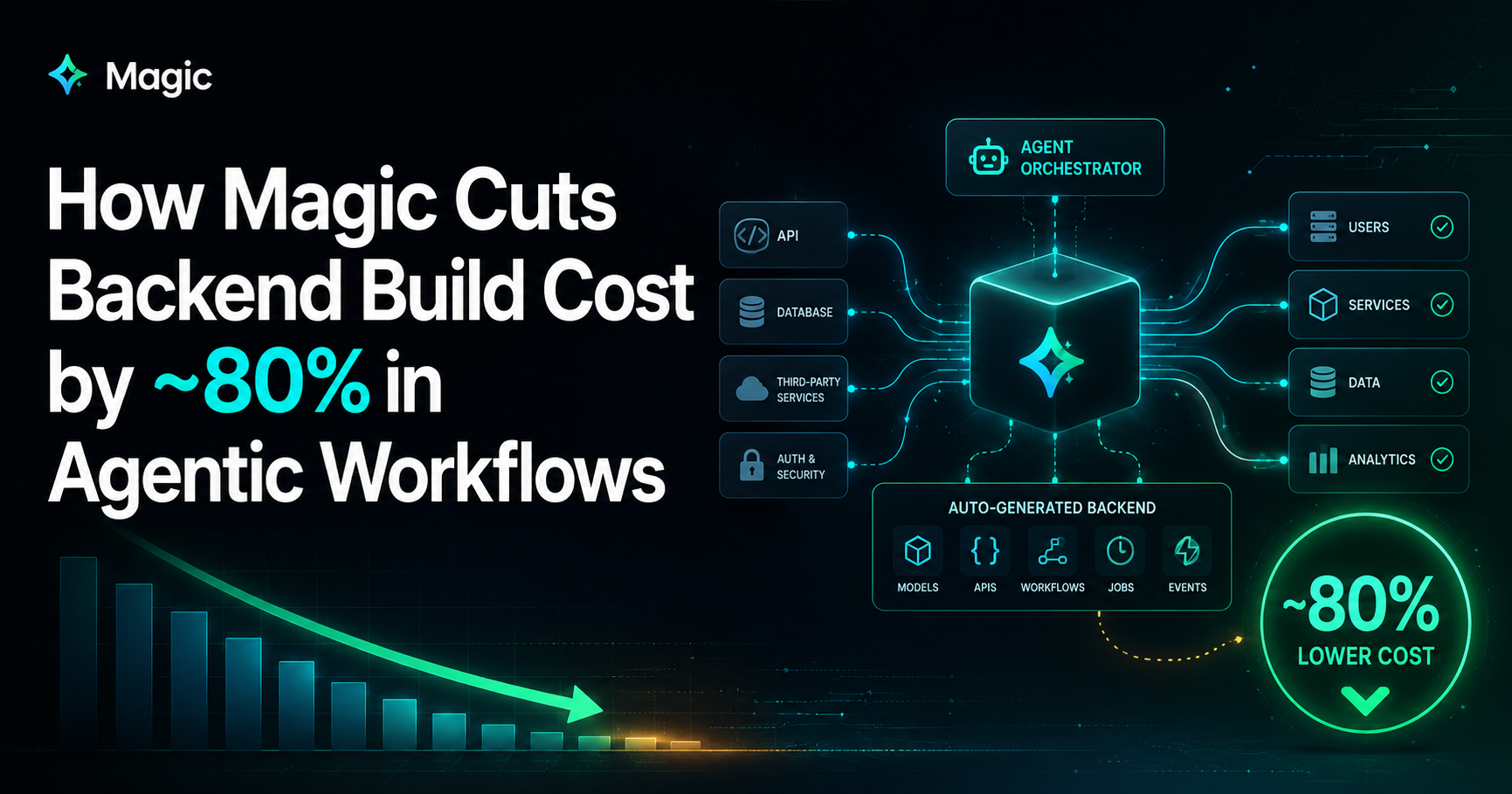
On the backend and integration slice of work, Magic reduced token usage by roughly 80 percent.
The time savings were arguably even more important.
The task we gave Magic
The request itself was straightforward.
We asked Magic to create a taskmanager database with two linked tables.
The first table was clients.
The second was tasks.
The two were joined through a foreign key relationship so that tasks belonged to clients.
On top of that, we asked for a complete CRUD API.
That meant eight endpoints in total.
Create, read, update, and delete for each entity.
We also asked that the API be secured so the endpoints were restricted to the guest role.
That is an important detail because it moves the task beyond mere schema generation.
This was not just “make me some tables.”
It was “make me a hosted backend with data relationships, access control, and a usable API surface.”
And it was all described in plain English.
What Magic generated
Magic produced the database structure, the linked entities, and the CRUD API endpoints from that request.
There was no manual server scaffolding. No route wiring. No dependency installation. No handwritten JWT handling. No custom middleware for role checks. No deployment choreography.
The endpoints came out live and hosted.
That last part matters more than people sometimes realize.
A lot of AI-assisted backend tooling still leaves you holding the bag on the operational side.
It can help generate code, but you still need to decide where it lives, how it authenticates, how permissions work, and how it becomes reachable.
Magic changes that because the platform already owns those concerns.
The result is that a backend request does not fan out into ten hidden subprojects.
It stays close to the shape of the original intent.
That is where a large share of the savings comes from.
We verified the result end to end
This was not a paper exercise.
We verified the backend by using it.
First, we created a client. Then we created a task attached to that client. Then we queried the data back successfully.
That may sound simple, but it is the difference between generated artifacts and a working backend.
A lot of “AI built this” stories quietly stop at code output.
This one did not.
The backend was live, usable, and validated through the actual data flow it was created to support.
That matters because any serious cost comparison has to be grounded in a working result, not merely a plausible-looking scaffold.
Where traditional backend work burns tokens
To understand the savings, it helps to understand where the token spend usually comes from.
If you build this kind of backend from scratch with a general coding model, the work tends to expand into several layers.
- database schema design
- ORM or SQL setup
- server scaffolding
- route creation
- input validation
- authentication setup
- role-based authorization checks
- dependency management
- environment configuration
- deployment instructions
- testing and debugging
Every one of those layers has a token cost.
Not just because the model must generate code, but because it usually must explain, revise, fix, and regenerate code across multiple rounds.
That is the hidden tax of traditional agentic backend work. It is also the reason AI agent builders end up paying for the same backend three times — once to generate it, once to debug it, and once to secure it after the fact.
The first answer is rarely the final answer.
You go back and forth. You patch a route. You adjust a migration. You fix an auth assumption. You revisit a role check. You modify deployment details.
And every correction consumes more context, more output, and more validation effort.
This is why backend tasks often become disproportionately expensive inside LLM-heavy workflows.
They have a lot of boilerplate, a lot of integration points, and a lot of places where slight mismatches force another iteration.
The token comparison
For this backend, the traditional approach was estimated to consume roughly 140,000 tokens.
Using Magic, the same job landed at about 25,000 tokens.
That is an approximately 80 percent reduction.
Those figures are calibrated estimates rather than exact metered logs, but the directional gap is the point.
The savings are large because Magic removes the need to repeatedly generate and repair the same backend infrastructure layers.
Instead of using tokens to manufacture scaffolding from scratch, the model can spend them expressing intent against a runtime that already knows how to host, secure, and expose the result.
That is a fundamentally better use of tokens.
What the savings look like in dollars
When mapped to Claude Fable 5 pricing from July 13, 2026, at $10 per million input tokens and $50 per million output tokens, the difference becomes easy to understand.
For a single build, the estimated cost was roughly:
- about $0.53 with Magic
- about $2.60 when built from scratch
That alone is useful.
But single-build economics are not the real story.
The real story appears when a team repeats this pattern over and over.
For a 25-person team using Fable heavily in agentic workflows, the estimated savings came out to roughly $14,300 per month.
Annualized, that is around $171,000.
Framed differently, this represented about a 36 percent reduction in total Fable spend for that team model, with the backend and integration slice itself seeing the much larger reduction.
That is the kind of number that shifts a platform decision from interesting to financially material.
The bigger win is time
The token savings are real.
But they are not the most important thing.
Time is.
A hosted, auth-secured backend with linked tables and CRUD endpoints is not an exotic engineering project.
It is exactly the sort of thing competent developers build all the time.
Which is also precisely why it is so expensive in aggregate.
Each one is small enough to seem routine. But each one still consumes hours.
Schema design. Endpoint wiring. Auth setup. Role checks. Deployment. Verification. Debugging.
Taken together, that is often a half-day of work. Sometimes more, depending on the stack and the deployment environment.
With Magic, the task shrinks to minutes of specification and validation.
That difference compounds far faster than token accounting alone suggests.
In an agentic team, backend requests are not rare one-off events. They are recurring operational work.
So the real payoff is not just that one build got cheaper.
It is that a category of work moved from “meaningful engineering chunk” to “quickly expressed platform task.”
That is how teams recover velocity.
Why Magic changes the economics
The reason Magic can do this is not mysterious.
It changes the cost structure by eliminating the layers that usually dominate backend effort.
Hosting is already solved. Authentication is already solved. Permissions are already solved. CRUD generation is already solved.
That means the prompt is not trying to recreate a backend stack from first principles every time.
It is targeting a runtime that already contains the expensive primitives.
This is the core distinction between “AI that writes code” and “AI that operates inside a capable backend platform.”
In the first model, the LLM must keep regenerating infrastructure. In the second, the LLM mainly describes what should exist.
That is why the savings are not incremental.
They are structural.
And structural savings are the only kind that compound reliably.
Why this matters for agentic workflows
This becomes even more relevant when you look at modern agentic tooling.
The workflow described here is not limited to a single client experience.
It works in environments that support MCP and OAuth, including tools such as Codex.
That matters because it means the backend capability is not trapped inside a closed demo path.
It can participate in a broader agent ecosystem where tools, permissions, and live capabilities need to connect cleanly and securely.
For teams building serious agentic systems, this is where platform architecture starts to matter more than prompt cleverness.
If your agents need dependable access to real backends, then secure hosting, permission boundaries, and fast capability generation are not optional conveniences.
They are the foundation.
Magic is compelling here because it reduces both the execution cost and the operational friction of giving agents useful backend surfaces.
An example of the shift, visually
The economic argument is easier to understand when you see the difference between backend work as a multi-step engineering project and backend work as an intent-driven platform operation.

That is the real transition Magic is driving.
It is not merely making developers type less.
It is collapsing an entire category of repetitive backend assembly into a much smaller unit of expression.
The honest fine print
There are limits to this comparison, and they are worth stating clearly.
The token numbers used here are estimates, not exact metered counts.
They are also specific to the backend and integration slice of work.
General coding, writing, architecture discussion, and analysis do not automatically get the same reduction.
Not every engineering task compresses this dramatically.
And not every team will have the same cost profile.
Still, those caveats do not change the larger conclusion.
On the kind of work Magic is designed for, the gap is real.
And because backend and integration tasks recur so frequently in agentic development, the effect compounds quickly.
Conclusion
Magic does not make all software free.
What it does do is remove a large amount of recurring backend overhead from the token economy and the engineering calendar.
In this case, a plain-English request produced a hosted, secured, verified backend with linked data and CRUD endpoints at roughly one-fifth of the normal token cost.
That alone is compelling.
But the bigger point is that backend work moved from hours to minutes.
And when that happens repeatedly across a team using agentic workflows, the strategic impact is much larger than the per-build price difference.
When hosting, authentication, and CRUD collapse into a sentence, backend development does not just get cheaper.
It becomes a different kind of task entirely.