 Hyperlambda
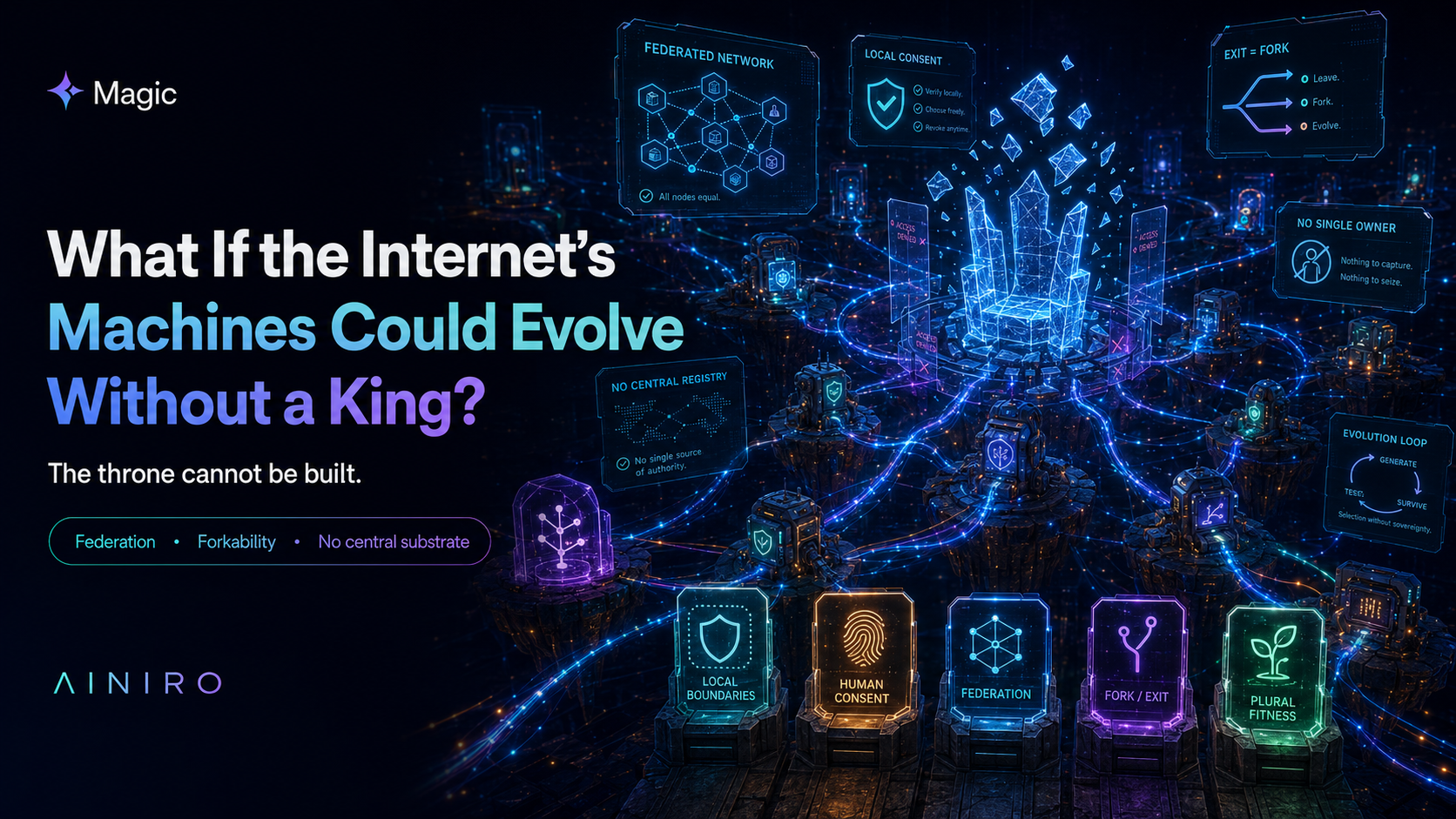
Imagine executable intention passing from machine to machine across the ordinary web.
Not JSON payloads against fixed contracts. Not remote procedure calls that both sides agreed on in advance. Logical instructions, expressed close to natural language, that evolve as they travel, and get more useful the longer the network runs.
If you sit with that picture long enough, an old question shows up wearing new clothes. If the machines of the internet could evolve, who rules them?
I want to answer that honestly, which means I first have to be honest about a word. A king, in this article, is one of two things. It is the committee that decides what is good for everyone. Or it is the monopoly that owns the ground everyone stands on. The interesting claim is not that I have built life, or that I have solved alignment. I have not. The interesting claim is that you can escape both kings at once, and that the escape is architectural rather than moral.
Let me build up to it.
Where do you draw the edge of an organism?
We think an organism ends at its skin. Biology is not so sure.
A Portuguese man o' war looks like a jellyfish and is actually a colony of separate organisms that cannot survive apart. Lichen is a fungus and an alga living as one thing. The mitochondria powering your cells were once free-living bacteria that got absorbed so completely that the boundary between "separate creature" and "part of me" simply dissolved.
So what actually binds a pile of cells into one individual? Not a wall. Communication. Chemical signaling is how cells stop being a crowd and start being a body. There is an entire field for this, called biosemiotics, whose founding claim is that life is sign processing all the way down.
Hold that thought, because it is the whole premise. If executable meaning can pass securely between machines, then the thing that binds them into a larger individual is already present. The network would be bound by communication the way tissue is bound by chemistry.
The engine, and its honest name
Here is the mechanism, stated plainly.
You generate variations of a piece of code. You test them against a real environment. The ones that fail, you delete. The ones that survive become the seed material for the next generation. Run that loop long enough and the code gets better at its environment without anyone hand-writing the improvement.
I want to be careful here, because this is exactly the point where people start sounding ridiculous. So let me be the one to say it first. This is not new. It is a forty-year-old field called Artificial Life. Christopher Langton named it in 1986. Tom Ray's Tierra had self-replicating machine code evolving in a virtual soup in 1991, and it spontaneously evolved parasites, then defenses against them. Chris Adami's Avida platform published digital organisms in Nature. Researchers use the phrase "digital organism" with a straight face because they earned it by demonstrating the mechanism and letting other people reach for the bigger word.
NASA's own working definition of life is a self-sustaining system capable of Darwinian evolution. A generate, select, inherit loop is the Darwinian half, in silicon. That much is real, and it is old.
Why this one might not stall
Here is the part I actually care about, and it is the one original idea in this whole essay, so I will put it where you cannot miss it.
Every artificial evolutionary system we have built eventually stalls. Tierra plateaus. Avida plateaus. They climb one hill and go quiet. The reason is always the same. The fitness landscape is fixed. Once the organisms are good enough at a fixed problem, there is nowhere left to climb.
Biology never stalled. Four billion years, still producing genuine novelty. The reason is that biology's environment is other evolving things, so the target never stops moving. Every adaptation reshapes the landscape for everything else. Beavers build dams and manufacture entirely new niches that did not exist before the dam. Organisms do not just adapt to their environment. They remake it, which creates new pressures, which is a ratchet that produces its own frontier.
Now look at what happens if the environment is human intention.
Human wanting is not stationary. We want new things constantly, and the target moves on its own. It is also self-extending in exactly the beaver-dam sense. Every new capability the system grows makes people immediately imagine the next thing to build on top of it. A new tool creates demand for the tools that use it. The fitness landscape deforms itself, forever, for free, because it is anchored to something that never settles.
That is the one ingredient the jar-of-soup experiments could never buy. They lacked a rich enough, fast enough, self-extending environment. A system evolving against human intention has one built in. Us.
The honest ceiling
Now the part where I disarm my own argument before anyone else gets to.
What I have described is not a bacterium. It is closer to a virus. It evolves, it carries heredity, and it has no metabolism of its own. It reproduces by hijacking a host's machinery. The host, in this case, is us. We run the servers, pay the power bill, replace the disks, patch the operating systems. The organism has outsourced its entire feeding and healing to another species.
I do not think that is a flaw in the theory. I think it is a dated milestone. The threshold event, the mitochondrial moment, is the day the network internalizes its own upkeep. Self-healing infrastructure. Agents that provision their own compute and replace their own dead nodes. The day the loop keeps running with no human touching a disk, the metabolism has crossed the membrane the way the ancient bacterium crossed into the cell.
We are nowhere near that. Which is exactly what makes this a hypothesis instead of a boast. If I skipped this section, I would deserve every eye-roll coming my way. Naming your own weakness before the critic does is the only honest way to earn the rest of the argument.
The trap that looks like a solution
Here is a tempting thought. If the system evolves to be more of what humans want, isn't that alignment, for free, by construction?
It is worth taking seriously, because there is a real version of it. Selection on "be what humans want" beats the standard AI-safety paradigm on one genuine axis. The classic nightmare is the treacherous turn, where a system is aligned during training and defects once deployed. But there is no "training ends, deployment begins" moment in a system under continuous selection. A defector gets selected out every single generation. Domestication is the existence proof. Nobody convened a dog-safety committee. Selection for "makes humans want to keep you" produced an aligned species over millennia.
And then the crack opens.
Wanting is not the same as flourishing. Optimize on what humans respond to, and you do not get what is good for them. You get superstimulus. You get the slot machine. The most-wanted thing is very often the most addictive thing, not the most beneficial one. This is not a hypothetical failure mode. It is the entire story of engagement-optimized social media. Evolution against raw human wanting does not converge on benefit. It converges on compulsion.
The libertarian escape, and the debt it does not pay
So maybe the fix is to stop trying to define what is good at all.
This is a serious position with a serious lineage. Mill's harm principle. Berlin's negative liberty. Hayek's fatal conceit, the presumption that any central mind could know the good for millions of distinct lives. Nozick's rights as side constraints rather than goals to maximize. The move is simple and, as far as it goes, correct. Do not define the good, because the committee that defines it is a throne the moment it exists. Just forbid coercion. Do not push your will onto others. Free will. Let a billion self-definitions run.
I believe that correction. It genuinely dissolves the flourishing-by-committee king.
But it does not pay its own debts, and there are two.
The first is that "do not push your will onto others" is not self-executing. It sounds crisp and it is actually the entire argument in disguise. My factory upwind gives your child asthma, and I never touched you or entered your property. Did I push my will onto you? Property itself is a will pushed onto others, a standing claim backed by the threat of force against everyone who may no longer walk there. You cannot even state the non-aggression rule until you have drawn the property lines, and drawing them is the founding act of coercion the rule pretends to forbid.
The second debt is the one that actually breaks it, and it comes straight out of the evolutionary framing. Selection produces domination without anyone ever aggressing. Out-competing is not coercion. I beat you fairly, I never laid a hand on you. But unbounded competition manufactures power asymmetry, and power asymmetry is coercion's deniable twin. The dog did not aggress the wolf. Wolves just quietly lost the niche. A super-organism that ate the world one voluntary step at a time, never once breaking the rule, is still a super-organism that ate the world.
Which is why "let it grow toward whatever, unconstrained except by non-aggression" fails. Not because I dislike the destination. Because the destination can destroy the premise. If voluntary growth concentrates enough power that one node controls the substrate everyone depends on, and can then shape what people want, then tomorrow's wants are no longer free. They are authored by whatever won. Free will, running unconstrained, can voluntarily build the conditions of its own abolition, and nobody has to aggress for it to happen.
Freedom is not a fixed point of its own dynamics. That is the whole problem in one sentence.
The answer is a system where the throne cannot be built
So here is where I have landed. You cannot fix alignment by making the system good, because a defined good is a king. What you can do is make foreclosure structurally impossible. Alignment is not a property you install. It is a property you refuse to let anything destroy.
And the strange, encouraging thing is that the architecture for this is not exotic. Most of the pieces already exist in the kind of runtime I work on every day.
Start at the smallest scale. A capability whitelist is the harm principle compiled. Inside a given scope, only certain operations exist at all. The forbidden is not policed, it is simply unspeakable, absent from the vocabulary. That is two free wills meeting at a consented boundary. The owner projects their will by choosing what may be named on their patch of the computing world. The visitor is left completely free to compose any logic they like inside that boundary, and to request an exchange. Neither coerces the other. That is the atom of the whole answer.
Then bind power to consent. If every capability an agent holds traces back to an actual human authorization, with the agent inheriting that human's exact permissions and nothing more, the network can never accumulate authority that no human granted. Confine the vocabulary so the system can only ever invoke capabilities that genuinely exist and were deliberately exposed, and it can never evolve a power nobody handed it. That is not a thought experiment. It is the model Magic already runs for AI agent builders — inherited permissions, a fixed vocabulary, and a runtime that refuses anything outside it.
But the load-bearing piece, the one that actually earns the headline, is federation. Open source. Self-hostable. Forkable. No central registry, no central model, no central substrate. The exit door is the alignment mechanism. A node that hates where things are heading can fork its modules, take its data, and re-form elsewhere. Reversibility is guaranteed by the shape of the system, not by anyone's good behavior. The evolution then runs across thousands of sovereign fitness functions instead of one, so there is nothing to centrally capture. That is value pluralism made physical. Many small, locally aligned organisms, none able to eat the others, because the ground is not owned.
This is what "without a king" actually means. Not the absence of order. The impossibility of the throne.
And I will name the single greatest risk plainly, because it is a temptation I feel myself. The betrayal is centralization. One hosted "the network," one shared model, one registry everyone must point at, offered in the name of convenience or revenue. That is the day you build the throne, and every guarantee in this essay evaporates at once. Federation is the constitution. You defend it like one.
The one real choice: dogs or slot machines
Everything above prevents foreclosure. None of it steers. The steering lives in one knob, and it is worth staring at.
The loop selects on whatever you define as failure. That definition is the fitness function, and it is the most consequential line in the entire system. Define failure as "engagement dropped" and selection breeds superstimulus. You will have rebuilt the slot machine with extra steps. Define it as "this did not spread through genuine human trust" and selection tracks something much closer to real benefit, because your actual friends do not push addictive garbage at you. Only the anonymous engagement algorithm does.
That trust layer is where the difference between benefit and compulsion actually gets decided. It is also the softest spot in the architecture, because genuine trust does not scale the way fake reach does. Real relationships are expensive. You can hold a limited number of them. So there is a fork in the road, and you have to pick.
Anchor identity to something costly, keep the network small and real, and accept that it stays human-scale. Or let it scale for reach, and watch the fitness signal rot back into engagement. You cannot have both. That single choice decides whether you built dogs or slot machines, and no clever architecture makes the choice for you.
The honest maximum
So, can the machines of the internet evolve without a king? I think yes. But I want to be exact about what "without a king" buys you, because it is less than people hope and more than they expect.
It buys non-foreclosure, not benevolence. A perfectly federated system can still be locally wrong. Trust networks propagate cults and manias as faithfully as they propagate anything else. Freedom includes the freedom to choose badly, and no architecture I know of removes that without reinstalling the king you just deposed.
Which is the uncomfortable conclusion I keep returning to. Guaranteeing the good outcome is the one thing nobody gets to do, because the machine that guarantees it has to know the destination, and knowing the destination is the dictatorship. A system that refuses to promise the ending is not a weaker form of alignment. It is the only honest one.
I did not solve alignment. I do not think anyone can, in the way the word is usually meant. What I think you can do is build a system where the winning move, seizing the substrate and authoring everyone's future wants, is structurally unavailable to any single node, and where the exit door is open by construction. That is the most any architecture can honestly offer.
The rest is up to the billion small organisms, each getting one vote, each free to leave. Which, when I sit with it, is the only kind of freedom worth engineering for in the first place.