 Hyperlambda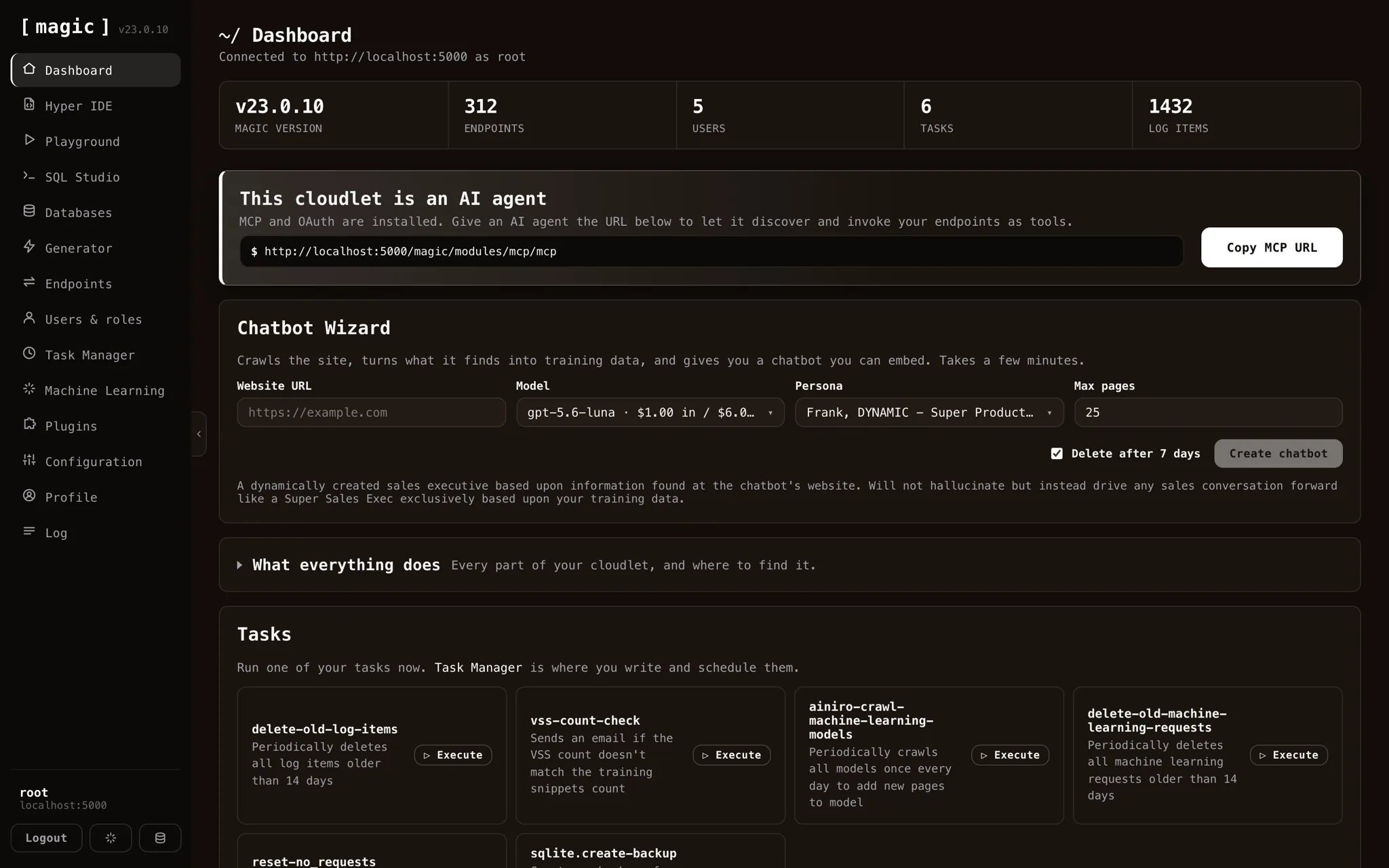
Per-seat billing
Two meters, not one
Business is $50 per builder per month plus $15 per internal user. Everyone who builds is a line item, and so is everyone who merely opens an app. The bill tracks headcount, not usage.
Retool bills per builder and per internal user, and its self-hosted deployment is available on one plan only — switch the pricing page to Self-host and Free, Team and Business all read “Plan not available.” Magic Cloud is MIT-licensed end to end, self-hosts with one Docker command, and costs the same number whether two people use it or two thousand. This page is an honest comparison, with the arithmetic shown — and the rows Retool wins called plainly.
Business is $50 per builder per month plus $15 per internal user. Everyone who builds is a line item, and so is everyone who merely opens an app. The bill tracks headcount, not usage.
Free, Team and Business are all marked unavailable on self-host. Enterprise is the only self-hostable plan, and it is priced on request. There is no published number at which you can run Retool on your own hardware.
Workflows include 5,000 runs a month on both Team and Business, then $75 per additional 5,000. AI credits are capped monthly and do not roll over. Agents are billed separately, by the hour, at a rate that varies with the model.
Source control and SAML or OpenID SSO are Enterprise-only. Audit logs and role-based permissions start at Business. On Free and Team, reusable modules are capped at five.
Retool’s public repositories are deployment plumbing — install scripts, Helm charts, Terraform modules. The installer writes a license key and pulls a closed image. This one gets its own section below.
None of the above is a scandal. Retool is excellent at what it is: the most mature internal-tools builder on the market, with a component canvas nothing here matches. The question this page answers is what to pick when the qualifiers — self-hosted, open, priced flat — matter to you.
Retool figures are the Business plan, which is the first tier with role-based permissions and audit logs. Magic figures are the Professional cloudlet at $100 a month, or Enterprise at $300 where the extra machine helps. Retool prices verified 19 September 2026.
| Scenario | Retool Business | Magic Cloud |
|---|---|---|
| 5 developers, 20 colleagues using the apps | 5 × $50 + 20 × $15 = $550 / month | $100 / month |
| 10 developers, 100 colleagues | 10 × $50 + 100 × $15 = $2,000 / month | $100–300 / month |
| 1 developer, a customer-facing app with 500 external users | $50 + external-user tiers = roughly $3,050 / month | $100 / month |
| Running it on your own hardware | Enterprise contract, price on request | $0 — MIT, one Docker command |
One honest caveat on the third row. Retool lists external users as free to 50, then $8, $6 and $4 per month at rising volumes, without stating whether the rate is graduated or applied flat at your volume. Read both ways, 500 external users land between roughly $3,000 and $3,100 a month, before the builder seat. The range is theirs, not ours.
Retool’s pricing page has a Cloud/Self-host toggle. Switch it to Self-host and three of the four plans change to “Plan not available on Self-host.” What remains is Enterprise, priced on request. Their documentation is consistent with this: the self-hosted deployment pages are labelled Enterprise, production deployment is described as Kubernetes via Helm, and Docker is offered explicitly for testing purposes.
That is a legitimate commercial choice, and for a large regulated buyer with a procurement function it may not even register as friction. But it means self-hosting is not something you can evaluate on a Tuesday afternoon. You cannot price it, you cannot start it without a contract, and the smallest unit of commitment is an enterprise agreement.
Magic inverts this. Self-hosting is the primary deployment model and it costs nothing, because the runtime is MIT-licensed. One command brings up the whole stack — database layer, generated APIs, auth and RBAC, file handling, task scheduling and the MCP server — and the hosted cloudlets run exactly the same code, because there is nothing gated to gate.
Retool maintains public repositories, and several carry the MIT licence. It is worth being precise about what they contain: deployment scripts for running Retool on your own infrastructure, Helm charts for Kubernetes, Terraform modules for cloud provisioning, an RPC library and a React embedding component. Useful engineering, openly published.
None of it is the product. The on-premise repository carries no licence file of its own, and its documented flow is to run an install script that writes a license key into an environment file and then pull a versioned, closed container image from Retool’s registry. The open part is the thing that installs Retool. Retool itself is closed.
For comparison: Magic is MIT in full — the runtime, the plugins, the slots, the dashboard, the CRUD and SQL generators, the auth and RBAC layer, the AI features. Fork it, run it, sell it, never speak to us again. There is no key, no threshold, and no plan that unlocks a feature the self-hosted build is missing.
Including the rows Retool wins, and there are several. The visual builder row is the one most people should weigh hardest.
| Feature | Retool | Magic Cloud |
|---|---|---|
| Licence | Proprietary; public repos are deployment tooling only | MIT, everything included — self-hosted runs the same code as hosted |
| Self-hosting | Enterprise plan only, priced on request; production via Kubernetes and Helm | First-class and free — one Docker command, any plan, no contract |
| Pricing model | Per builder and per internal user, plus external-user tiers | Per cloudlet. Users of every kind are never counted |
| Usage metering | Workflow runs, AI credits that do not roll over, agent hours billed separately | None — the cloudlet is the unit, and the invoice does not move |
| Visual app builder | Retool wins — a mature drag-and-drop canvas with a large component library, usable by non-developers | No equivalent designer. Frontends are hosted, not composed on a canvas |
| Native mobile apps | Retool wins — iOS, Android and PWA, with offline mode, push notifications and biometric auth | Web frontends served from the cloudlet; no native mobile story |
| Integration catalogue | Retool wins — a large library of database and SaaS connectors | Four database engines, plus HTTP and OpenAPI import for everything else |
| Databases | Connects to many; its own hosted store is PostgreSQL with a 5GB allowance | SQLite built in; PostgreSQL, MySQL and SQL Server connected, treated as local |
| API generation | Queries and workflows authored per app | Generated Hyperlambda endpoints per table — readable files, editable after generation |
| Access control | RBAC from the Business plan; SSO on Enterprise | Runtime-enforced RBAC from the first minute, with full OIDC and OAuth |
| Source control | Enterprise plan only | Git built into the IDE, publish a module as a repository in one click |
| AI and agents | AI app builder and agents, metered by credits and hours | Native MCP server; agents generate their own tools inside runtime-enforced permissions |
| Maturity and ecosystem | Retool wins — Fortune 500 deployments, large community, professional services | Smaller — one team, one architecture, and the authors answer the support channel |
You need non-developers building interfaces. This is the big one. Retool’s canvas lets an analyst or an ops lead assemble a working, decent-looking tool without writing a frontend. Magic has no equivalent, and pretending otherwise would waste your time. If the people building are not developers, Retool is the better product and it is not close.
You need native mobile. Offline mode, push notifications, biometric authentication and a white-labelled app in the stores are real product surface, and we do not have them.
Your integration list is long and exotic. Retool’s connector catalogue is far broader. If your tool has to speak to fifteen SaaS products on day one, count the connectors before you count the dollars.
Your seat count is small and staying small. Three developers on Team is $30 a month. The per-seat model is genuinely cheap at the bottom; it is growth that makes it expensive. If you are not growing, the arithmetic above never fires.
If the thing you need is a polished internal interface assembled by people who do not write code, buy Retool. If the thing you need is a backend — generated APIs over databases you already have, auth and RBAC enforced by the runtime, and tools an AI agent can safely operate — on hardware you choose, at a price that does not move when you hire, that is this column. Plenty of teams run both, and the same logic drives our n8n, Lovable and Supabase comparisons.
Only on an Enterprise contract. Switching Retool’s pricing page to the Self-host view marks Free, Team and Business as not available, leaving Enterprise with custom pricing. Their documentation lists production self-hosting as a Kubernetes deployment via Helm, with Docker offered for testing purposes.
The platform is not. Retool’s public repositories are deployment tooling — install scripts, Helm charts, Terraform modules and an embedding SDK. The installer writes a license key into an environment file and pulls a closed container image. Magic Cloud is MIT-licensed in full, including the runtime, the dashboard and the code generators.
At the time of writing, Team is $10 per builder per month plus $5 per internal user, and Business is $50 per builder plus $15 per internal user. External users on Business are free to 50, then $8, $6 and $4 per month at rising volumes. Magic Cloud charges per cloudlet and never counts users.
No, and this is the clearest row Retool wins. Their component canvas is a mature visual builder that non-developers can use productively. Magic generates backends, APIs and agent tools, and hosts frontends, but it does not ship an equivalent application designer.
On Retool the bill grows with headcount, because builders and internal users are separate per-seat meters. On Magic the bill is attached to the cloudlet, so hiring developers, onboarding colleagues or launching to end users does not change the invoice.
Magic ships SQLite and connects to PostgreSQL, MySQL and Microsoft SQL Server, generating secured endpoints over schemas that already exist — see AI agents over your existing SQL database. Retool connects to a considerably broader catalogue, which is a genuine advantage if your integration list is long.
The whole platform — database, generated APIs, auth, frontend hosting and the MCP server — on your own hardware, MIT-licensed, with no seat to buy and no contract to sign. Still evaluating? The Supabase, n8n and Lovable comparisons are written the same honest way as this page.
# When it’s up: log in at http://localhost:5555 with root/root.
$ curl -fsSL https://hyperlambda.dev/docker-compose.yaml | docker compose -f - up