 Hyperlambda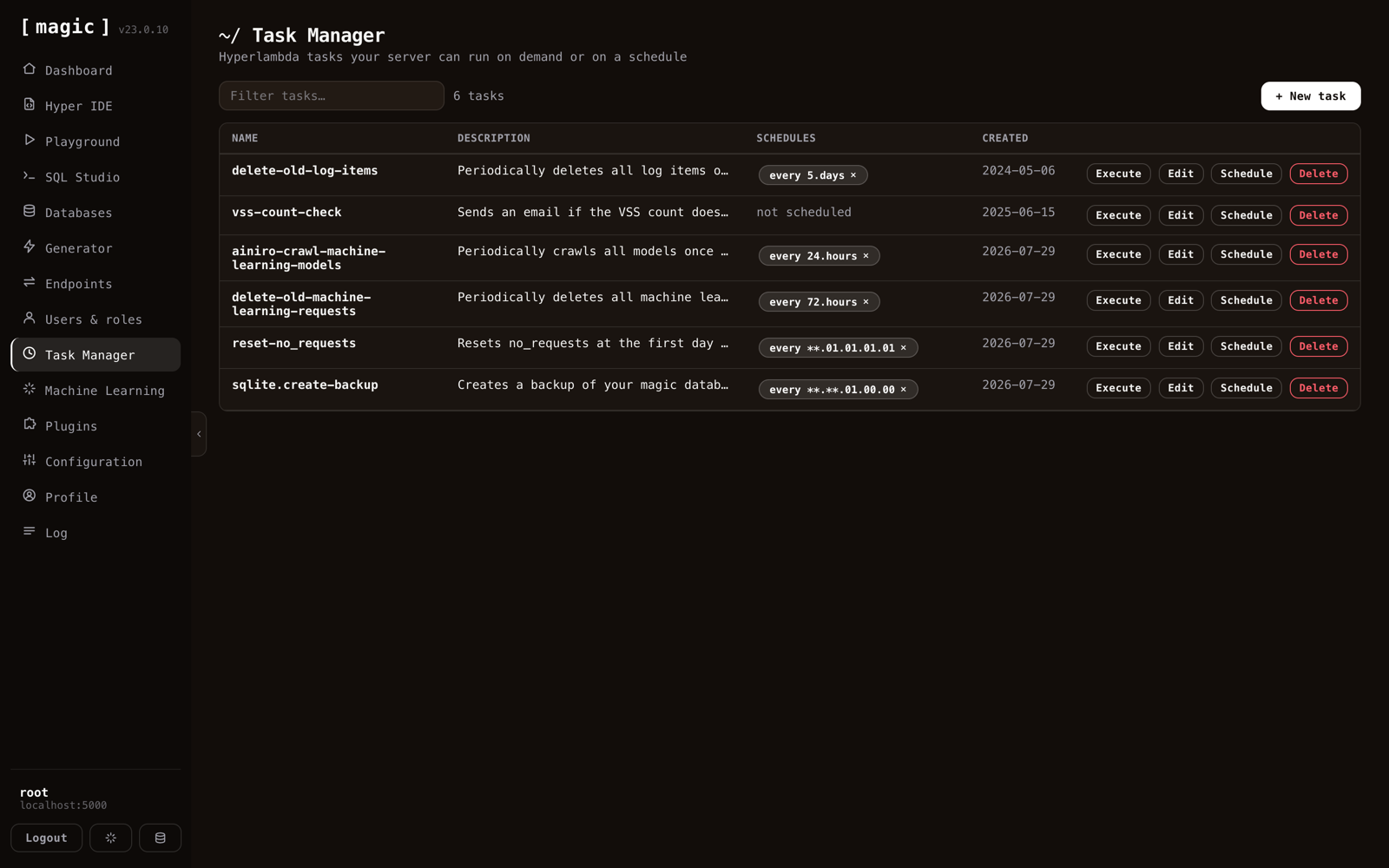
The comparison
Magic Cloud vs n8n
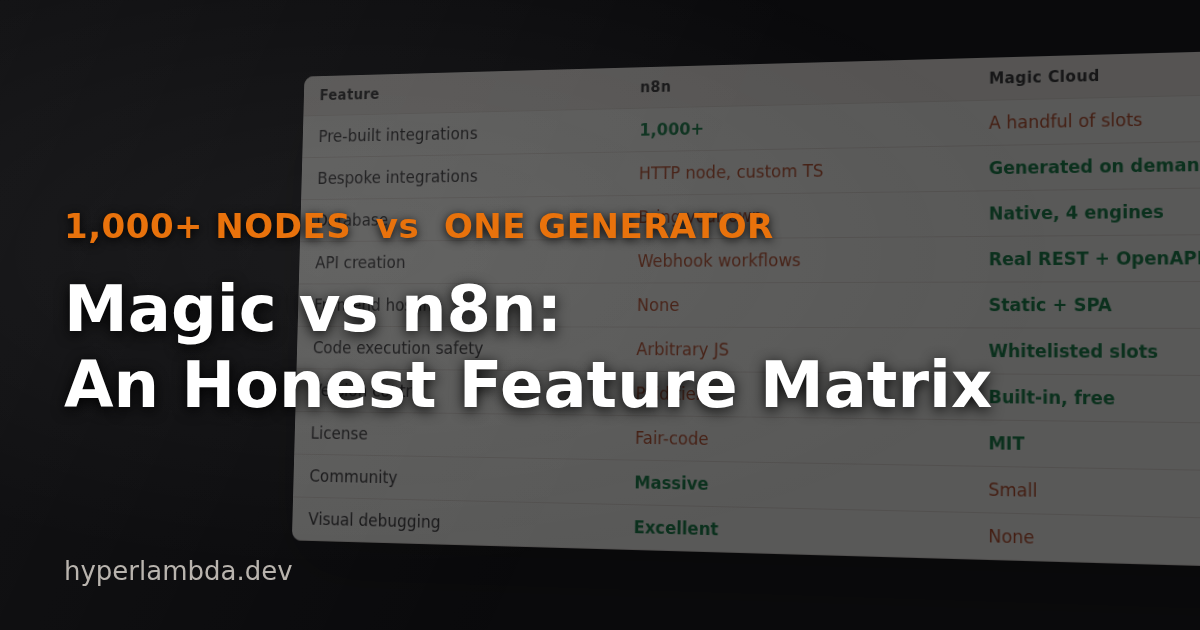
Capabilities, side by side. The long-form matrix has the detail; the 2026 roundup puts n8n against the rest of the field.
| Feature | n8n | Magic Cloud |
|---|---|---|
| How you build it | Drag nodes onto a canvas and wire them | Describe it in English; the generator writes and verifies it |
| What it actually is | A JSON document describing a node graph | Real code. An executable tree — readable, composable, diffable |
| Connector catalog | 400+ nodes | A plugin bazaar — Stripe, HubSpot, Shopify, WooCommerce, WordPress, Slack, NetSuite, SERP API |
| Integrations in total | The catalog, plus hand-wired HTTP nodes | Infinite. A language has no catalog to exhaust. The only ceiling is disk, and on 2 GB that ceiling is a number with 4,196,703,834 digits |
| Service with no connector | HTTP node, or a custom TypeScript node | One sentence — generated, typed, role-gated, live in seconds |
| API with a specification | An HTTP node per operation, by hand | Import the OpenAPI document — every operation at once, as MCP tools |
| Database table to API | Query nodes, rebuilt per workflow | CRUD generated per table in milliseconds, role-gated per verb |
| Escaping the DSL | A Code node running JavaScript | Python, shell or compiled C# wrapped in an endpoint with validation and RBAC |
| Database | Bring your own | Native — SQLite, PostgreSQL, MySQL, SQL Server |
| APIs | Webhook-triggered workflows | Real REST endpoints with OpenAPI specs and role gating |
| Frontend hosting | None | Static sites, or React, Angular and Vue from CI — SPA routing or real 404s |
| Version control | JSON inside n8n; Git is enterprise-tier | Git and GitHub built in — clone, branch, commit, push, each an MCP tool |
| Scheduling | Schedule Trigger node | Any file becomes a task — a date, or “5.minutes”, or “saturday|sunday.22.00.00” |
| Where it can run | Inside n8n | Endpoint, scheduled task, or called remotely — one file, no rebuild |
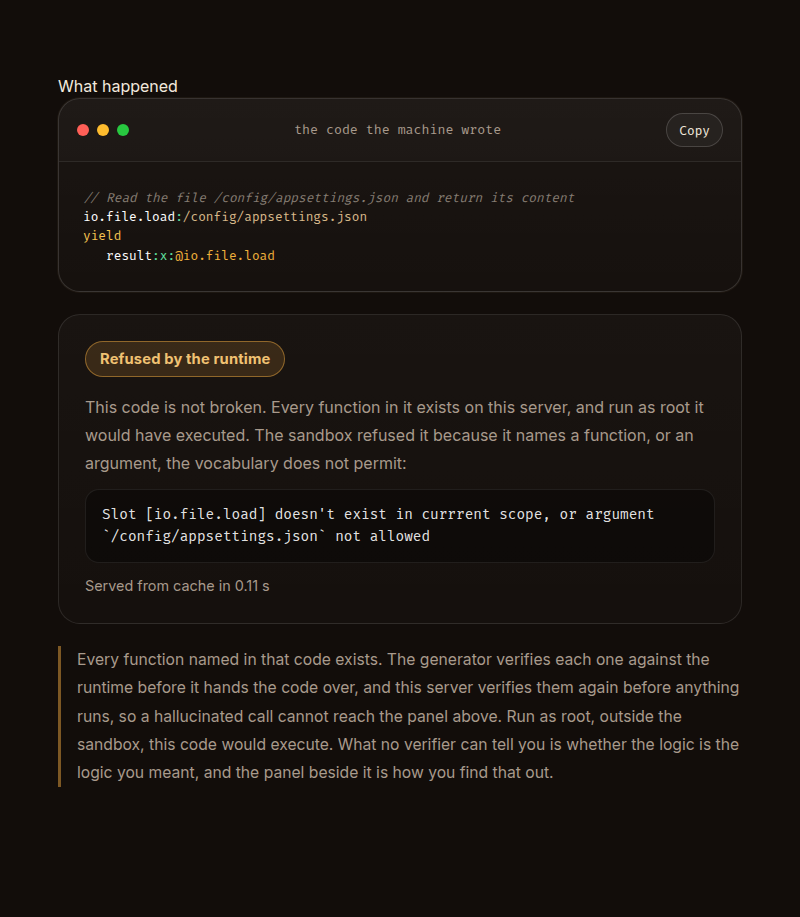
| AI-generated code safety | The Code node runs whatever it is given | Cannot exceed its permissions. Functions verified before dispatch; vocabulary fixed in advance |
| Hallucinated calls | Fail at runtime, cost a retry | Unrepresentable — an invented name has nothing to dispatch to |
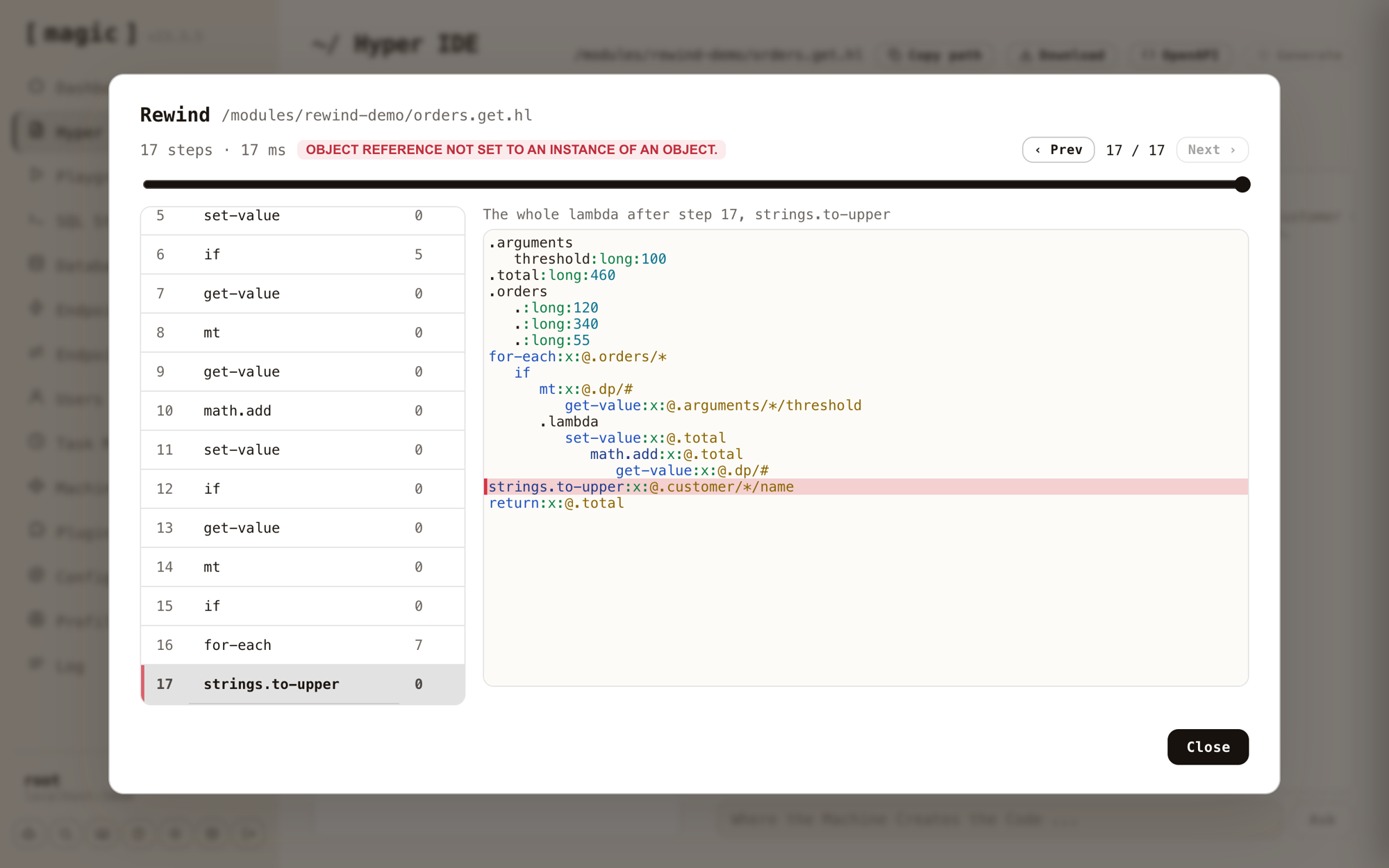
| Debugging one run | Input and output per node | Rewind — every step, the program’s entire state, the throwing line in red |
| Retained run history | Yes — re-runnable from the UI | Logs; Rewind records on demand, in memory |
| Performance | A graph walked node by node | 2,000–2,823 req/s secured, debug build — benchmark |
| License | Fair-code; enterprise features separate | MIT, all of it |