Is Magic Cloud really open source?
Yes. The entire platform is MIT-licensed — database layer, CRUD generation, auth, RBAC, AI features, and the dashboard. There is no enterprise edition holding features back and no platform flag disabling functionality when you self-host.
Can I self-host Magic Cloud completely?
Yes, and self-hosting is the primary deployment model, not a community afterthought. One Docker command brings up the full stack, and the self-hosted version is the same code the hosted cloudlets run — nothing gated.
Does Magic Cloud work with PostgreSQL?
Yes. SQLite is built in, and you can connect PostgreSQL, MySQL, and Microsoft SQL Server. Once connected, the platform treats an external database like a local one for querying, design, and code generation — including a Supabase project’s underlying Postgres.
Can Magic Cloud replace Supabase auth and row-level security?
For most applications, yes, with a different model. Magic ships JWT authentication, full OIDC and OAuth support, and role-based access control enforced by the runtime at execution time. Where Supabase expresses row-level rules in per-app SQL policies, Magic expresses access rules as endpoint and slot-level constraints — and row-shaped filters are implemented in the generated endpoint, enforced server-side.
Does Magic Cloud work with Claude, MCP, and AI agents?
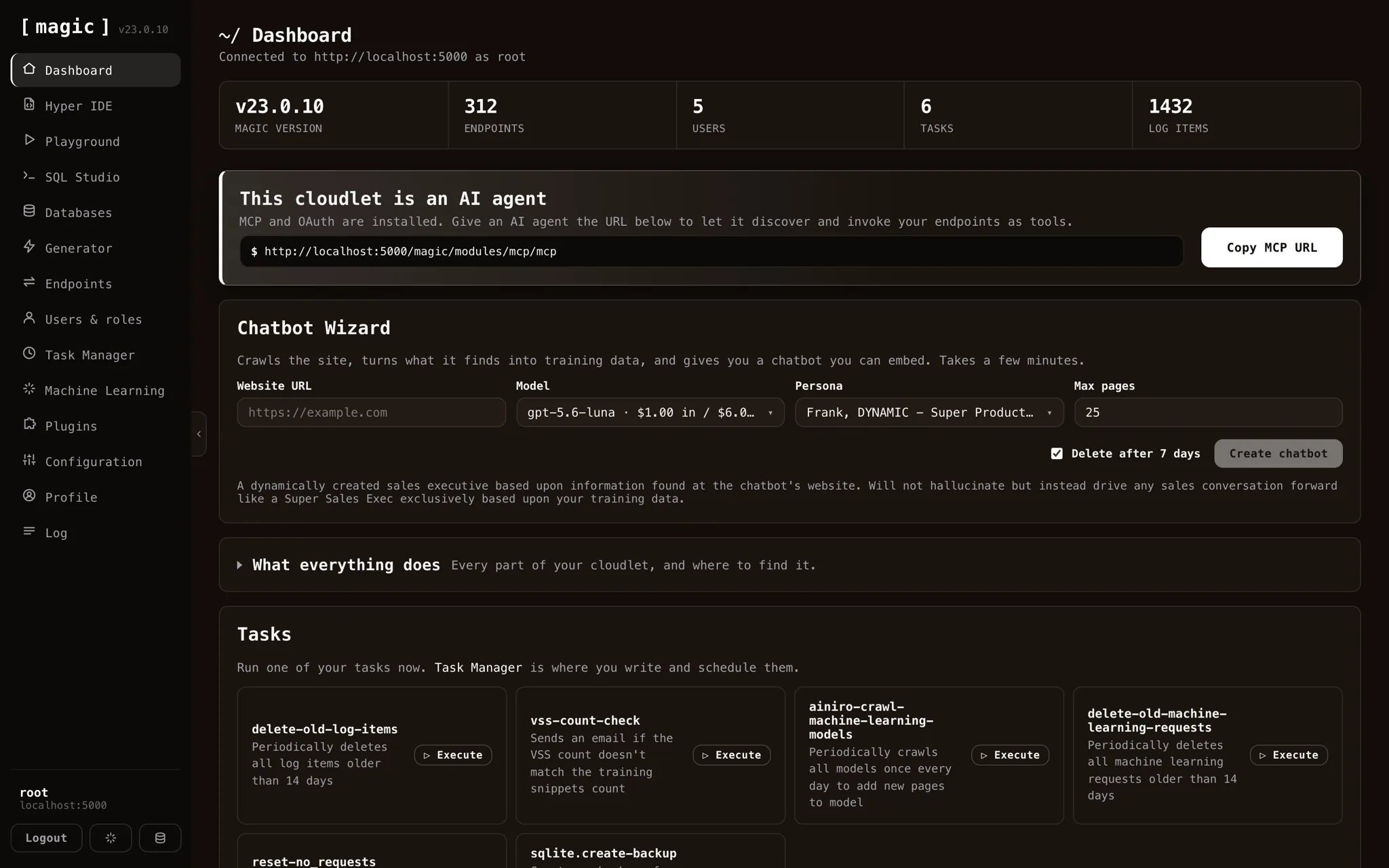
Yes, natively. Magic includes an MCP server, so Claude and any MCP-capable agent can connect directly and use the platform’s tools — creating databases, generating endpoints, managing files, scheduling tasks — inside the RBAC boundaries of the authenticated user. Agents can also generate new tools for themselves through the Hyperlambda Generator.
Can Magic Cloud host my frontend as well as my backend?
Yes. Static sites and single-page apps are served straight from the same cloudlet that holds your database, API and auth, at the same domain — so there are no CORS hoops and no separate deploy pipeline. Supabase has no frontend hosting at all, so a Supabase application needs a third product alongside it, usually Vercel, Netlify or Cloudflare Pages.
Can an AI agent generate the frontend too, or only the backend?
Both. The agent writes the HTML, CSS and JavaScript, saves it to the cloudlet’s web root, and it is live at a URL immediately — in the same conversation that created the database and endpoints. What the agent writes is plain HTML and JavaScript; it does not write React components, and there is no visual editor. That is a limit on what the agent generates, not on what the cloudlet serves — a compiled React, Angular, Vue or Svelte bundle is deployed and served exactly the same way. See the next two questions.
Can I deploy a React or Angular app to a cloudlet?
Yes, and it is the normal way to do it once the frontend is a real application. Generate a long-lived access token on the cloudlet, store it as a GitHub secret, and let GitHub Actions do the rest: check out the repository, run your framework’s production build, zip the build output, and send it to the cloudlet, which replaces the target folder with the new build. Nothing is installed on the server — no SSH key, no deploy agent, no runner — because file management is already part of the platform. The step-by-step is in deploy to a cloudlet on every git push; the only difference for React or Angular is that you zip the build output instead of the repository.
Do I need GitHub Actions to deploy to a cloudlet?
No. Git and GitHub ship with the dashboard: once a GitHub access token is in your configuration you can clone a repository onto the cloudlet, create and check out branches, commit, push, pull, and create or delete GitHub repositories, all from the platform itself. For a site with no build step, cloning once and pulling on each change is the deployment — no workflow file, no runner, no third-party CI. A framework app still needs its build run somewhere, so either a workflow builds and deploys it, or you commit the build output and pull that onto the cloudlet. Every one of those Git operations is also exposed as an MCP tool, so an AI agent can branch, commit and push on your behalf.
Can the cloudlet serve a single-page app, or only normal websites?
Either, and it is a setting rather than a rebuild. In single-page-app mode, a URL matching no file is handed to your application, so React Router, the Angular router or any client-side router resolves it — deep links and refreshes work instead of breaking. In normal-website mode, a URL matching no file returns a genuine 404, which is what a content site wants, where a wrong link should be reported rather than swallowed. Either way the same cloudlet serves your API, so the app calls its backend on its own origin with no CORS configuration.
How do I debug backend logic on a cloudlet?
With Rewind, a post-execution step debugger built into the dashboard. Run any file with Debug instead of Invoke and you get a recording of the whole execution: every operation in order, how long each one took, and your program’s entire state at every step. When something throws, the failing statement is marked in red and everything that had already happened is still there to inspect — which is exactly what a stack trace cannot give you. Recording only happens when you press Debug, lives in memory, and is never written to disk, so normal traffic is unaffected and there are no log files to clean up afterwards.
Does Magic Cloud have pre-built integrations?
Yes, through a plugin bazaar you install from the dashboard. Stripe, HubSpot, Shopify, WooCommerce, WordPress, Slack, NetSuite and SERP API are all there, alongside LLM providers including OpenAI, Ollama, HuggingFace and Together AI. The difference from an integrations directory is where the plugin lands: it installs into your runtime, so what you get is endpoints, workflow actions and slots that your own code and your agents call directly — and everything installed is published through the MCP server, role-gated, without extra work. Anything with no plugin can be imported from its OpenAPI specification and becomes secured endpoints the same way.
Is there a managed option like Supabase Cloud?
Yes. AINIRO runs hosted cloudlets with the same codebase as the self-hosted version — no feature differences, because there is nothing gated to gate.
Do I have to migrate off Supabase to use Magic?
No. Magic can connect to a Supabase project’s underlying PostgreSQL database and generate agents, endpoints, and tools on top of it without moving anything. Many teams run both while they evaluate.
 Hyperlambda