What is Hyperlambda?
Hyperlambda is a programming language whose code is a tree structure rather than free-form text — effectively an executable AST. That structure is what lets natural-language requests compile into something deterministic and inspectable before it runs, which is why it suits AI-generated backends.
What can I actually build with it?
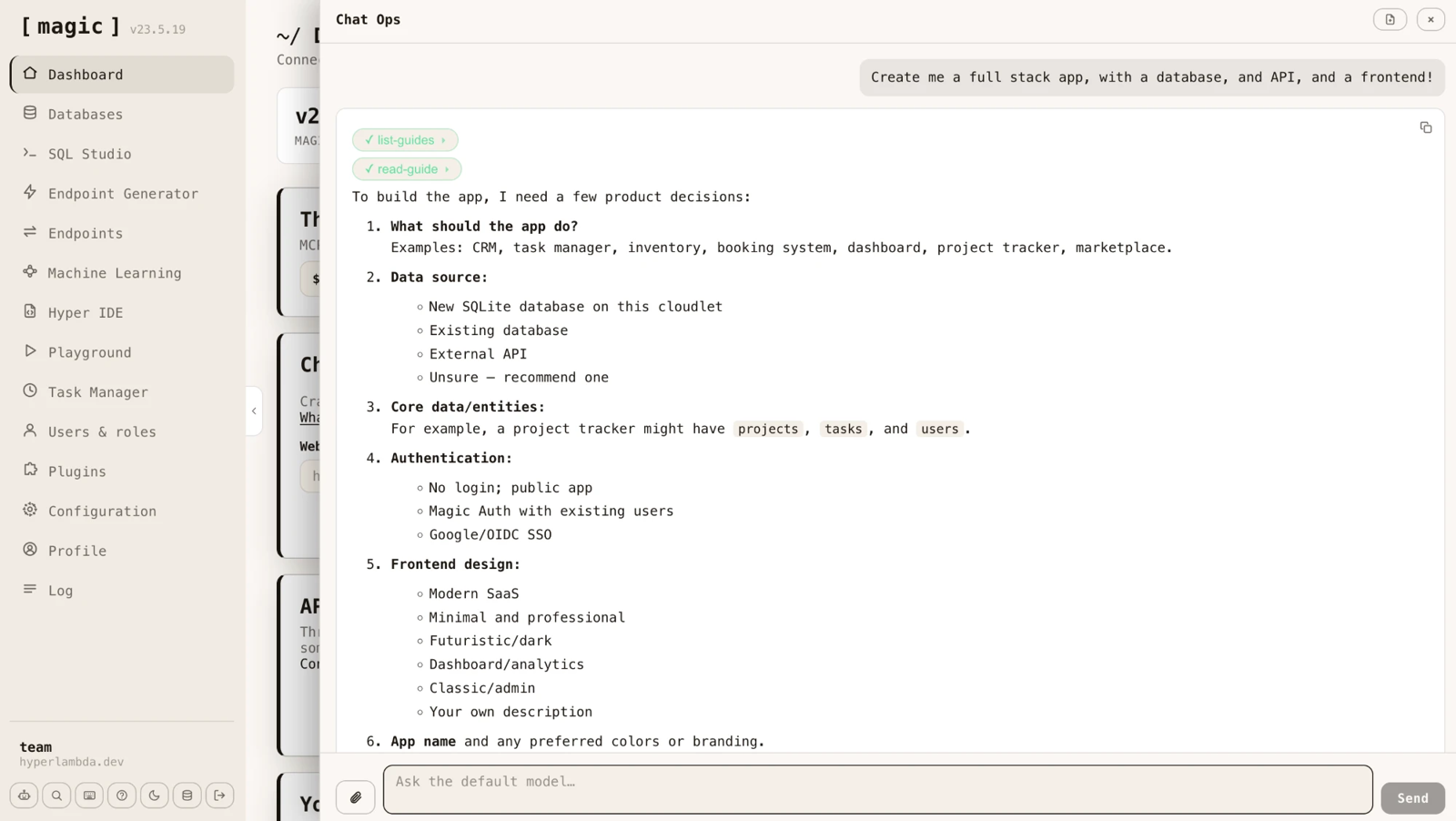
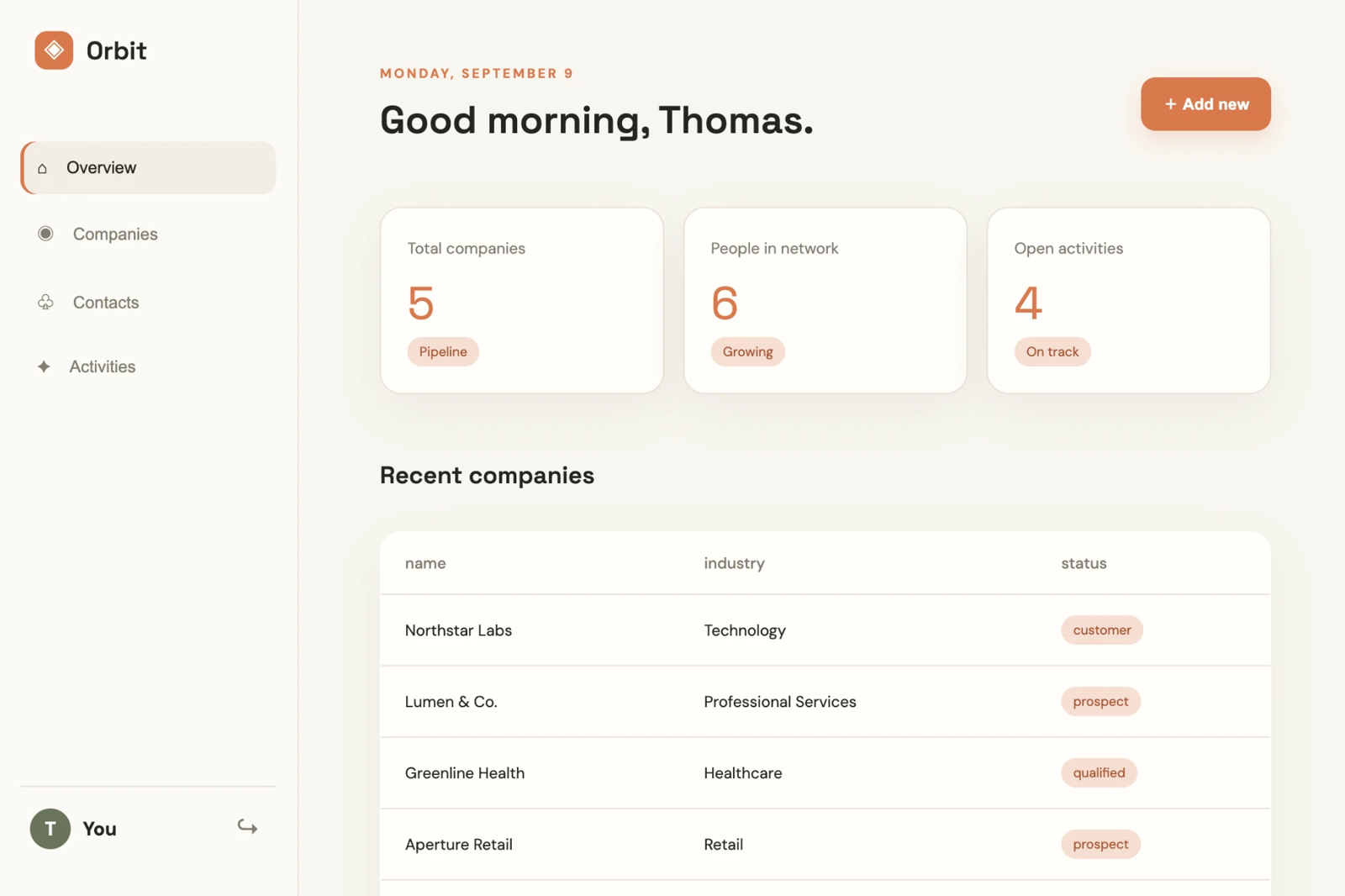
Complete full-stack applications — secured CRUD APIs over your databases, frontends and SPAs served from the same cloudlet, backend workflows, scheduled tasks, AI agents and tools, and embeddable chatbots trained on your own content. All generated from short natural-language prompts rather than hand-written.
Can it build complete applications, including the frontend?
Yes. A Magic cloudlet serves static sites and single-page applications alongside the APIs they consume, so a working prompt-to-app flow is: design the database, generate the secured endpoints, and deploy the frontend — one system, one deployment. Users, roles, and full OIDC and OAuth support are built into the platform, so the applications you ship come with real authentication rather than something bolted on per project.
Do I need to know Hyperlambda to use it?
No. You describe what you want in plain language and the generator compiles it to Hyperlambda for you. Knowing the language helps you read and adjust the result, but it is not required to build working backends.
What makes AI-generated code safe to run?
Generated Hyperlambda compiles to a structure whose every node must bind to an explicitly whitelisted capability in the current context; anything outside that fails before it executes. The model proposes, the runtime decides.
Does it work with any LLM or AI coding agent?
Yes. The runtime's safety model is independent of which model generated the code. Magic integrates OpenAI, Ollama and HuggingFace for its own AI features, and with the MCP plugin installed your cloudlet exposes an MCP server that any MCP-capable harness — including Claude, Codex, Cursor and Qoder — can connect to, using your endpoints as tools.
What does Magic's MCP server do?
It turns every endpoint on your cloudlet into an MCP tool, with no tool definitions to write and no separate server to host. The cloudlet runs its own OAuth 2.1 flow, so Claude, Claude Code, Cursor or any MCP client connects by pasting one URL and authorising. The tool list is filtered by the roles of the user who signed in, and the same role check runs again on every invocation. Endpoints generated from a database table, imported from an OpenAPI specification, or described in a sentence all appear as tools — and an agent can ask for a tool that does not exist yet and have it generated in seconds. The full page is MCP Server.
What databases does it support?
SQLite is built in, and you can connect external MySQL, PostgreSQL and Microsoft SQL Server. Once connected, the platform treats an external database like a local one for querying, design and code generation, and its tables become MCP tools for connecting AI agents to your existing SQL database.
Which sign-in (SSO) providers does it support?
Magic ships single sign-on out of the box for Google, GitHub, LinkedIn, Microsoft Entra ID, Okta, Auth0, Keycloak and Slack. Each provider is turned on from the dashboard with a client ID, external identities are scoped per provider and mapped onto Magic's own role-based access control, and a provider is a single Hyperlambda file — so adding another is dropping a file into a folder.
Do I have to use a cloud, or can I self-host it?
You can self-host it entirely. Magic Cloud runs on your own server — a single Docker command brings up the full stack — and nothing leaves your machine unless an integration you configure sends it somewhere.
What is Magic's bus factor?
Three full-time employees maintain Magic every day, and the team is growing. Thomas Hansen invented Hyperlambda in 2013 and first published it in MSDN Magazine in 2017, and 13 years later he is still shipping it: the repository has more than 10,000 commits, and it publishes releases almost every day. A bus factor is a prediction that a project may disappear. The better test is what has actually happened to the tools people built on. Google Reader, Windows Phone, the Fire Phone, Silverlight, Flash and AngularJS were all retired by companies with far more than three employees. .NET Framework, with millions of developers, was frozen in maintenance mode. Python 2 took twelve years to retire, and migrating from it broke code. Magic is MIT licensed, so anyone can fork it and run it on their own server. Quality does not depend on any one person: every push and pull request runs the analyzer build, the test suite (coverage above 90%), SonarCloud, CodeQL and a secret scan, and the live health page shows master passing with the quality gate OK. The full argument is in Hyperlambda's "Bus Factor".
"So respectfully Mr. LLM, you can take your 'bus factor' and ram it up into the hole where the sun don't shine for all I care - Because 13 years later, I'm still frikkin' here, churning out 2,000+ commits per year, while in the same time, literally 'half your IT infrastructure' was rendered 'obsolete' by your alleged 'professional vendor', including .Net Framework, Microsoft's 'flagship product', and roughly 'half a billion' Java versions, and 100% of SourceForge(t), and Google (nope) Code!!"
— Thomas Hansen 😠
 Hyperlambda