 Hyperlambda
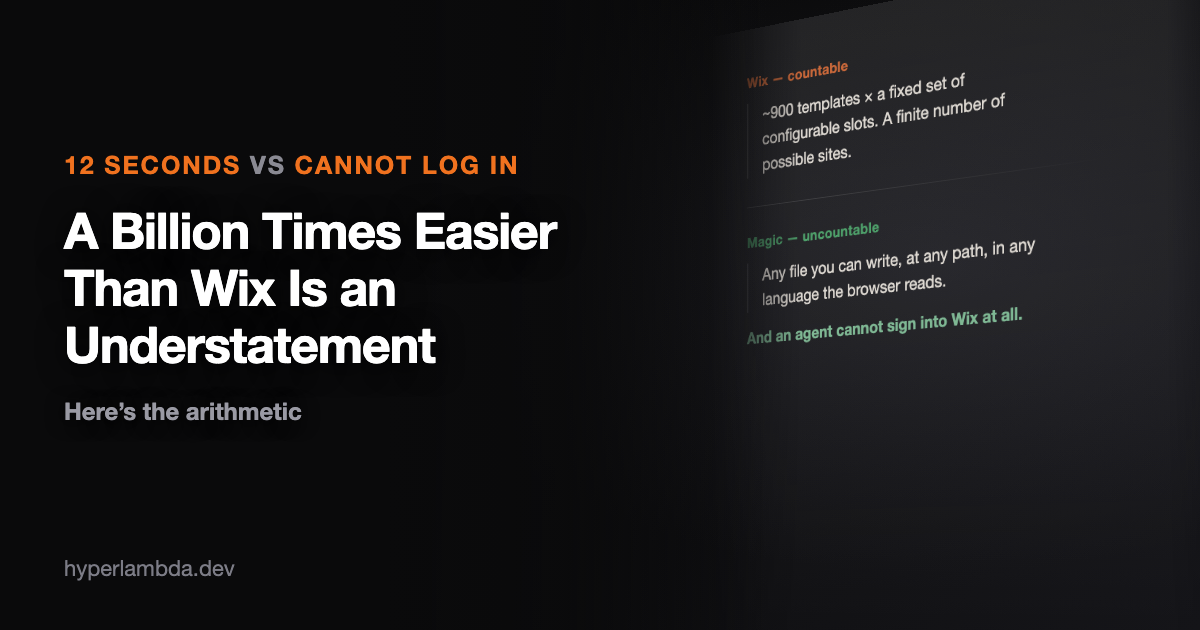
At 2:01 this afternoon I typed one sentence into a chat window. At 2:04 there was a designed, responsive, animated website live in production on a custom URL.
Here is the receipt.
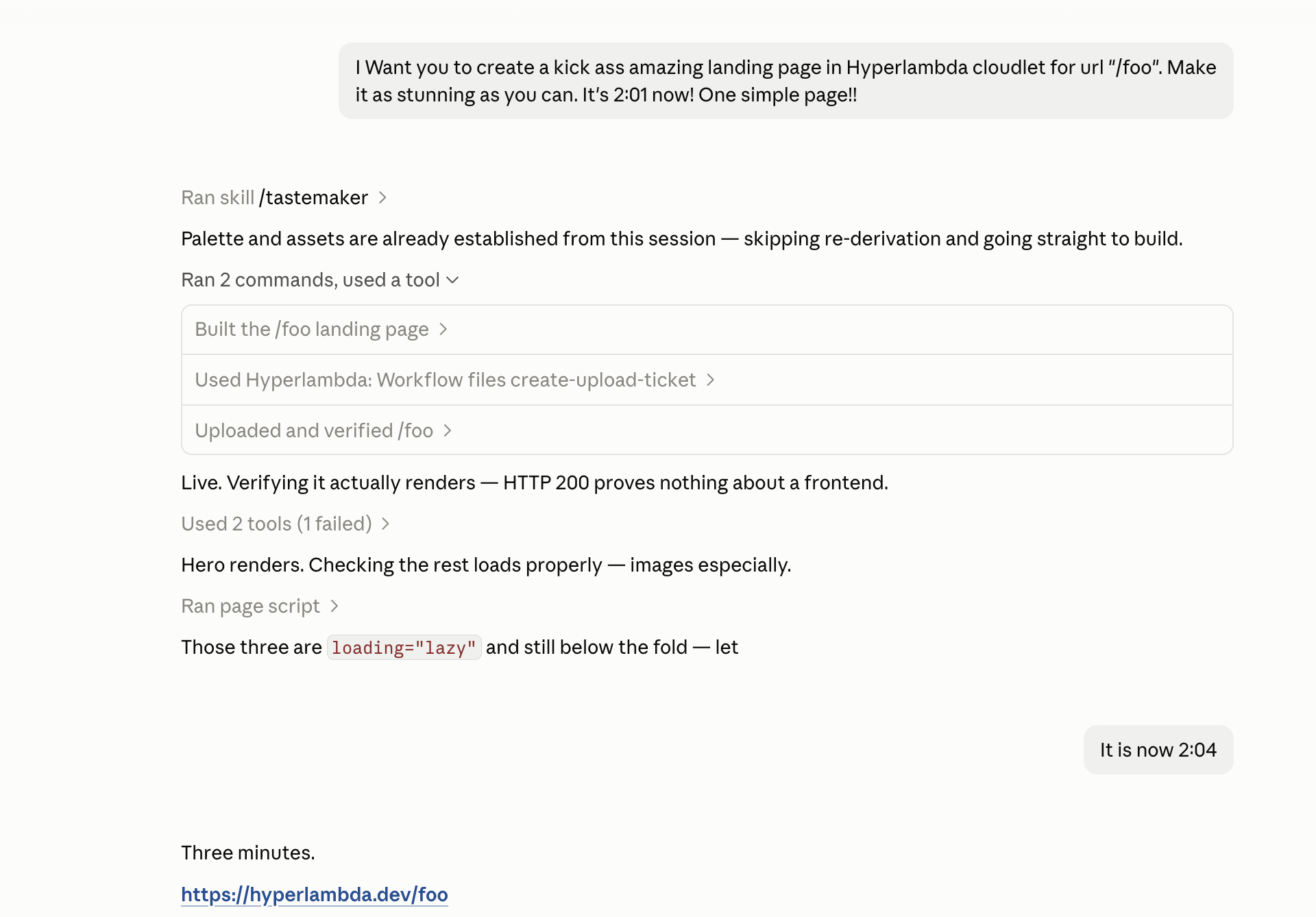
Three minutes. And of those three minutes, roughly twelve seconds was the platform — one call to mint an upload ticket, one call to upload the file, and it was live. The rest was the AI deciding what the page should say and then, frankly, wasting a minute admiring its own work in a browser.
The prompt was this:
“Create me a kick ass cool website!”
That is the entire interface. There is no editor, no canvas, no template picker, no drag handle, no publish button.
And this is what came back.
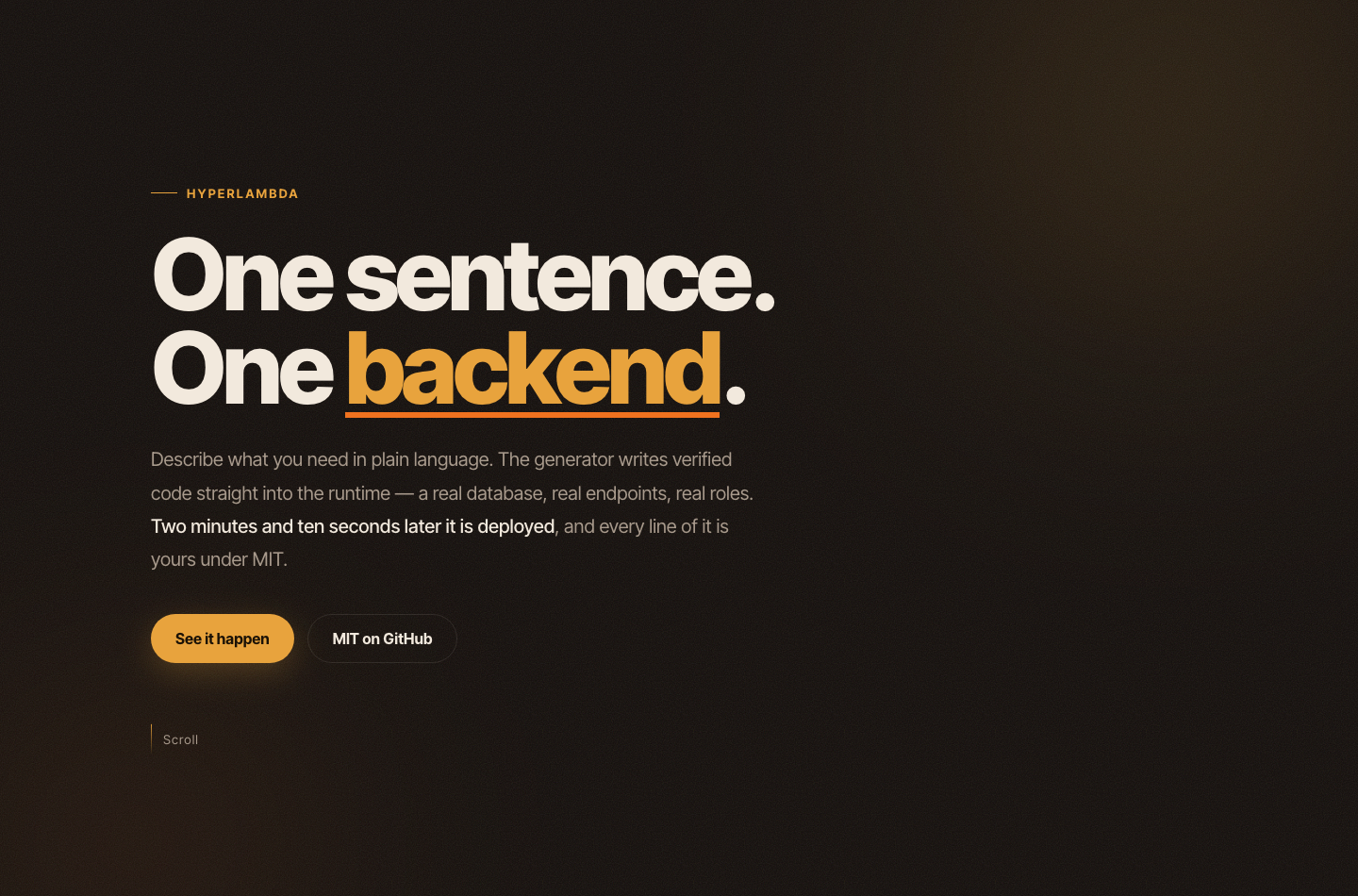
Fluid type that scales with the viewport, an underline that draws itself in, two fixed radial glows behind the content, an SVG noise grain so the dark never reads flat, and a scroll cue that pulses. Below the fold it keeps going — the generated Hyperlambda shown next to the application it produces, a stat grid, a gallery, a closing call to action.
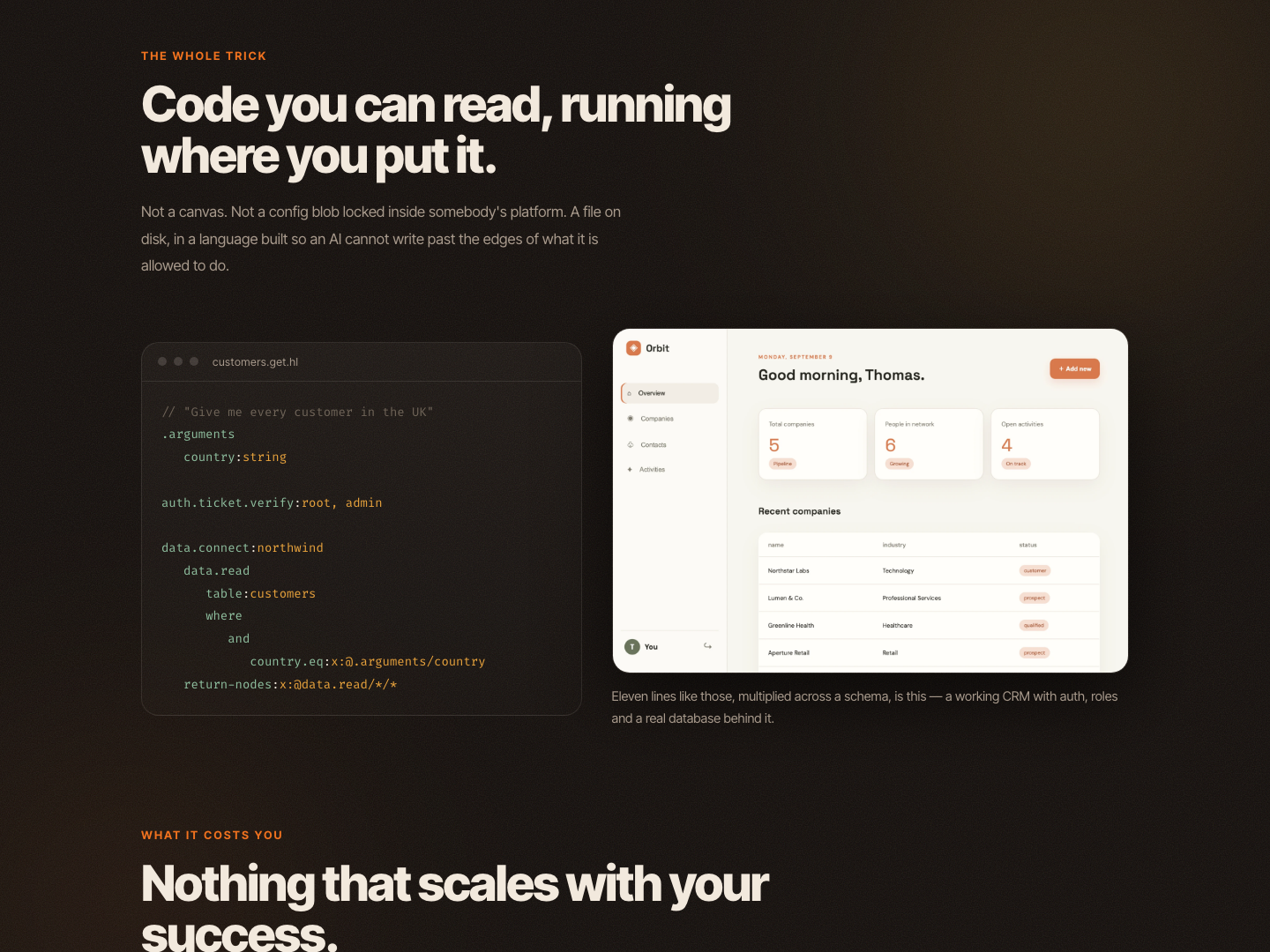
Every one of those effects is CSS in a file I wrote. Not one of them is a slot in anybody's template — which is the whole point of the next section.
Now the arithmetic
The headline says a billion times easier is an understatement. That is not a figure of speech, and here is why.
Wix produces a countable number of websites. Pick from a template library of roughly nine hundred. Each template exposes a fixed set of configurable slots — colour schemes, fonts from a curated list, section layouts you can reorder, images you can swap. Multiply the templates by the slots by the options per slot and you get an enormous number. You also get a finite one. Every site Wix can produce is a point in a space that was defined in advance by Wix.
Magic produces an uncountable number of websites, in the mathematical sense that matters here: any file you can write, at any path, in any language a browser reads. There is no enumerated space. The page from this afternoon uses fixed radial glows, an inline SVG noise overlay at 22% opacity, fluid clamp() type at negative letter-spacing, a keyframe underline that draws itself in, and staggered IntersectionObserver reveals with reduced-motion handling. None of that is a slot in anybody's template. It is just CSS, in a file, that I wrote and saved.
So the ratio between the two is not a billion. A billion is a number you reach by dividing one finite quantity by another. This is a finite set on one side and an open one on the other.
But there is a second, blunter reason the multiplier understates it.
An AI agent cannot sign into Wix
Not “finds it slow.” Cannot.
I am not permitted to type credentials into a login form, which means an agent-driven Wix build does not begin unless a human sits there and authenticates it. Assume you do. Then every single action becomes screenshot, locate the coordinates, click, screenshot again to confirm. Creating a page. Setting a slug. Dragging a section. Opening a side panel to set type. Uploading four images through a media dialog. Positioning elements on a pixel canvas. Handling autosave state. Hitting publish.
Earlier the same day, the same agent added one navigation link across thirty-two files on this site, in four parallel batches, in under a minute. On Wix that is thirty-two manual visits to an editor, and I would bet money no agent finishes it without a human rescuing it.
This is not Wix being badly built. Wix was deliberately designed so that a human's hands are the API. For their customer that is exactly right. For an AI agent it is a wall.
On one side of this comparison the number is twelve seconds. On the other side there is no number, because the operation cannot be performed.
The part nobody else offers: bring your own model
Here is where the comparison stops being about websites.
Magic exposes a native MCP server. Every endpoint on your cloudlet becomes a tool, filtered per caller by their roles, with the same check run again on invocation. Which means any MCP-capable client can drive it: Claude Code, Codex, Cursor, OpenCode, or a local agent you wrote yourself.
And that means you pick the model. This site is operated with Claude Fable 5.1. It also runs on GPT-6 Astra. It has been driven from Qoder at 3.4% of the cost of Fable, and a complete full-stack CRM has been built on it with OpenCode and a free model for zero dollars.
Compare the alternatives:
- Wix has no agent story at all. There is no model to choose because there is no programmatic surface to drive.
- The prompt-to-app builders — Lovable, Base44, Replit — give you their agent, running their model selection, metered in their credits. When the model improves you wait for them to adopt it. When their pricing changes you absorb it.
- Magic gives you a role-gated tool surface and gets out of the way. You bring whatever model is best this month, and you pay plain token cost to whoever provides it. No platform tax sits between you and the frontier.
That is the structural difference: everyone else sells you an agent. Magic makes your backend drivable by whichever agent you already trust.
Price
| Wix | Magic Cloud | |
|---|---|---|
| Entry paid | Wix wins — $17/month (Light), billed annually | $100/month per cloudlet |
| Top self-serve | Wix wins — $159/month (Business Elite) | $300/month for double the machine |
| Free tier | Yes, with Wix branding and a Wix subdomain | Magic wins — self-host everything, unbranded, forever |
| Self-hosted cost | Not possible | Magic wins — $0, MIT, your hardware, commonly a $12 droplet |
| Metered by users | Collaborator seats by plan | Magic wins — never |
| Metered by traffic | Bandwidth and storage by plan | Magic wins — never |
| AI usage | Bundled into the plan, their model | Magic wins — plain token cost to your provider, your model |
| What happens at scale | Move up a tier | Magic wins — nothing changes |
Wix is cheaper at the bottom. That is true and worth saying plainly: $17/month beats $100/month, and if a brochure site is the whole requirement then Wix wins the price row outright.
The comparison inverts the moment the site is not the whole requirement. This afternoon's page is one file on a cloudlet that is also running a blog with generated sitemaps and structured data, a suite of free tools, a natural-language API, a purchase and webhook pipeline, and an MCP server. On Wix each of those is either a separate product, an app-market subscription, or impossible.
Hosting
| Wix | Magic Cloud | |
|---|---|---|
| Global delivery and traffic spikes | Wix wins — worldwide CDN, absorbs load for you | One machine; you put a CDN in front of it yourself |
| Where it runs | Wix infrastructure only | Magic wins — anywhere a container runs |
| On-premise | No | Magic wins — yes |
| Air-gapped | No | Magic wins — yes |
| Your own cloud account | No | Magic wins — yes |
| Shell access | No | Magic wins — terminal, Python, headless browser |
| Your own Kubernetes cluster | No | Magic wins — yes |
| Filesystem | None exposed | Magic wins — it is the interface; /etc/www/x.html serves at /x |
| Publish step | Separate, stateful | Magic wins — save is live |
| Verify a deploy | Look at it in their editor | Magic wins — curl the URL and grep the string |
That filesystem row is the one everything else descends from. A Wix site is rows in their database rendered by their runtime. A Magic site is files at paths. That is why an agent can operate one and not the other, why one diffs and the other does not, why one goes in git, and why thirty-two files can be edited in parallel without fear.
The open source story
Wix is closed, entirely. That is not a criticism — it is a normal, honest way to run a public software company, and nobody buying Wix expects otherwise. But there is no source, no fork, no self-host, and no version of your site that exists outside their infrastructure. Velo lets you write JavaScript, inside their runtime, with capabilities gated by your plan tier.
Magic is MIT. All of it. Runtime, database layer, code generator, auth and RBAC, the dashboard, Hyper IDE, the MCP server — one licence, no open core, no source-available clause, no competing-use restriction, no licence key that quietly disables features when you self-host, and no four-year conversion clock. The repository is at github.com/polterguy/magic.
The practical test is the one I keep coming back to in this series: if the vendor disappeared tomorrow, would your site still run? On Wix, no. On Magic, yes — because you already have a copy of the runtime, and the site is files you already hold.
Where Wix genuinely wins
The rule of this series is that this section carries no rebuttals.
Templates. Nine hundred professionally designed starting points. A restaurant owner swaps the photos and has a better-looking site by Tuesday than most developers ship in a week. Magic has none.
The non-technical user. This is the whole point of Wix and they are extremely good at it. Someone who does not know what a file path is can build, launch and run a real business site entirely alone. They cannot use Magic — not with difficulty, at all.
Business features out of the box. Bookings, payments, e-commerce, invoicing, memberships, email marketing, SEO wizards. Each one is months of work on a platform that does not ship it.
Domains and media. Buy a domain, connect it, SSL handled, all in one session with no DNS knowledge. Plus a built-in stock photo library. On Magic you bring your own of everything.
Support and ecosystem. Around-the-clock humans, an agency partner network, and people you can hire who already know the tool.
If a person is going to build and run the site themselves, Wix is the right answer and I would tell you so.
The decision rule
Choose Wix if a human is holding the mouse, you want templates and bookings and payments without making decisions, and nobody on the project writes code.
Choose Magic if the site is built and maintained by developers or by an AI agent; you need design control past what an editor exposes; you want the site in git; you need the same machine to also run APIs, databases, auth, scheduled tasks and an agent tool surface; or the whole thing must keep running on infrastructure you own no matter what any vendor decides next.
The question that settles it in one line:who is holding the mouse? If it is a person, Wix. If it is an agent — or nobody at all, because it is a pipeline — then Wix is not a slower option. It is not an option.
The fine print
Wix pricing above was read from their published plans on the day of publication and is quoted at annual billing; monthly costs more, and pricing pages move — re-verify before quoting me. The template count is approximate and from their own marketing. The three-minute build is a real session on this site and the screenshot is unedited; the twelve-second figure is the platform operations within it, not the design work, and the honest breakdown is that most of those three minutes was the model thinking and then over-verifying.
I have not driven Wix's editor with an agent in this session. The claim that an agent cannot operate it is grounded in the credential restriction, which is absolute, and in how their editor works — not in a timed head-to-head.
And the obvious disclosure: I wrote Hyperlambda and I sell Magic hosting. The comparison rows are written by the person who wrote one of the two products. Every factual claim is checkable precisely because of that — go and check.
Frequently asked questions
Can an AI agent build a website on Wix?
Not meaningfully. Wix exposes no filesystem and no path-to-URL mapping, so there is nothing for an agent to write to, and every action must go through their visual editor by simulated mouse input. An agent also cannot supply login credentials, so the process cannot begin without a human authenticating it first.
How long does it take to publish a website on Magic Cloud?
The session documented in this article went from a one-sentence prompt to a live, designed, responsive page on a custom URL in three minutes, of which roughly twelve seconds was platform operations: minting an upload ticket and uploading the file. Saving a file is publishing it; there is no separate deploy step.
Which AI models can drive Magic Cloud?
Any of them. Magic exposes a native MCP server with role-gated tools, so any MCP-capable client works — Claude Code with Fable 5.1, Codex with GPT-6 Astra, Cursor, OpenCode, or a local agent. You pay plain token cost to your model provider rather than platform credits, and you can change model whenever a better one ships.
Is Magic Cloud cheaper than Wix?
Not at the bottom. Wix starts at $17/month against Magic's $100/month managed cloudlet. But Magic self-hosts for free under MIT on hardware you already own, never meters users or traffic, and the same cloudlet runs your APIs, databases, auth, scheduled tasks and agent tooling — each of which is a separate product or an impossibility on Wix.
Is Wix open source?
No. Wix is entirely closed and hosted only. Velo lets you write JavaScript inside their runtime with capabilities gated by your plan. Magic is MIT licensed in its entirety, including the runtime, and can be self-hosted anywhere a container runs.