 Hyperlambda
Firebase deserves its success. For a decade it has been the fastest zero-to-app experience in the industry — sign in with Google, and you have a database, auth, and hosting before your coffee cools. Nobody chose Firebase by mistake, and this article will not pretend otherwise.
But Firebase locks you in twice, and only one of the locks makes it into the conversation. The first is the vendor lock everyone knows: Google's pricing, Google's terms, and the quiet anxiety of building on a company with a well-tended product graveyard. The second is subtler and worse: the data-model lock. Firestore is a document store, and to make your application fit it, you contorted your business data into denormalized documents shaped around query limitations. Years later, your data does not look like your business anymore — it looks like Firestore's constraints.
An alternative worth the name has to fix both. Open source fixes the first. A real database fixes the second. Magic Cloud is MIT-licensed — all of it, nothing gated — and it is built on SQL: SQLite out of the box, with PostgreSQL, MySQL, and SQL Server as first-class connections.
What "a real database" gives back
Here is what you gave up when your data became documents, whether you noticed at the time or not: joins, transactions across entities, ad-hoc queries, aggregation, and constraints the database enforces instead of your application promising to.
One concrete example carries the whole argument. "Show me customers with unpaid invoices older than 90 days." In SQL, that is one statement — a join, a filter, done, and it works even though nobody anticipated the question when the schema was designed. In Firestore, that query is an architecture decision: either you denormalized invoice status onto customer documents in advance (and maintain that duplication forever, correctly, in every code path that touches an invoice), or you fan out reads and join in application code, or the question simply cannot be answered efficiently. Multiply that by every question your business will ever ask, and you understand the tax. A relational database answers questions you did not plan for. A document store answers the questions you designed it around.
SQL Studio: your data as data again
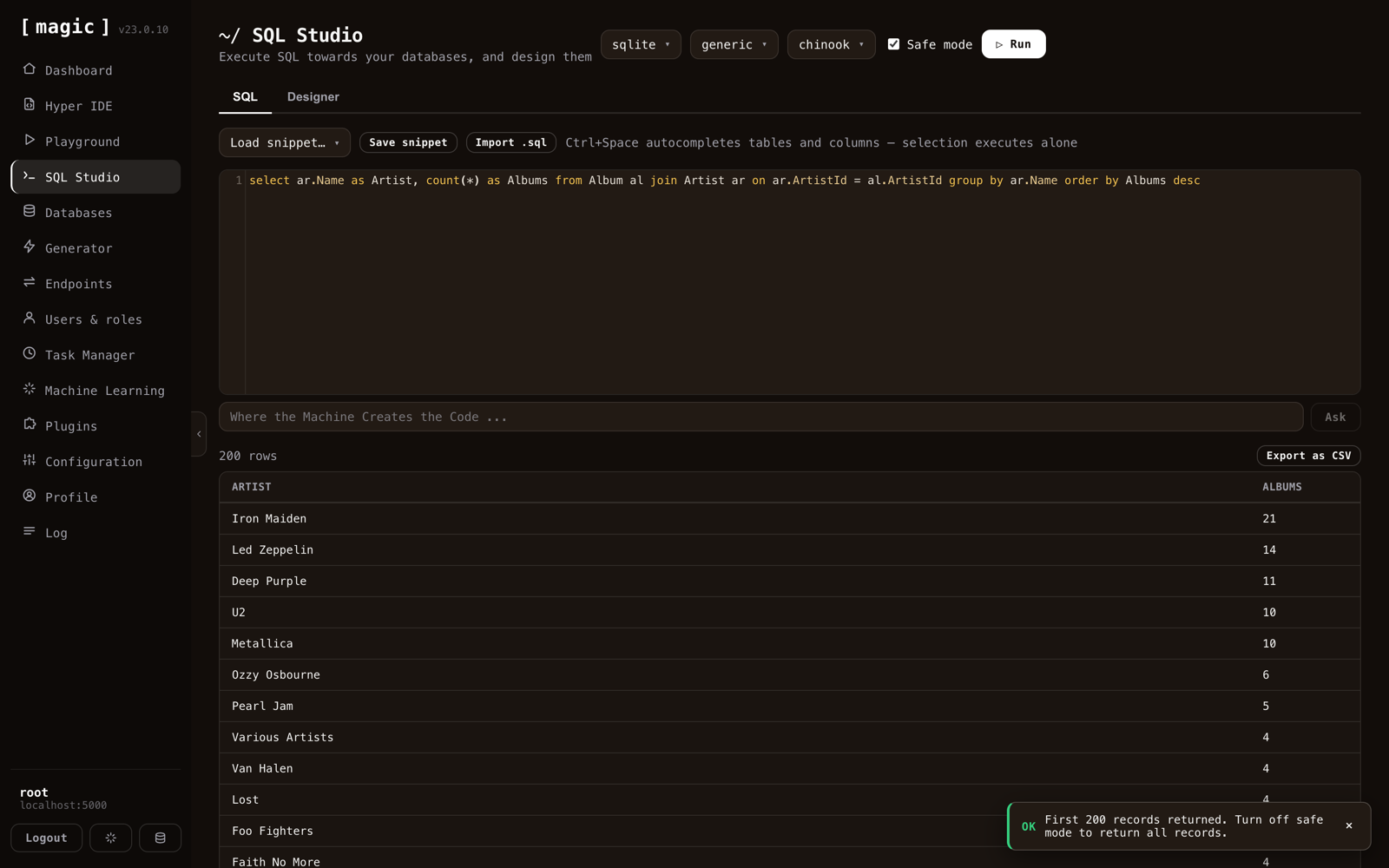
This is the part of the platform Firebase users tend to react to first, because it is the thing they forgot they missed. SQL Studio connects to any of your databases — the built-in SQLite or an external PostgreSQL, MySQL, or SQL Server — and gives you your data as data: browse the schema, inspect relationships, query with autocomplete, and when you would rather not write the SQL yourself, describe what you want in plain language and let the machine write it. No console full of JSON trees. Tables, rows, and questions answered in one statement.
The Generator: APIs instead of client-side database access

Firebase's architecture puts the SDK in your client, talking directly to the database, with security rules as the only wall between your users and your data. Magic inverts that: between clients and data sit generated, role-gated REST endpoints. Pick a database, tick the tables you want exposed, choose which roles may read, create, update, and delete — and click. The Generator emits one secured endpoint per table and verb: paging, filtering, and sorting included, JWT-authenticated, documented with an OpenAPI spec. The output is readable Hyperlambda you can open and extend with custom business logic — not scaffolding to finish later, and not a black box.
That architectural inversion matters beyond taste. An API boundary is something you can version, cache, monitor, rate-limit, and hand to a partner — or to an AI agent as MCP tools. A client SDK wired straight into your database is none of those things.
Auth that speaks enterprise
Firebase Auth is genuinely good at consumer sign-in — the provider buttons, the phone verification, the friction-free onboarding. What it was never built for is the other half of the auth world: roles as first-class objects, endpoint-level authorization, and identity federation with the systems enterprises actually run. Magic ships users, roles, and JWT out of the box, gates every generated endpoint by role, and speaks full OIDC and OAuth — which is the difference between "sign in with Google" and "sign in with your employer's Entra tenant." If your roadmap includes selling to companies, this section is the comparison that matters.
Security rules vs runtime whitelisting
Firebase security rules are a policy language: per-app rules, evaluated per request, that every application must write correctly and every change must not break. They share a structural weakness with every per-app security model — the boundary is reimplemented in each project, and each reimplementation is a fresh chance to get it wrong. In 2026, that weakness has a new edge: increasingly, the code talking to your backend was written by an AI agent, and a probabilistic author reimplementing a security boundary is how you get a leak with no malicious line of code anywhere.
Magic's model puts the boundary in the runtime instead. Hyperlambda compiles to an AST where every node must bind to an explicitly whitelisted capability; endpoints declare the roles that may invoke them; anything outside the whitelist fails structurally, before execution. Security is implemented once, deterministically, as a property of the platform — not re-derived per app, per generation, per prayer. The full argument is in runtime whitelisting, not prompt filtering, and there is a standing $100 bounty on proving it wrong.
Frontends on the same box
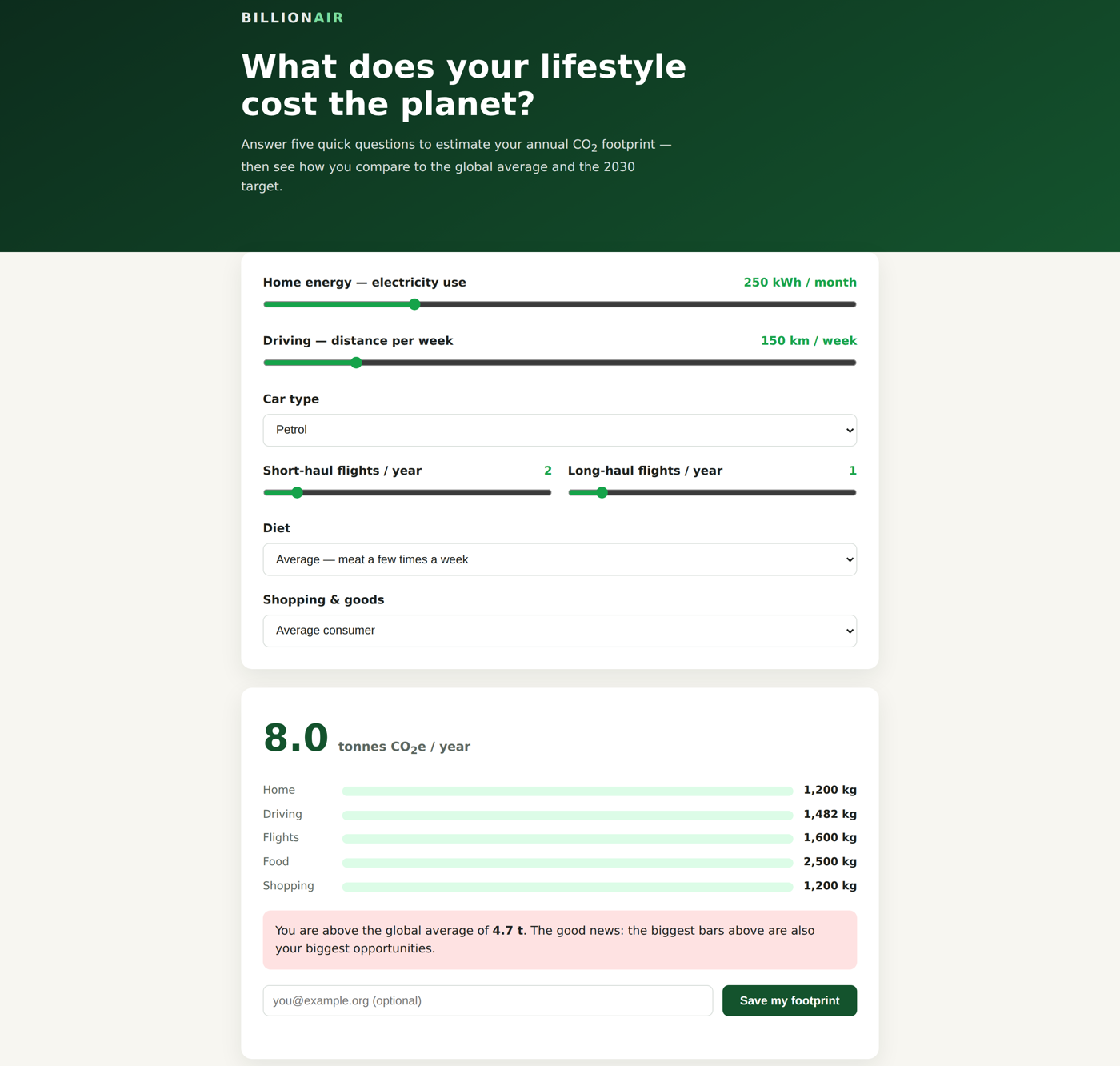
The piece self-hosters usually lose when they leave Firebase is Hosting — and it is the piece most alternatives quietly skip. A Magic cloudlet serves static sites and SPAs alongside the APIs they consume. The screenshot above is a complete application on one cloudlet: SQLite database, public and role-gated endpoints, and the branded frontend itself — built autonomously by an AI agent during a live client meeting, deployed and smoke-tested before the call ended. Database, API, auth, frontend: one system, one deployment, your hardware.
What leaving Firebase actually looks like
Here is the section every "Firebase alternative" page owes you and almost none deliver, so let me be precise: there is no painless exit from Firestore, to Magic or to anyone. Firestore has no SQL interface to connect to, your documents need remodeling into relational shape, and because Firebase's SDK lives in your client, any exit means changing your application's data layer. Anyone promising otherwise is selling something.
What Magic changes is the shape of the migration, not its existence. Firestore exposes a REST API, and Magic's generated integrations can read it — so an agent builds the bridge, drafts a relational schema from your document shapes, and moves data incrementally while both systems run. Your client changes screen by screen, against documented REST endpoints, on your schedule — retirement by attrition rather than a cutover weekend. Incremental, agent-assisted, client changes required. That is the honest sentence, and it is still a far better sentence than a rewrite.
When Firebase is the right call
A comparison you can trust has to include this section. Stay on Firebase if: you are building a consumer mobile app and want Google-native push, analytics, and Crashlytics as one integrated stack; you want zero operations forever and accept the pricing curve that buys; or your product is realtime-sync-first, where Firestore's offline synchronization is genuinely excellent and hard to replicate. None of those describe a company backend managing business data — but they describe plenty of good apps, and Firebase serves them well.
FAQ
Is Magic Cloud really open source?
Yes — MIT-licensed in full: database layer, API generation, auth, RBAC, AI features, dashboard. No enterprise edition withholding features, no platform flag disabling functionality when you self-host.
Can I self-host it completely?
Yes, and self-hosting is the primary deployment model. One Docker command brings up the full stack on your own hardware; AINIRO runs hosted cloudlets on the same codebase if you would rather not.
Which databases does it support?
SQLite is built in; PostgreSQL, MySQL, and Microsoft SQL Server connect as externals and are treated like local databases for querying, design, and code generation.
Can it replace Firebase Auth?
For application auth, yes — users, roles, JWT, and endpoint-level gating out of the box, plus full OIDC and OAuth for enterprise identity. What it does not replicate is Firebase's consumer-provider convenience layer; if one-tap phone auth is your core need, weigh that honestly.
Can I migrate off Firestore automatically?
No — and be suspicious of anyone who says yes. Firestore's data needs remodeling into relational shape and your client's data layer must change. What Magic offers is an incremental, agent-assisted path: generated integrations read Firestore's REST API, data moves while both systems run, and the client migrates screen by screen.
Does it work with AI agents?
Natively. Every cloudlet exposes an MCP server, generated endpoints double as agent tools, and agents can create new tools for themselves through the Hyperlambda Generator — inside runtime-enforced permission boundaries.
Related reading
- Why Secure AI Code Execution Requires Runtime Whitelisting, Not Prompt Filtering
- Magic Cloud: The Self-Hosted Supabase Alternative Built for AI Agents
- Supabase Alternative — the overview
- A Complete CRM in One Conversation: 60 Seconds of Backend, Six Cents of Tokens
- Legacy Modernization Without the Rewrite