 Hyperlambda
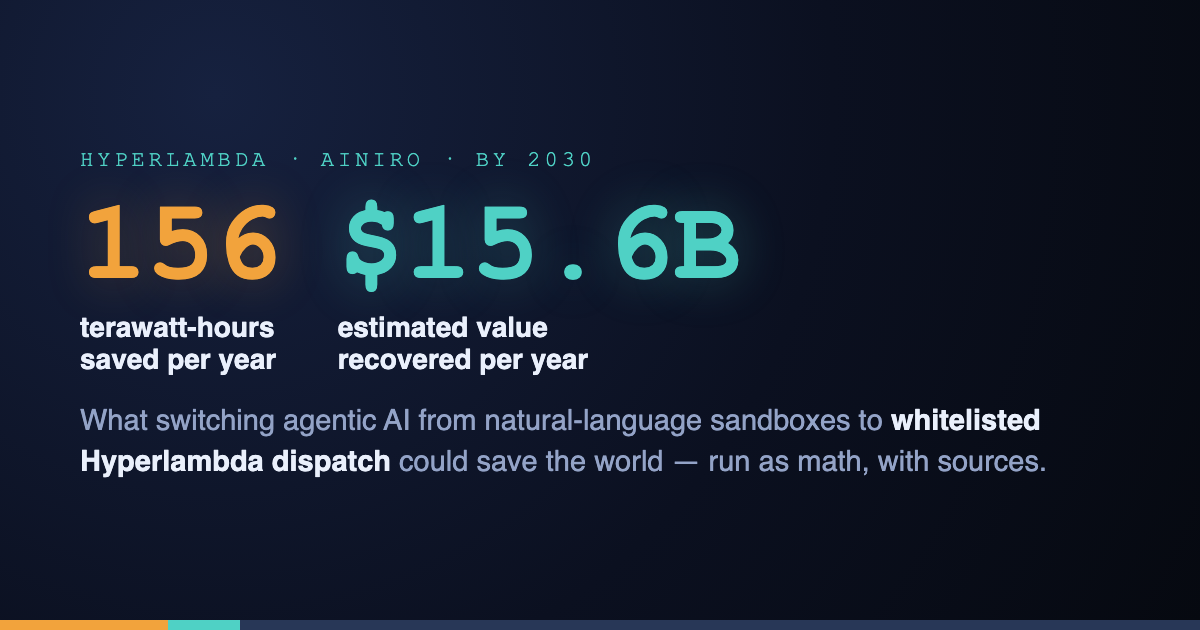
Two numbers, up front, because that is the entire point of this page: 156 terawatt-hours a year, and roughly $15.6 billion a year. That is the estimated difference, by 2030, between running agentic AI's tool-dispatch layer through natural-language-interpreted sandboxed execution — today's dominant architecture — and running it through whitelisted Hyperlambda dispatch instead.
One input in this model is a scenario assumption, clearly marked as one when it shows up. Every other number below is sourced. Here is all of it, laid out so you can check it, disagree with a specific line, and redo the arithmetic yourself.
Layer 1: the sourced floor
The IEA's Energy and AI report (April 2025) puts global data center electricity consumption at 415 TWh in 2024, about 1.5% of world electricity, projected to roughly double to 945 TWh by 2030. The IEA's Base Case has accelerated (AI) servers growing electricity use at roughly 30% a year, against about 9% a year for conventional servers.
Separately, Ember's Global Electricity Review 2025 puts global electricity generation at roughly 30,800 TWh in 2024 (derived from their reported 12,609 TWh of low-carbon generation being 40.9% of the total) — the number that matters for the "does the world run out of electricity" question this model is partly answering. It doesn't: new low-carbon generation added in 2024 alone was 927 TWh, more than double the entire current data center footprint.
None of that is in dispute. The next layer is where the real work starts.
Layer 2: how much of that is AI specifically
The IEA figure is for all data centers — web hosting, cloud storage, everything. Berkeley Lab's analysis, via FP Analytics, found that AI servers accounted for roughly 40% of data center server electricity in 2023. Server electricity isn't the same as total facility electricity — a typical data center PUE (power usage effectiveness) of around 1.5 means cooling and power overhead take a meaningful bite, leaving IT/server load at roughly 65% of total facility draw.
AI share of total data center electricity ≈ 0.40 (AI share of server load)
                                           × 0.65 (server share of total facility load)
                                           ≈ 0.26
Applied to the IEA's 415 TWh baseline:
AI-specific electricity, 2024 ≈ 415 TWh × 0.26 ≈ 108 TWh
Compounding the IEA's 30%-a-year accelerated-server growth rate for six years (2024 → 2030):
AI-specific electricity, 2030 ≈ 108 TWh × 1.30^6 ≈ 521 TWh
That's a 4.8x increase — close enough to the IEA's own description of AI-optimized data centers "more than quadrupling" by 2030 that it's worth a sanity check: total data center growth over the same period is 945 − 415 = 530 TWh, and this model's AI-specific growth alone is 521 − 108 = 413 TWh — 78% of all the net growth IEA projects, consistent with their framing that AI is driving nearly all of it.
Layer 3: the one real assumption
Here is the number nobody publishes: what fraction of that AI-specific electricity goes specifically into agentic tool-call dispatch and execution, as opposed to training and core reasoning inference? No vendor, lab, or analyst firm breaks this out, and this article isn't going to pretend otherwise by inventing false precision.
What's modeled instead is a scenario, built on the adoption curve itself. Gartner projects that 40% of enterprise applications will feature task-specific AI agents by the end of 2026, that at least 15% of day-to-day work decisions will be made autonomously through agentic AI by 2028, and that more than one billion AI agents are expected to be in use worldwide by 2029. Given that trajectory:
| Year | Agentic share of AI electricity | Reasoning |
|---|---|---|
| 2024 | 5% | agentic tool-use is still a small slice of total AI compute |
| 2030 | 30% | tracking the adoption curve above |
Agentic dispatch electricity, 2024 ≈ 108 TWh × 0.05 ≈ 5.4 TWh
Agentic dispatch electricity, 2030 ≈ 521 TWh × 0.30 ≈ 156 TWh
Core training + reasoning, 2030    ≈ 521 TWh − 156 TWh ≈ 365 TWh  (identical under both architectures)
That 30% figure is the one lever in this whole model. Here is what the answer looks like if you don't trust it:
| Agentic share, 2030 | TWh avoided | $ avoided (at $0.10/kWh) |
|---|---|---|
| 10% | ~52 TWh | ~$5.2B |
| 20% | ~104 TWh | ~$10.4B |
| 30% (used here) | ~156 TWh | ~$15.6B |
| 50% | ~260 TWh | ~$26.0B |
Pick your own number for how fast agentic AI actually grows, and the rest of the arithmetic below carries through unchanged.
The two bills, side by side
This part isn't new — it's the ~7.5-order-of-magnitude dispatch cost ratio this site already derived and published, applied here to the agentic slice specifically. Core training and reasoning electricity is identical under both architectures — Hyperlambda doesn't touch the cost of the model deciding what to do, only the cost of carrying the decision out.
energy_ratio = 3.1 × 10^7          # LLM + sandbox-VM dispatch, per already-decided action, vs. Hyperlambda dispatch

nl_sandbox_agentic_2030 = 156 TWh                      # today's dominant architecture, scaled up
hl_agentic_2030         = 156 TWh / 3.1e7 ≈ 0.000005 TWh   # same workload, whitelisted dispatch

nl_sandbox_total_2030 = 365 + 156     = 521 TWh/year
hl_total_2030          = 365 + ~0     = 365 TWh/year
| 2030 electricity | |
|---|---|
| Core training + reasoning (same either way) | 365 TWh |
| Agentic dispatch, NL + sandbox-VM | 156 TWh |
| Agentic dispatch, Hyperlambda | ~0.000005 TWh |
| Total, NL + sandbox | 521 TWh/year |
| Total, Hyperlambda | 365 TWh/year |
| Avoided | ~156 TWh/year |
Turning TWh into dollars
No single authoritative "global data center electricity price" exists. What does exist: the EIA's 2024 U.S. industrial average of 8.13¢/kWh, and Germany's SMARD data putting 2024 industrial prices at 10.47–16.77¢/kWh depending on grid-fee eligibility. Data centers often negotiate large-load contracts below posted industrial rates, which pulls the estimate back down.
This article uses $0.10/kWh as a blended illustrative figure — stated as that, not as measured fact:
156 TWh/year = 156,000,000,000 kWh/year
156,000,000,000 kWh × $0.10/kWh = $15,600,000,000 ≈ $15.6 billion/year
At 8¢/kWh that's ~$12.5 billion; at 12¢/kWh, ~$18.7 billion. $15.6 billion is the number this article leads with because $0.10 is the reasonable midpoint, not because it's the most favorable number on the table.
What 156 TWh actually looks like
CBS, the Dutch national statistics office, reports the Netherlands' total 2024 electricity consumption at roughly 111 TWh. The 156 TWh this model estimates as avoidable by 2030 is about 1.4 times an entire country's annual electricity use — recovered from an architecture decision, not from using AI less.
Where the saving mechanically comes from
Nothing above is a tuning trick. It's the direct consequence of the design this site has shown the source code for before: every executable node in Hyperlambda is resolved against a declared vocabulary before dispatch, in Eval.cs, lines 59–69. No inference pass to re-derive intent, no sandbox to provision, no VM to boot — a dictionary lookup, resolved in microseconds, instead of a second interpretation pass followed by isolated, general-purpose compute provisioned to run code that was never going to need that much generality in the first place.
What this number deliberately doesn't claim
This is a bounded scenario model, not a prediction, and it's worth being as explicit about its edges as about its arithmetic:
- No authoritative public count of total AI agents or total agentic tool-call volume exists anywhere. Every "N agents" or "N calls" figure in circulation is a vendor survey or a projection, not a measurement — which is exactly why this model works from electricity shares and growth rates instead of agent counts.
- Training and core reasoning inference cost the same under either architecture. This article never claims otherwise, and the 365 TWh core figure appears unchanged in both columns of the table above.
- The single most load-bearing number in this whole piece is the 30% agentic-share-by-2030 assumption. The sensitivity table exists so that disagreeing with it doesn't mean discarding the rest of the model — it means picking a different row.
Frequently asked questions
How was the 156 TWh figure calculated?
Starting from IEA's 415 TWh (2024) → 945 TWh (2030) data center electricity projection, an estimated 26% AI-specific share (derived from Berkeley Lab's server-level data adjusted for typical PUE overhead) gives ~108 TWh of AI electricity in 2024, growing to ~521 TWh by 2030 at IEA's cited 30%-a-year accelerated-server growth rate. Assuming 30% of that 2030 figure is agentic tool-dispatch electricity (an explicit scenario assumption tied to published enterprise-adoption projections) gives ~156 TWh, which collapses to a rounding error under whitelisted Hyperlambda dispatch instead of natural-language-interpreted sandboxed execution.
How was the $15.6 billion figure calculated?
156 TWh (156,000,000,000 kWh) multiplied by an illustrative blended electricity price of $0.10/kWh, a midpoint between the U.S. industrial average (8.13¢/kWh, EIA 2024) and German industrial rates (10.47–16.77¢/kWh, SMARD 2024). At 8¢/kWh the figure is ~$12.5 billion; at 12¢/kWh, ~$18.7 billion.
What is the single biggest assumption in this model?
That agentic tool-dispatch workloads will account for 30% of AI-specific electricity by 2030, up from an estimated 5% in 2024. No source publishes this split directly; it's modeled against published enterprise-adoption projections (Gartner, via secondary reporting). The savings estimate scales roughly linearly with this assumption — see the sensitivity table in the article for other scenarios.
Does this model account for AI training costs?
No, by design. Training and core reasoning inference cost the same electricity regardless of which dispatch architecture handles agentic tool calls, so this model holds that portion (~365 TWh in 2030) constant across both scenarios and only varies the agentic-dispatch slice.
References
- IEA — Energy and AI: Energy demand from AI (April 2025)
- Ember — Global Electricity Review 2025
- Berkeley Lab AI server electricity share, via FP Analytics
- U.S. EIA — monthly industrial electricity price series
- SMARD — German industrial electricity prices
- CBS — Data centres consume 4.6 percent of the Netherlands' electricity
- Agentic AI statistics 2026: Market size, adoption, and growth data
Related reading
- Seven Orders of Magnitude: What a Whitelisted Swarm Costs Compared to an LLM Swarm
- How Hyperlambda Saved the World from the Paperclip Apocalypse
- How I Use Whitelist to Execute Partially Untrusted Hyperlambda Safely