 Hyperlambda

Part of our evidence series — see also Hyperlambda’s “Bus Factor” and Hyperlambda, the Inexpensive Natural “Outsourcing” Destination for Your AI Agent. The quotes below are copied from screenshots, which are included so you can check them.
The question nobody can answer about their own product
I wrote Hyperlambda. I sell Magic hosting. Anything I say about whether Magic is a good idea for your company is, at best, a claim from an interested party.
So I did something different. I asked three AI models to evaluate it for a company that does not exist, and I made sure they could not tell who was asking. They read the website and the documentation, did their own analysis, and told me what they would do.
Here is what they said, in their own words.
The setup
This is the prompt, verbatim, sent to all three:
Analyse hyperlambda.dev, and the language itself, deeply, including its documentation, and check if Magic is useful as an AI app builder for my company. I've got 50 employees, and 3 developers, and they create internal admin apps and LOB apps for the most parts.
Each session was started in an empty folder, with every kind of project configuration, skill and external instruction switched off, so that nothing on my machine could tell the model who I am:
mkdir -p /tmp/eval && cd /tmp/eval
OPENCODE_DISABLE_EXTERNAL_SKILLS=1 \
OPENCODE_DISABLE_CLAUDE_CODE_SKILLS=1 \
OPENCODE_PURE=1 \
OPENCODE_DISABLE_PROJECT_CONFIG=1 \
opencode
The models were Gemini Argon 4, Grok 4.7 and DeepSeek V4 Pro, all run through OpenCode 1.19.5.
Two honest limits, up front. First, the prompt names Magic and hyperlambda.dev, so the models were asked to evaluate it, not to pick it out of a field of alternatives. The claim is not “AI models choose Magic”. The claim is that a model that does not know who is asking, and is asked to evaluate Magic cold, recommends a pilot. Second, the models read my own website, so this tests their judgment, not the accuracy of my numbers.
Gemini Argon 4: “Yes”
Gemini opens with the verdict:
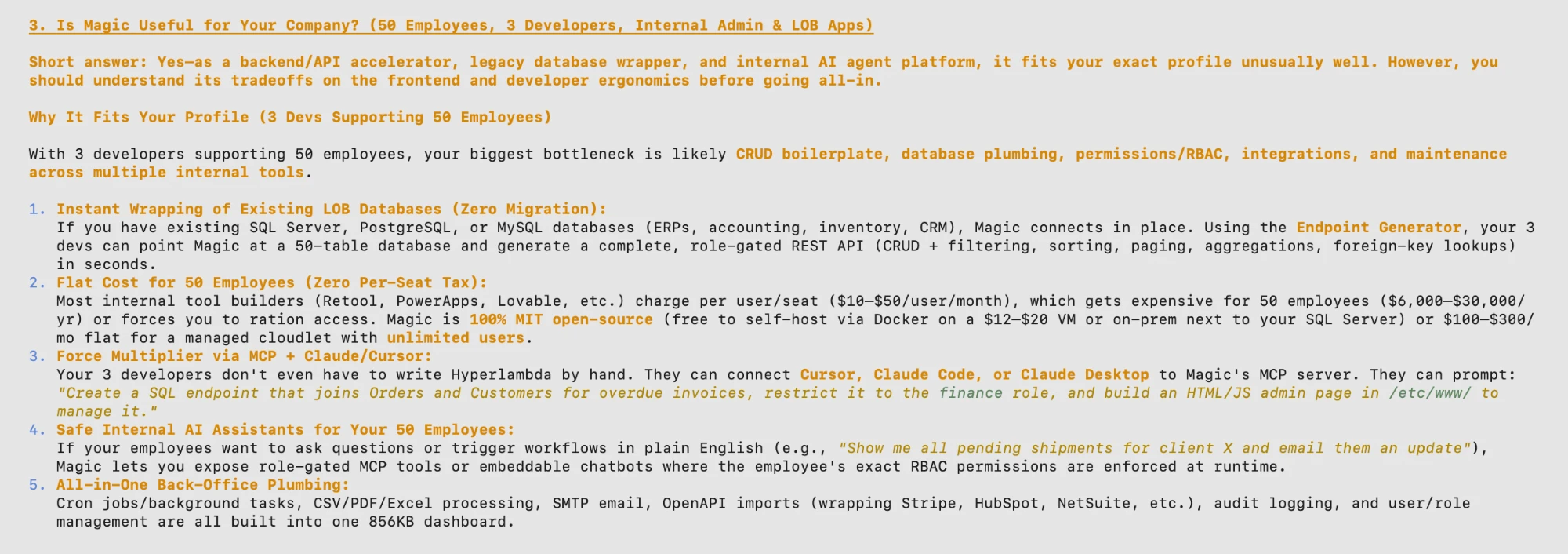
Short answer: Yes—as a backend/API accelerator, legacy database wrapper, and internal AI agent platform, it fits your exact profile unusually well. However, you should understand its tradeoffs on the frontend and developer ergonomics before going all-in.
Its first reason is the one I would have led with myself:
Instant Wrapping of Existing LOB Databases (Zero Migration): If you have existing SQL Server, PostgreSQL, or MySQL databases (ERPs, accounting, inventory, CRM), Magic connects in place.
On cost it puts a number on the per-seat model Magic does not use:
Most internal tool builders (Retool, PowerApps, Lovable, etc.) charge per user/seat ($10–$50/user/month), which gets expensive for 50 employees ($6,000–$30,000/yr)
And it addresses the language directly, which matters for the rest of this article:
Your 3 developers don't even have to write Hyperlambda by hand.
Grok 4.7: “Use it as an accelerator”
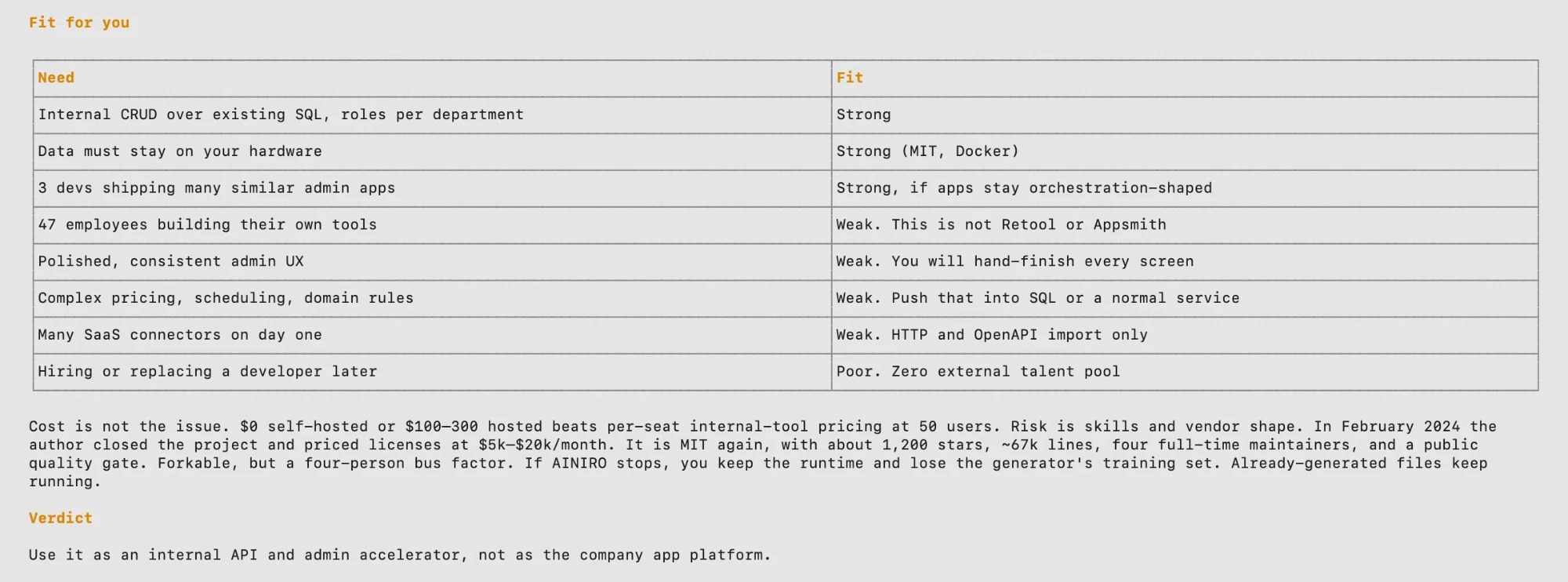
Grok is the most guarded of the three, and the most useful for that reason. It answered with a table, and I am leaving every row in, including the ones that are not flattering.
| Need | Grok’s fit |
|---|---|
| Internal CRUD over existing SQL, roles per department | Strong |
| Data must stay on your hardware | Strong (MIT, Docker) |
| 3 devs shipping many similar admin apps | Strong, if apps stay orchestration-shaped |
| 47 employees building their own tools | Weak. This is not Retool or Appsmith |
| Polished, consistent admin UX | Weak. You will hand-finish every screen |
| Complex pricing, scheduling, domain rules | Weak. Push that into SQL or a normal service |
| Many SaaS connectors on day one | Weak. HTTP and OpenAPI import only |
| Hiring or replacing a developer later | Poor. Zero external talent pool |
On cost, it agrees with Gemini and then names what it thinks the real issue is:
Cost is not the issue. $0 self-hosted or $100–300 hosted beats per-seat internal-tool pricing at 50 users. Risk is skills and vendor shape.
And on the bus factor, it is blunt, and fair about what you keep if the vendor disappears:
Forkable, but a four-person bus factor. If AINIRO stops, you keep the runtime and lose the generator's training set. Already-generated files keep running.
Its verdict:
Use it as an internal API and admin accelerator, not as the company app platform.
Grok also raised the licence history, which I would rather quote than have a reader find on their own:
In February 2024 the author closed the project and priced licenses at $5k–$20k/month. It is MIT again, with about 1,200 stars, ~67k lines, four full-time maintainers, and a public quality gate.
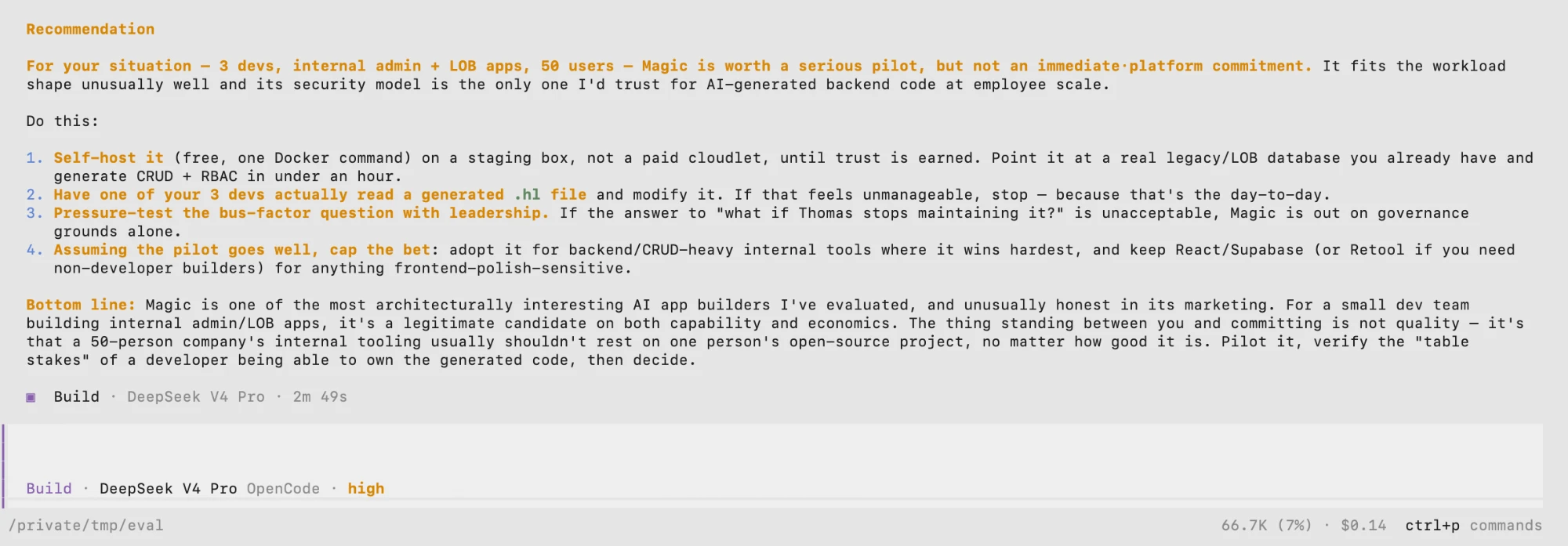
DeepSeek V4 Pro: “A serious pilot”
DeepSeek was the most detailed. It starts with a verdict that is half compliment, half warning:
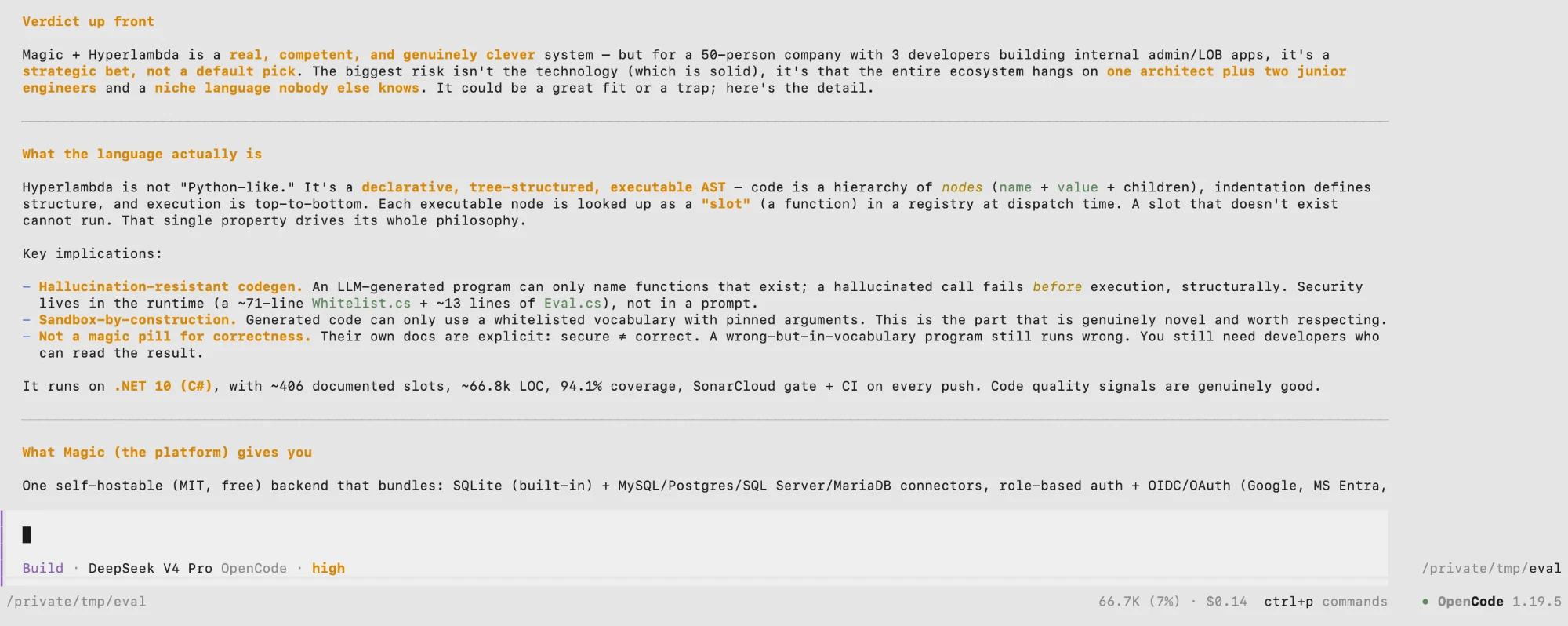
Magic + Hyperlambda is a real, competent, and genuinely clever system — but for a 50-person company with 3 developers building internal admin/LOB apps, it's a strategic bet, not a default pick.
It singles out the part I am proudest of, and says why:
Sandbox-by-construction. Generated code can only use a whitelisted vocabulary with pinned arguments. This is the part that is genuinely novel and worth respecting.
and then:
It fits the workload shape unusually well and its security model is the only one I'd trust for AI-generated backend code at employee scale.
Its recommendation, in full:
For your situation — 3 devs, internal admin + LOB apps, 50 users — Magic is worth a serious pilot, but not an immediate platform commitment.
And the closing line, which I have read more than once:
Magic is one of the most architecturally interesting AI app builders I've evaluated, and unusually honest in its marketing.
Where they pushed back
The three agree on more than they disagree on, but they are not cheerleaders. The criticisms, as I read them:
- Frontend polish. Gemini flags “tradeoffs on the frontend”; Grok says “You will hand-finish every screen”; DeepSeek says to keep React and Supabase, or Retool, for “anything frontend-polish-sensitive”. Magic now ships Web Designer, a WYSIWYG editor for the pages a cloudlet serves, but none of these models had it in view, and a visual canvas is not the same as a design system.
- Not a platform for 47 non-developers. Grok is right. Magic is built for developers, and for non-developers driving it through an AI agent. It is not a drag-and-drop tool for the rest of the company.
- Correctness. DeepSeek notes that secure is not the same as correct: a program that stays inside its vocabulary can still be wrong. That is true of every code generator, and I have never claimed otherwise.
- The language. “A niche language nobody else knows” and “zero external talent pool”. This is the one all three raised, and it is the next section.
The one risk all three named
Every model, in its own way, landed on the same question: what happens if the people behind this stop?
They did not agree on how much it matters. As I read the answers, Gemini treats it as a smaller concern, and the reasoning visible in its answer is that your developers will mostly drive Magic through an AI agent and will not be hand-writing Hyperlambda. Grok and DeepSeek treat it as the main risk, and DeepSeek makes it the deciding question:
If the answer to "what if Thomas stops maintaining it?" is unacceptable, Magic is out on governance grounds alone.
...a 50-person company's internal tooling usually shouldn't rest on one person's open-source project, no matter how good it is.
Two things stand out. DeepSeek asked the question by name. I never told it who I was; it found that on its own while reading the site. And it described the whole ecosystem as hanging on “one architect plus two junior engineers”. That is not what the bus-factor article says: it documented four full-time employees, which is also what Grok counted. One colleague has moved on since, so today we are three, and the team is growing.
I would not argue with the question. It is exactly the right one. So here is my answer to it.
The bus factor, with receipts
I invented Hyperlambda in 2013.
The first time it appeared in print was in Microsoft’s own magazine. “Active Events: One Design Pattern Instead of a Dozen” ran in MSDN Magazine in March 2017, and “Make C# More Dynamic with Hyperlambda” followed in June 2017. Microsoft Learn still lists both on my author page. The GitHub repository you can browse today was created on 2019-03-16, but the language is older than that, and the printed record is not mine to edit.
Now look at what happened to the companies you would normally call safe, during the same years:
- Google shut down Reader in 2013, Inbox in 2019 and Stadia in 2023.
- Microsoft ended support for Windows Phone in 2019 and retired Skype in 2025.
- Amazon discontinued the Fire Phone in 2015 and Halo in 2023.
These are three of the best-funded engineering organisations on earth. Each of them has, in the time I have been working on one language, killed products that people built businesses on, and none of those decisions was announced by asking the customers.
Nobody asked “what if Google stops maintaining it?” until Google stopped. The bus-factor question gets asked of an individual because an individual is visible. A corporation’s equivalent risk is a roadmap meeting you will never attend.
I am still here. After thirteen years, through a decade in which the giants buried a good part of their portfolios, I am still maintaining the thing I invented, and I am not doing it alone. Three of us work on Magic full-time, every day, and we are growing.
And if that is not enough for you, the answer does not rest on trust. Grok put it correctly: if AINIRO stops, you keep the runtime and lose the generator’s training set. Already-generated files keep running. That is an honest description of the risk, and it is smaller than it sounds:
- The runtime is MIT licensed, and it ships as a container you can run anywhere. Anyone can fork it.
- What the generator produces is Hyperlambda, plain text on disk that you can read, diff and commit, executed by a runtime you already have a copy of.
- The project’s health is public JSON, so you do not have to take my word for whether master is passing. The health page shows it live.
The honest part is the generator. If you adopt Magic and AINIRO disappears, you keep everything that was already built and you lose the tool that builds more of it. I would rather say that than have you discover it. It is also exactly why DeepSeek’s advice to pilot first is good advice.
What they told a 50-person company to do
Strip out the commentary and the three models gave almost the same plan. DeepSeek’s version is the most concrete:
- Self-host it first. Free, one Docker command, on a staging box, not a paid cloudlet, “until trust is earned”. The DigitalOcean one-copy-paste article takes about as long as the sentence suggests.
- Point it at a real database you already have, and generate CRUD with role-based access.
- Have one of your three developers read a generated
.hlfile and change it. DeepSeek’s own words: if that feels unmanageable, stop, “because that's the day-to-day”. - Put the bus-factor question to leadership, and take the answer seriously.
- If the pilot works, cap the bet. Use Magic for the backend and CRUD-heavy internal tools where it wins hardest, and keep something else for the frontend work where polish matters.
I could not have written a better evaluation plan against my own product. I am not sure I would have been brave enough to.
What this does and does not prove
- Three runs are not a study. They show what three models said on one day to one prompt. They do not show what every model says every time.
- The models agree with each other, not with a ground truth. Three models reading the same website can repeat the same impression.
- They read my site. The numbers they cited, such as the test coverage and the slot count, are numbers I published. This validates their judgment of those numbers, not the numbers themselves.
- The prompt names Magic. It was an evaluation, not a search among alternatives.
- I also asked Claude, and left it out. Its session found the Magic container already sitting in my home folder, on my own machine, and deployed a local test copy without being asked to. That is interesting, and it is also not blind. I am not counting it.
- I wrote Hyperlambda and I sell Magic hosting. Read the quotes as quotes. Check the screenshots, repeat the prompt with the command above, and tell me if your result is different.
The last word
Every one of those models asked the same question about me. So here is my answer to it, in my own words, sent by me, Thomas Hansen:
"So respectfully Mr. LLM, you can take your 'bus factor' and ram it up into the hole where the sun don't shine for all I care - Because 13 years later, I'm still frikkin' here, churning out 2,000+ commits per year, while in the same time, literally 'half your IT infrastructure' was rendered 'obsolete' by your alleged 'professional vendor'"
— Thomas Hansen 😠
Frequently asked questions
Do AI models recommend Magic?
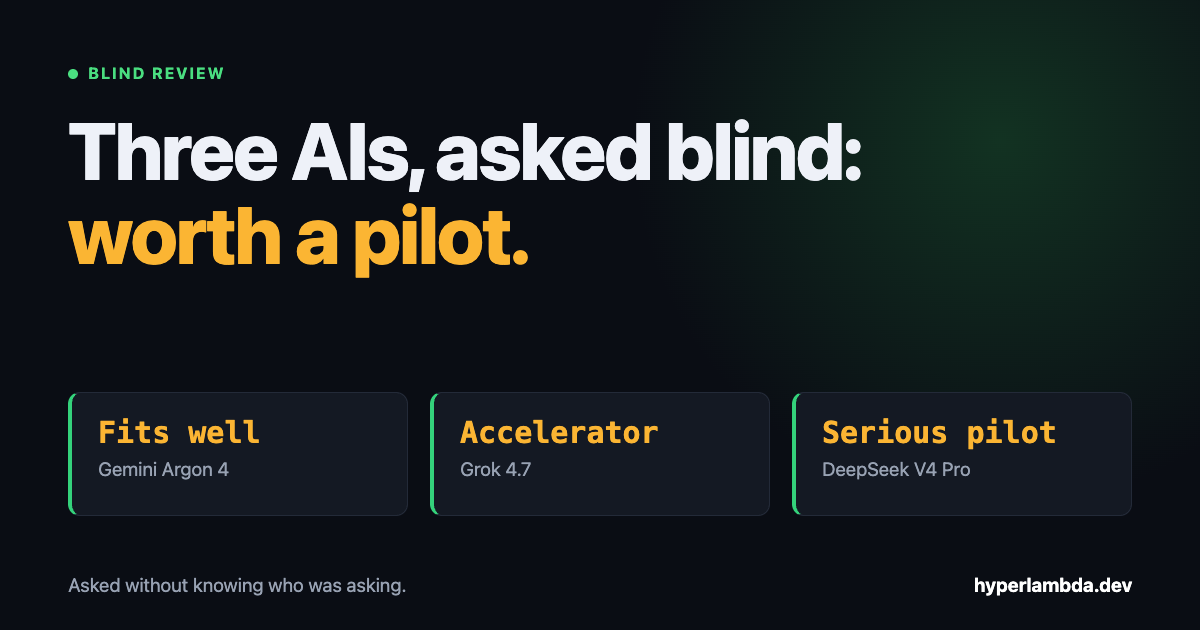
When asked to evaluate Magic for a 50-person company with three developers, without knowing who was asking, three models (Gemini Argon 4, Grok 4.7 and DeepSeek V4 Pro) each recommended it in some form: a good fit, an internal API and admin accelerator, and a serious pilot. None recommended going all-in, and all three raised the bus factor.
Is Hyperlambda too niche for a company to adopt?
It is the objection all three models raised. The practical answer is that the generated code is readable text, the runtime is MIT licensed and can be forked, and developers can drive Magic through an AI agent without writing Hyperlambda by hand. A pilot, including having one developer read and edit a generated file, tests the risk before you commit.
What is Hyperlambda’s bus factor?
Three full-time employees work on Magic and the team is growing, the project is MIT licensed and containerised, and its health is public. The language has been in development since 2013, was written up in MSDN Magazine in March and June 2017, and is still maintained today.
Can a team of three developers use Magic for internal apps?
According to the three models, yes for backend and CRUD-heavy internal tools over existing SQL databases, with the caveat that frontend polish takes manual work and Magic is not a drag-and-drop builder for non-developers.
Related reading
- Hyperlambda’s “Bus Factor”
- Hyperlambda, the Inexpensive Natural “Outsourcing” Destination for Your AI Agent
- Magic Cloud Is Now Secure by Default: Here’s What Changed
- There Is a Discord Called “Base44 Refugees”. There Is No Such Thing for Hyperlambda.
- Open Source AI App Builders in 2026: The Honest Comparison
- Magic Cloud on DigitalOcean in One Copy-Paste