 Hyperlambda
Update, 24 September 2026. Two statements below — that Magic has no visual editor — were true when this was published and are not any more. Magic now ships Web Designer, a WYSIWYG editor for the pages a cloudlet serves. The rows about React component generation still stand, and both places are corrected in context rather than rewritten away.
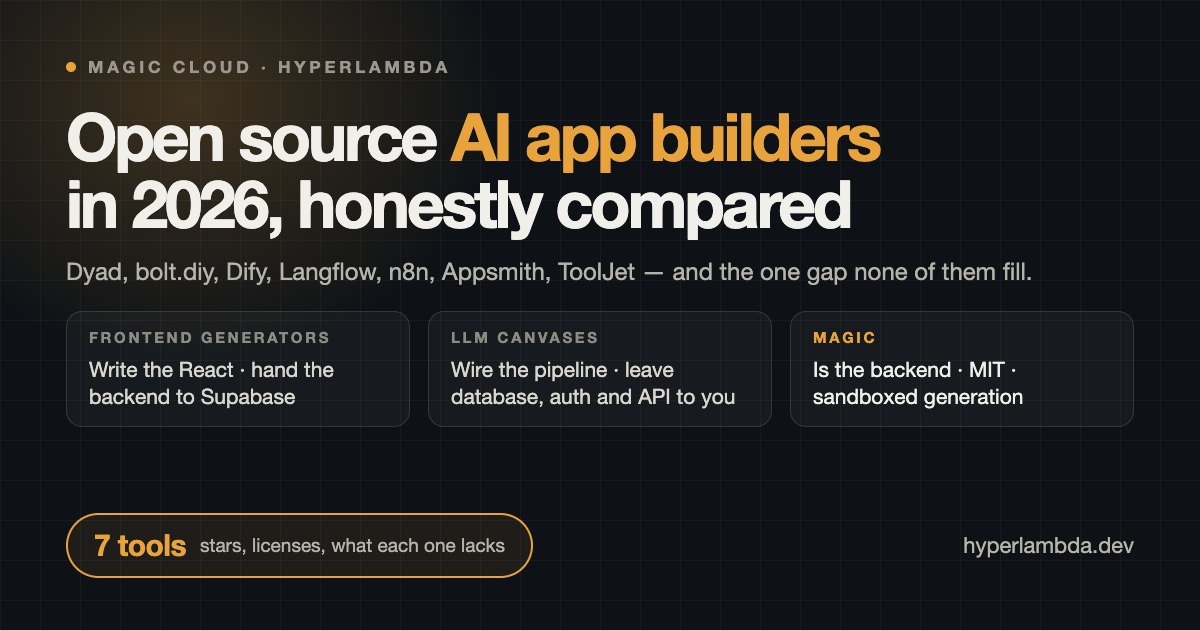
The best open source AI app builders in September 2026 are Dyad, bolt.diy and Open Lovable if you want a frontend from a prompt; Dify, Langflow and n8n if you want to wire an LLM pipeline on a canvas; and Appsmith or ToolJet if you want internal tools with AI bolted on. All of them are self-hostable, most are MIT or Apache licensed, and every one of them has more GitHub stars than the platform this site is about.
They also share a gap, and it is the reason this page exists. Not one of them ships the backend. The frontend generators hand your database and auth to Supabase. The canvases leave your database, auth and API to you. Magic Cloud is the only tool in this comparison that is the backend, which is where it is better, and the frontend and canvas are where it is not. Both halves are below.
The comparison in one table
Star counts are from each repository on 4 September 2026. "Sandboxed code" means the tool constrains what AI-generated code can do at runtime, not merely where it runs.
| Tool | Stars | License | Generates | Database | Auth and roles | API | Sandboxed code | MCP server |
|---|---|---|---|---|---|---|---|---|
| Dyad | 21k | Apache 2.0, FSL for pro | React frontend | Supabase | Supabase | No | No | No |
| bolt.diy | 20k | MIT | Node web app | Supabase | Supabase | No | No | No |
| Open Lovable | 28k | MIT | React from a URL | No | No | No | No | No |
| Dify | 154k | Apache 2.0 with conditions | LLM workflow | No | No | Yes | No | Client only |
| Langflow | 154k | MIT | LLM workflow | No | No | Yes | No | Yes |
| n8n | 203k | Fair-code | Automation | No | No | Webhooks | No | Yes |
| Appsmith | 41k | Apache 2.0 | Internal tool UI | Connects | Yes | No | No | No |
| ToolJet | 41k | AGPL-3.0 | Internal tool UI | Yes | Yes | No | No | Client only |
| Magic Cloud | 1.2k | MIT | Backend, API and UI | Yes, 4 engines | Yes, plus SSO | Generated | Yes, whitelist | Yes, role-gated |
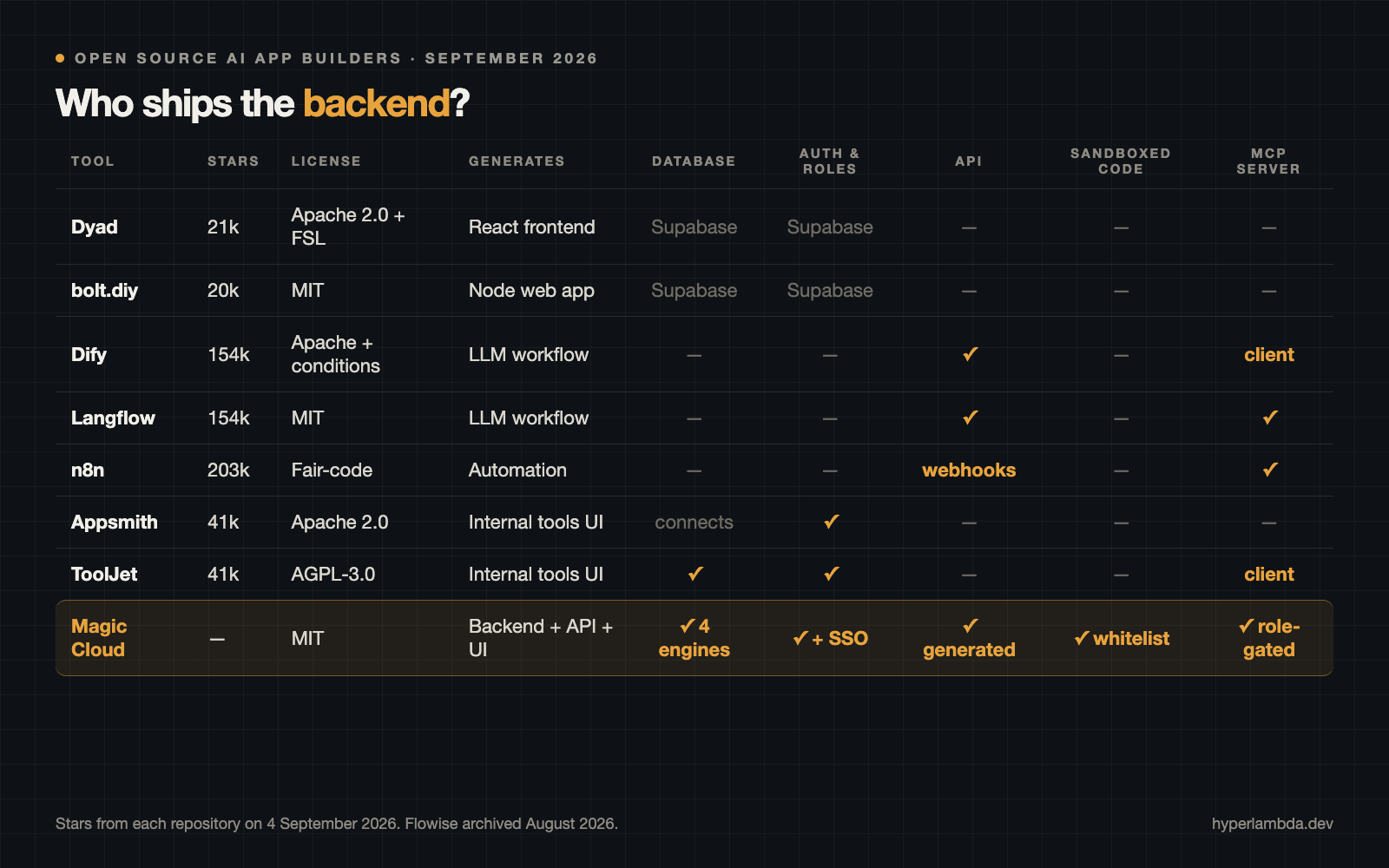
Flowise, the fourth canvas people usually list, was archived in August 2026 and is read-only, so it is not in the table.
Three kinds of tool wearing one name
"AI app builder" is doing a lot of work in that phrase. The tools above are three different products.
A prompt-to-app builder generates a frontend project from a chat. You describe a screen, it writes React or Next.js, you see a live preview, you iterate. Dyad, bolt.diy, Open Lovable and Claudable are this. They are the open source answers to Lovable, Bolt and v0.
An LLM canvas lets you wire prompts, retrieval, memory and tools into a pipeline on a visual graph, then expose the pipeline as an API or a chat widget. Dify, Langflow and n8n are this, with n8n being a general automation engine that grew AI nodes.
A low-code internal tool builder gives you a drag-and-drop UI over your existing databases and APIs, with AI generation of screens as a recent addition. Appsmith and ToolJet are this.
Magic Cloud is none of the three. It is an open source backend, with a database, generated APIs, authentication, an MCP server and an AI agent, where the AI generates code into the runtime rather than beside it. The sections that follow take each tool on its own terms first.
Prompt-to-app builders
Dyad
Dyad is a desktop application, Electron on Mac and Windows, that runs entirely on your machine with your own model keys. It supports OpenAI, Anthropic, Gemini, DeepSeek and local models through Ollama, and it generates React and TypeScript projects. Data and auth are Supabase integrations. It is the strongest local-first option in the category and the one to pick if privacy of the prompt matters. The code outside the pro folder is Apache 2.0; the pro folder is under the Functional Source License.
bolt.diy
bolt.diy is the community fork of Bolt.new, running in the browser on StackBlitz's WebContainer technology, which gives the model a real Node.js sandbox with a filesystem, npm and a terminal. It supports nineteen or more providers, has a diff view, file locking and revert, and deploys to Netlify, Vercel or GitHub Pages. Backend again means Supabase. MIT licensed.
Open Lovable
Open Lovable is Firecrawl's example app: give it a URL, it scrapes the site and rebuilds it as an editable React project. It is a demonstration rather than a product, runs in Vercel or E2B sandboxes, and has no backend story at all. Worth knowing because it has more stars than Dyad and people will ask.
The honest gap
These three are excellent at the thing they do. What they do is the frontend. When your app needs a table, a login, a role check or an API, the answer in every README is a link to Supabase. That is a fine answer, and it is also a second product with its own pricing, its own dashboard and its own export story. Our Lovable alternative page is about the same objection from the commercial side.
LLM canvases
Dify
Dify is the most complete product of the canvases: workflow builder, RAG pipeline over documents, agents with function calling, fifty or more built-in tools, MCP integration, and LLMOps monitoring, all behind an API you can call from your own app. It is Apache 2.0 with additional conditions, mainly around multi-tenant offerings and branding. If you are building a chat product over a document corpus, Dify is the pick.
Langflow
Langflow is the Python LangChain canvas, now backed by IBM through DataStax. Multi-agent orchestration, RAG, every major model and vector database, and a flow can be deployed as an MCP server directly. MIT licensed. The pick if your team lives in Python and wants to see the chain.
n8n
n8n is an automation engine with 1,500 or more integrations that added AI agent nodes, human approvals and code steps. It has the most stars on this page by a wide margin. It is also not open source in the OSI sense; the license is fair-code under the Sustainable Use License, which matters if you intend to offer it to others. Our n8n alternative page has the full 18-row matrix.
The honest gap
A canvas is a pipeline, and a pipeline needs somewhere to keep its data, someone to authenticate its users, and something to expose as an API. Dify and Langflow give you the last of those. The database and the auth are yours to bring. A canvas that calls your CRM still needs your CRM to have an API, and building that API is a different product.
Internal tool builders
Appsmith
Appsmith is a mature Apache 2.0 low-code platform for admin panels and dashboards, connecting to 25 or more databases and any API. Its AI angle is "Appsmith Agents", which lets agents work over private data inside the tool. It brings its own auth and roles. It does not generate APIs and it does not have its own database; it connects to yours.
ToolJet
ToolJet is the closest thing on this page to Magic's shape, and it is worth being precise about the difference. It has its own database, its own auth and roles, 90 or more datasources, prompt-to-app generation, and it can be driven from Claude Code or Cursor over MCP. The license is AGPL-3.0, which is a real constraint for anyone embedding it. What ToolJet generates is a UI over data. It does not generate APIs, and it does not sandbox generated code.
What none of them do
Line the table up and the empty columns tell the story. Seven tools, and only ToolJet has both a database and auth of its own. None of the eight generates a backend API. None constrains what generated code can do at runtime. Two expose their own tools over MCP.
This is not a criticism of any of them. It is the category. An app builder that generates a frontend is a frontend generator, and an app builder that wires an LLM is a pipeline tool, and both of them assume a backend exists somewhere else. Somewhere else has a name, and it is usually Supabase. Our Supabase alternative page is the long version of why that assumption is the interesting part.
Where Magic Cloud is better
These are the columns where Magic's cell is filled and the others' are not, with the proof next to each.
It is the backend. A Magic cloudlet is a database, an API layer, users and roles, OAuth single sign-on against eight providers, scheduled tasks, email, file hosting and an MCP server, in one process, from one Docker compose file. There is no second product to sign up for.
CRUD APIs from a table, in milliseconds. Tick a table in SQLite, PostgreSQL, MySQL or SQL Server and the generator writes read, create, update, delete and count endpoints, each role-gated per verb. The database AI agents page walks through it.
Generated code that cannot escape. The Hyperlambda Generator turns a sentence into a verified, saved, live endpoint in about three seconds, and the code it produces runs inside a whitelisted runtime that has no route to the shell, the filesystem or any slot the whitelist does not name. No tool in the table has an equivalent. There is a standing bounty on breaking it.
One MCP server, role-filtered. Every endpoint on the cloudlet is a tool, the catalogue is assembled per caller from their roles, and the same check runs again on invocation. Dify and ToolJet can consume MCP; Langflow and n8n can serve it; Magic serves everything it has, filtered by who is asking. The MCP server page has the details.
An AI agent with native tools and RAG, built in. The chat engine does retrieval over your training data and calls your endpoints as native OpenAI tools, in the same turn, and renders widgets. As of this week that is a native tool-calling pipeline rather than a text protocol.
Plain MIT. Not fair-code, not AGPL, not Apache with conditions, no pro folder under a different license. Take the files and the database anywhere and everything keeps running.
Where Magic Cloud is not better
Frontend generation. Dyad, bolt.diy and Onlook produce real React or Next.js projects with live preview, diffs and, in Onlook's case, visual editing on a canvas. Magic's frontends are generated by the agent as HTML and JavaScript served from the cloudlet, and there is no component library. There is now a visual editor — Web Designer, added after this was written, which edits the served file directly rather than a project — but it designs pages, not React components, so the gap in this row is the component model rather than the canvas. If the frontend is the product, use one of them and point it at Magic for the backend.
Visual workflow canvas. Dify, Langflow and n8n let someone who does not write code see and rearrange a pipeline. Magic's workflows are files, readable and editable in the dashboard, but not a graph.
Integration count. n8n's 1,500 nodes and ToolJet's 90 datasources are years of work. Magic has a plugin bazaar, OpenAPI import that turns any spec into secured endpoints, and a headless browser for the systems that have no API, but it does not have a pre-built node for every SaaS.
Model choice in the built-in agent. The chat engine defaults to OpenAI's Responses API, gpt-5.2 and newer, and its native tool calling, where the agent invokes your endpoints mid-turn, is tied to that path. The model itself is swappable: the ollama, hugging-face and together-ai plugins in the bazaar override the slots the chat engine uses to talk to an LLM, so chat and retrieval over your training data run on a local Ollama model, or on any open-weight model hosted by HuggingFace or Together AI. What swapping costs you is native tool calling, not the agent. Dyad, bolt.diy and Dify make the model a first-class setting rather than a plugin install, and lose nothing when you change it. The MCP route sidesteps the question entirely, since any client model can drive Magic's tools from Claude, Cursor or a local agent.
Community size. Every tool in the table has more stars, more contributors and more third-party tutorials.
Which one should you pick
- You want a frontend from a prompt and you are happy with Supabase behind it: Dyad locally, bolt.diy in the browser.
- You want a chat product over a document corpus: Dify.
- Your team is Python and wants to see the chain: Langflow.
- You want automation glue with AI as one step among many: n8n, with the license read first.
- You want admin panels over databases you already have: Appsmith, or ToolJet if you also want it to bring its own database.
- You want a backend an agent can build on, with the database, auth, API, MCP server and sandbox in one MIT-licensed process: Magic Cloud.
Combinations are normal. A Dyad frontend over a Magic backend is a reasonable stack. So is Claude Code driving Magic over MCP while n8n handles the notifications.
Try it
curl -fsSL https://hyperlambda.dev/docker-compose.yaml | docker compose -f - up
Open localhost:5555, point it at localhost:4444, log in with root / root. Tick a table, get an API. Type a sentence, get a tool. Connect your client to the MCP URL and the tools are already there.
Magic is MIT-licensed and open source. The repository is at github.com/polterguy/magic, documentation at docs.ainiro.io, and a managed cloudlet is the same thing with the hosting done.
Frequently asked questions
What is the best open source AI app builder in 2026? It depends on what you mean by app. Dyad and bolt.diy are the best open source prompt-to-frontend builders. Dify and Langflow are the best open source LLM workflow builders. Magic Cloud is the only open source AI app builder that generates and hosts the backend itself, including the database, auth and API.
What is the best free open source alternative to Lovable? Dyad, if you want it local on your desktop with your own model keys, and bolt.diy if you want it in the browser. Both generate React frontends and use Supabase for data and auth. For the backend half of what Lovable does, Magic Cloud is the open source alternative.
Is n8n open source? Not in the OSI sense. n8n is distributed as fair-code under the Sustainable Use License, which permits self-hosting for internal use but restricts offering it as a service to others. Dify, Langflow, Appsmith, bolt.diy and Magic Cloud are OSI-approved open source; ToolJet is AGPL-3.0.
Can I self-host an AI app builder? Yes. Every tool in this comparison is self-hostable. Dyad is a desktop app. bolt.diy, Dify, Langflow, n8n, Appsmith, ToolJet and Magic Cloud all ship Docker images or compose files.
Which AI app builder includes a database and authentication? ToolJet and Magic Cloud bring their own database and their own auth. Appsmith brings auth and connects to your database. Dyad and bolt.diy rely on Supabase. Dify, Langflow and n8n do not include either.
Which AI app builder generates backend APIs? Magic Cloud generates REST endpoints from database tables and from natural-language prompts, role-gated and published as MCP tools. Dify and Langflow expose a workflow as an API but do not generate CRUD or business-logic endpoints. n8n exposes workflows as webhooks.
Is AI-generated code safe to run? Only if the runtime constrains it. Dyad, bolt.diy and Open Lovable run whatever the model writes, inside a container or browser sandbox at best. Magic Cloud runs generated Hyperlambda inside a whitelist that names the exact operations the code may perform, so generated code cannot reach the shell or the filesystem.
What is Magic Cloud's biggest limitation compared to these tools?
Frontend generation. Dyad, bolt.diy and Onlook produce React projects with live preview and visual editing; Magic's generated frontends are plain HTML and JavaScript, now editable in Web Designer, but with no React component model behind them. The built-in agent's native tool calling is also tied to OpenAI's Responses API, though the ollama, hugging-face and together-ai plugins let the built-in chat run on a local or open-weight model, and any model can drive Magic over MCP.
Related reading
- Lovable Alternative — the overview
- n8n Alternative — the overview
- Supabase Alternative — the overview
- Hyperlambda Generator — the overview
- MCP Server — the overview
- Magic vs n8n: An Honest Feature Matrix
- The Only Sandbox Your AI Agent Cannot Break Out Of
- From FUNCTION_INVOCATION to Native Tools