 Hyperlambda
Fourth in this series, and the first entry where the competitor got here first.
n8n was a category difference. PocketBase was the closest architectural sibling. Directus was the closest competitor on positioning. DreamFactory is something else again: it has been selling "point it at your database, get a secured REST API" since 2013, which is a decade before I started saying it. If you think automatic API generation over a legacy database is a novel idea, DreamFactory is the product that proves it is not — and proves the market is real, which is a thing I would rather know than not.
It is also the most expensive product in this comparison by a factor I had to re-read twice.
One sentence of thesis:
DreamFactory sells connectors. Magic sells a machine.
Everything below follows from what each side decided to meter.
The prices, first, because they frame everything
Read off DreamFactory's own pricing page the day this was published:
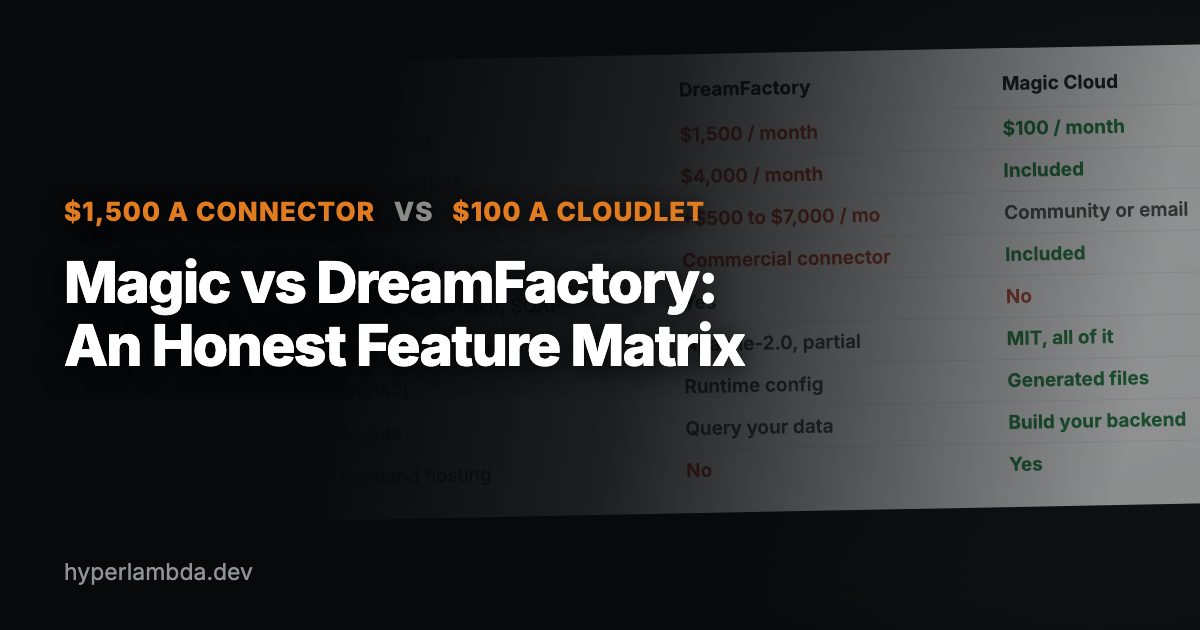
| Plan | Price | What you get |
|---|---|---|
| DF Linux Lite | $1,500 / month | One connector of your choice — excluding Oracle, Snowflake and DB2 |
| DF Linux Professional | $4,000 / month | Unlimited connectors, including Oracle, Snowflake and DB2, plus rate limiting, logging and governance |
| DF Docker/Kubernetes | Custom, per vCPU | As above, priced by core |
| Support (add-on) | $500 – $7,000 / month | Billed annually. One seat at the bottom, five and a 2-hour SLA at the top |
For comparison, the entire Magic price list is $100/month per cloudlet, or $300 for double the machine, support and hosting included, with no connector licensing anywhere in it.
The gap on the entry tier is fifteen times. On the tier where you can attach a second database, forty times. Add DreamFactory's mid support package and one deployment reaches $5,667/month, against $100.
There is an Apache-2.0 open-source edition, and it is genuinely open source — but the connectors that matter to the legacy-modernisation case are not in it. By DreamFactory's own repository, SQL Server, Oracle, Snowflake and SOAP are commercial, along with rate limiting, audit logging and multi-tenancy. So the sentence that sells the product — wrap the old SQL Server nobody wants to touch — is the sentence that costs $1,500 a month.
The matrix
| Feature | DreamFactory | Magic Cloud |
|---|---|---|
| Entry price | $1,500/mo for one connector | $100/mo per cloudlet |
| All connectors | $4,000/mo | Included |
| Support | $500–$7,000/mo add-on, billed annually | Community on Professional; email and a monthly call on Enterprise |
| Open source | Apache-2.0 core, with the enterprise connectors and governance features held back | MIT, all of it, nothing held back |
| SQL Server | Commercial connector | Included |
| Oracle, Snowflake, DB2 | Yes, on the $4,000 tier | No |
| SOAP to REST | Yes — a genuine enterprise unlock | No |
| Connector breadth | Very wide: databases, file stores, SaaS, Spark, Cassandra, Salesforce | SQLite, MySQL, PostgreSQL, SQL Server |
| The API | Service configuration resolved at runtime | Generated Hyperlambda files — readable, diffable, committable |
| Custom logic | Pre- and post-process scripts in V8, PHP, Python or NodeJS, running with full trust | Hyperlambda files, hot, inside runtime slot whitelisting |
| API gateway features | Rate limiting, API key management, audit logging, multi-tenancy | Role-gated endpoints; no gateway layer |
| Agent story | MCP server exposing its APIs as tools — "Let AI query your data", in their own words | Native MCP with OAuth; agents write new endpoints for themselves inside RBAC |
| Frontend hosting | Not offered — it is a data gateway | Static sites and SPAs served from the same cloudlet |
| AI and RAG | Governed data access for LLMs | ML types, crawling, vectorisation, deployable chatbots |
| Buyer | Enterprise integration teams replacing MuleSoft, Apigee, Kong | Developers and small teams |
| Assurance | G2 4.7, named customers in finance, healthcare and public sector, dedicated SEs, SLAs | A small project with a public bug ledger |
Where DreamFactory wins, stated plainly
Per the rules of this series: no rebuttals here. They live below.
Connector breadth, and it is not close. Oracle, Snowflake, DB2, Cassandra, Spark and Databricks, Salesforce, file stores, SaaS systems. Magic has four SQL engines. If your data lives in a warehouse or a mainframe-adjacent system, DreamFactory has a connector and I do not.
SOAP to REST. A real, unglamorous, enterprise-critical capability. There is a great deal of SOAP still running the world, and Magic has no answer for it whatsoever.
The API gateway layer. Rate limiting, key management per application, audit logging, multi-tenancy. Magic gates endpoints by role and stops there. These are the features you need the day an external partner consumes your API, and they are a product surface DreamFactory has spent a decade building.
Identity passthrough and governance. Credentials never leaving the gateway, mapping to existing enterprise security infrastructure. That is exactly what a bank's security review asks about, and DreamFactory has an answer rehearsed for it.
Enterprise assurance. Named customers in regulated industries, G2 ratings, dedicated solution engineers, a 2-hour SLA you can buy. Every one of those is a box Magic cannot tick, and for some buyers those boxes are the entire decision.
Where the bets diverge
Metering connectors versus metering nothing. DreamFactory's price scales with the number of systems you connect, because connectors are what it sells. Magic's price scales with the size of the machine, because a machine is what it sells. Both are coherent. But notice the incentive each creates: on DreamFactory, a second database is a purchase order; on Magic, it is a connection string. If your architecture involves more than one data source — and legacy modernisation almost always does — that difference compounds every quarter.
Runtime configuration versus generated files. The same architectural split I described against Directus applies here, for the same reason. DreamFactory's API is service configuration resolved per request; its customisation model is scripts attached as pre- and post-process hooks. Magic writes endpoint files to disk. Nothing to review in one case; text under git in the other.
Full-trust scripts versus a constrained vocabulary. DreamFactory's hooks run V8, PHP, Python or NodeJS with full trust — which is powerful, and which is also why the safe way to let an AI near it is to let it call the API rather than write the hooks. Magic's generated Hyperlambda executes as an AST where every node must bind to a whitelisted slot, so generated code cannot exceed its permissions regardless of what the prompt asked for. There is a standing $100 bounty on proving that boundary wrong.
The agent story, which they have and it is good. DreamFactory is not asleep on this. It has repositioned as an AI Data Gateway, ships an MCP server, and pitches governed, token-controlled access with identity passthrough — a legitimately strong answer for an enterprise that wants an LLM near its data without handing it SQL. The distinction is one their own headline draws better than I could: "Let AI query your data." Querying is the ceiling. On Magic, the agent reads the generated code and writes more of it — new endpoints, new tools, new integrations, live in production. One platform makes your data safe for an agent to read. The other makes your backend safe for an agent to build.
Different buyers, honestly. DreamFactory sells against MuleSoft, Apigee, Kong and AWS API Gateway — their own site lists those comparisons. That is a category where $4,000/month is unremarkable, procurement expects an SLA, and a dedicated SE is table stakes. I am not in that category and I am not pretending to be.
The decision rule
Choose DreamFactory if: your data is in Oracle, Snowflake, DB2 or behind SOAP; you need an API gateway with rate limiting, key management and audit logging; you have external partners consuming your APIs under contract; you need identity passthrough that maps to existing enterprise security; or you require an SLA and a named engineer. In that world the pricing is normal and the product is mature. Buy it.
Choose Magic if: you are a developer or a small team; your databases are SQLite, MySQL, PostgreSQL or SQL Server; you would like the API as reviewable source rather than gateway configuration; you want the frontend hosted alongside it; or you expect agents to be building the backend rather than querying it. And — bluntly — if a $1,500/month quote for one connector is the reason you are reading this article at all.
The test that decides it in one question: is your problem governing access to many systems, or building an application on a few? DreamFactory is a gateway. Magic is a place to build.
The fine print
Every DreamFactory figure above was read off their own pricing page and repository on the day this was published: the $1,500 Lite tier with a single connector excluding Oracle, Snowflake and DB2; the $4,000 Professional tier; per-vCPU pricing for Docker and Kubernetes; support add-ons at $500, $1,667 and $7,000 per month billed annually; the Apache-2.0 open-source core; and SQL Server, Oracle, Snowflake and SOAP listed as commercial alongside rate limiting, audit logging and multi-tenancy. Their pricing page and their open-source tier describe the free connector coverage slightly differently, so if that specific line matters to your decision, ask them rather than trusting my reading of it.
Pricing pages move, and enterprise vendors negotiate — a list price is not what a large customer pays. If you are reading this months later, re-verify before quoting me.
And the obvious disclosure: I wrote Magic, so read every row on the right with that in mind.
Magic is MIT-licensed and open source — the repository is at github.com/polterguy/magic. Testing any of this yourself takes one copy-paste on a $12 DigitalOcean droplet, or a managed cloudlet if you would rather not.
FAQ
Is Magic Cloud a DreamFactory alternative?
For the developer case, yes — both generate secured REST APIs over existing databases with role-based access, and both self-host. For the enterprise gateway case, no: DreamFactory offers rate limiting, key management, audit logging, multi-tenancy, SOAP translation and connectors Magic does not have.
Is DreamFactory open source?
Partly. There is an Apache-2.0 core on GitHub, which is a real open-source licence with no revenue test. But the enterprise connectors — SQL Server, Oracle, Snowflake, SOAP — and the governance features are commercial. Magic is MIT with nothing held back.
Why is DreamFactory so much more expensive?
Because it sells to a different buyer. Its listed competitors are MuleSoft, Apigee, Kong and AWS API Gateway, where enterprise integration budgets are the norm and $4,000/month is not a remarkable number. Magic is priced for a developer with a credit card.
Can both connect AI agents to a database?
Yes, and DreamFactory's answer is a good one — an MCP server with governed, token-controlled access and identity passthrough. The difference is what the agent does next: on DreamFactory it queries and updates data through the gateway; on Magic it can read the generated backend code and write new endpoints inside a runtime that constrains what that code may express. Magic's side of that answer is laid out on Database AI Agents.
Which is better for a legacy SQL Server database?
DreamFactory has the deeper enterprise story, but SQL Server is a commercial connector there, so the honest answer starts at $1,500/month. Magic includes SQL Server, turns it into a full-stack application, and costs $100.