 Hyperlambda
Evaluating alternatives? The evergreen comparison lives at n8n Alternative.
Two days ago I measured myself against n8n with their own yardstick, and it was not a fair fight — mostly because I never intended it to be one. That article was a provocation. This one is the sober version.
Because here is the thing CTOs actually need, and never get: a comparison written by one of the vendors that states plainly where the other product wins. You have read a thousand biased feature matrices. This one buys its credibility the only way credibility can be bought — by conceding real rows, in public, with no asterisks.
One sentence of framing before the table, because it is the thesis the whole matrix tests: n8n is a workflow orchestrator; Magic is a backend platform that AI agents build on. If that distinction is real, the rows should cluster. Watch them cluster.
The matrix
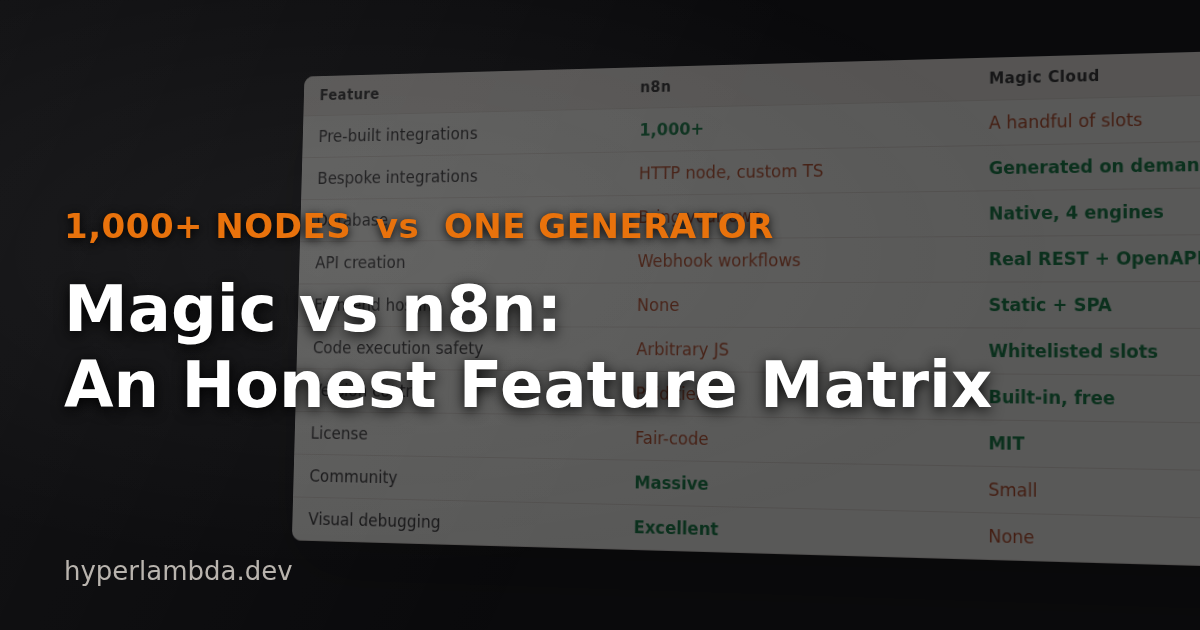
| Feature | n8n | Magic Cloud |
|---|---|---|
| Category | Workflow orchestrator | Backend platform agents build on |
| Unit of work | Visual workflow — nodes and edges, stored as JSON | Generated Hyperlambda endpoints — real files, real modules |
| Pre-built integrations | 400+ core nodes; community nodes push the practical count past 1,000 | A handful of built-in slots: HTTP, email, databases, files, browser, git, terminal, Python |
| Bespoke integrations | HTTP Request node and manual wiring, or write a custom node in TypeScript and publish it | Describe the API to the Hyperlambda Generator — it generates, saves, and exposes the integration in seconds |
| Who builds | Human drags nodes; AI assists | AI generates against a closed vocabulary; human reviews |
| Database | External dependency — bring your own | Native: SQLite by default, plus SQL Server, MySQL, PostgreSQL, with schema-aware CRUD generation |
| API creation | Webhook-triggered workflows | Real REST endpoints with OpenAPI specs, verb conventions, generated CRUD |
| Frontend hosting | None | Static hosting and SPAs on the same cloudlet |
| Auth and roles | Workflow-level credentials; RBAC and SSO in paid tiers | Users, roles, JWT, and endpoint-level role gating — out of the box, free |
| Code execution safety | Code node runs arbitrary JavaScript | Whitelisted slot execution — capabilities enforced by the runtime, not by prompts |
| AI and RAG | 30+ AI nodes, LangChain-based agents, external vector stores | ML types, website crawling, native vectorization, deployable chatbots — built in |
| MCP | MCP client and server support inside workflows | Full MCP server where agents grow their own tools at runtime |
| Version control | Git-based source control in paid tiers | Built-in Git in Hyper IDE — init, commit, branch, publish to GitHub — free |
| Scheduling | Cron and trigger nodes | Persistent task scheduler, drivable by agents over MCP |
| License | Fair-code — Sustainable Use License, with enterprise features under a separate Enterprise License | MIT, all of it |
| Self-hosting | Yes, with license restrictions on hosting-as-a-product | Yes — one copy-paste on a $12 droplet |
| Visual debugging | Excellent — per-node execution view | None; you read code and logs |
| Community and ecosystem | Massive — templates, forums, thousands of community nodes | Small |
Now the part that makes the table mean something.
Where n8n wins, stated plainly
The connector catalog. No contest. n8n ships 400+ core nodes, and the community ecosystem has published thousands more. If your automation is "when a Stripe payment lands, update HubSpot and post to Slack," n8n has a polished, maintained, pre-built node for every noun in that sentence. Magic does not.
Visual debuggability. An n8n workflow shows you exactly which node ran, what data flowed through it, and where it stopped. A non-developer can read it. This matters enormously to ops teams, and Magic has no answer for the person who needs to debug at 3 AM without reading code.
Community and ecosystem. Templates, forums, tutorials, a hiring pool that already knows the tool. Ecosystem gravity is real, and n8n has years of it.
SaaS maturity. n8n Cloud is a polished managed product. AINIRO hosts cloudlets, but n8n's hosted operation is larger and longer-running.
That is the honest list, and none of it comes with a "but actually." The rebuttals live in the next section, where they belong.
Where the categories diverge
The connector asymptote. Here is the structural problem with a catalog: it is finite, and your legacy SQL Server schema is not in it. Neither is your internal ERP's API, your weird SOAP endpoint from 2009, or the vendor API that launched last Tuesday. When the integration you need is bespoke — and in real enterprises, the important ones always are — the catalog stops helping and you are hand-wiring HTTP nodes anyway.
Magic's answer is not a bigger catalog. It is a generator with a vocabulary it cannot hallucinate its way out of. Describe the integration in plain language, and the Hyperlambda Generator produces it — a real endpoint, saved as a real file, live in production, in seconds. The number of integrations Magic ships with is small. The number it can have is unbounded. They enumerate; Magic generates. A thousand nodes is a lot until you compare it with a machine that makes nodes.
Workflows are not backends. The moment your n8n workflow needs users, roles, a database, and a UI, you are assembling a product federation: n8n plus Postgres plus an auth provider plus somewhere to host a frontend. Every seam is integration work, and every seam is yours to maintain. Magic ships the whole vertical as one system — database, generated APIs, auth, RBAC, static hosting — which is how a complete role-secured CRM happens in one conversation.
Security is in the runtime, not the prompt. n8n's Code node executes arbitrary JavaScript — fine when a trusted human wrote it, a different proposition when an AI did. Magic's execution model is whitelisted at runtime: generated code can only bind to slots the execution context permits, so an agent cannot generate its way out of its permissions. The worst a bad generation can do is fail. There is a standing $100 bounty on proving otherwise.
The license is a feature. n8n is fair-code: source-available under the Sustainable Use License, with commercial-exploitation restrictions and enterprise features under a separate license. That is a legitimate business model — and a procurement conversation, a field-of-use analysis, and a landlord. Magic is MIT. All of it. Build on it, resell what you build, host it for customers, fork it if I get hit by a bus. For a CTO doing a ten-year platform bet, this row alone can decide the evaluation. I have written about why owning your stack matters — the short version is that the exit door should never be someone else's decision.
Cost. The economics are not subtle and I will not re-litigate them here — the receipts exist, repeatedly. Six-cent backends on a $12 droplet.
The decision rule
If you are skimming, this is the section.
Choose n8n if: you are gluing SaaS tools together, non-developers own the automations, and the connector catalog covers your stack. In that lane it is the best tool in its category, and I mean that without irony.
Choose Magic if: you need an actual backend — your own databases, custom APIs, auth, a frontend — or you expect AI agents to be building and operating it. That is not n8n's category, and no number of nodes moves it into that category.
Choose both if: you already run n8n and it earns its keep. n8n workflows can call Magic endpoints like any other HTTP API — the products compose, and some shops genuinely should run both. This is not a zero-sum matrix.
The fine print
What the matrix does not capture: ecosystem momentum compounds, hiring familiarity matters, and "small community" is a real cost I pay every day. Integration counts and tier boundaries also move constantly — the n8n numbers above were verified the day this was published, and if you are reading this in 2027, re-verify them before you quote them.
Magic is MIT-licensed and open source — the repository is at github.com/polterguy/magic, with documentation at docs.ainiro.io. If you want to test the generator row of this matrix yourself, a cloudlet is one copy-paste on a $12 DigitalOcean droplet.
FAQ
Is Magic Cloud an n8n alternative?
Only partially. Magic replaces n8n where n8n is being stretched into a backend — webhook-driven APIs, database automations, anything needing auth and a UI. It does not replace n8n's core lane of visual SaaS-to-SaaS automation owned by non-developers.
Does Magic have pre-built integrations like n8n's nodes?
No, and it does not try to. Magic ships capability primitives — HTTP, databases, email, files, browser automation, terminal, Python — and the Hyperlambda Generator creates concrete integrations from plain-language descriptions on demand. The catalog is small; the reachable surface is any API you can describe.
Can n8n and Magic work together?
Yes. Magic exposes real REST endpoints with OpenAPI specs, and n8n calls HTTP APIs natively. Several sensible architectures use n8n for SaaS orchestration and Magic as the backend those workflows talk to.
Is n8n open source?
n8n is fair-code — source-available under its Sustainable Use License, with commercial-use restrictions and separately licensed enterprise features. Magic is MIT-licensed with nothing gated, which is a different legal category: no field-of-use restrictions at all.