 Hyperlambda
Part of our AI agent builders series — the overview lives at AI Agent Builders.
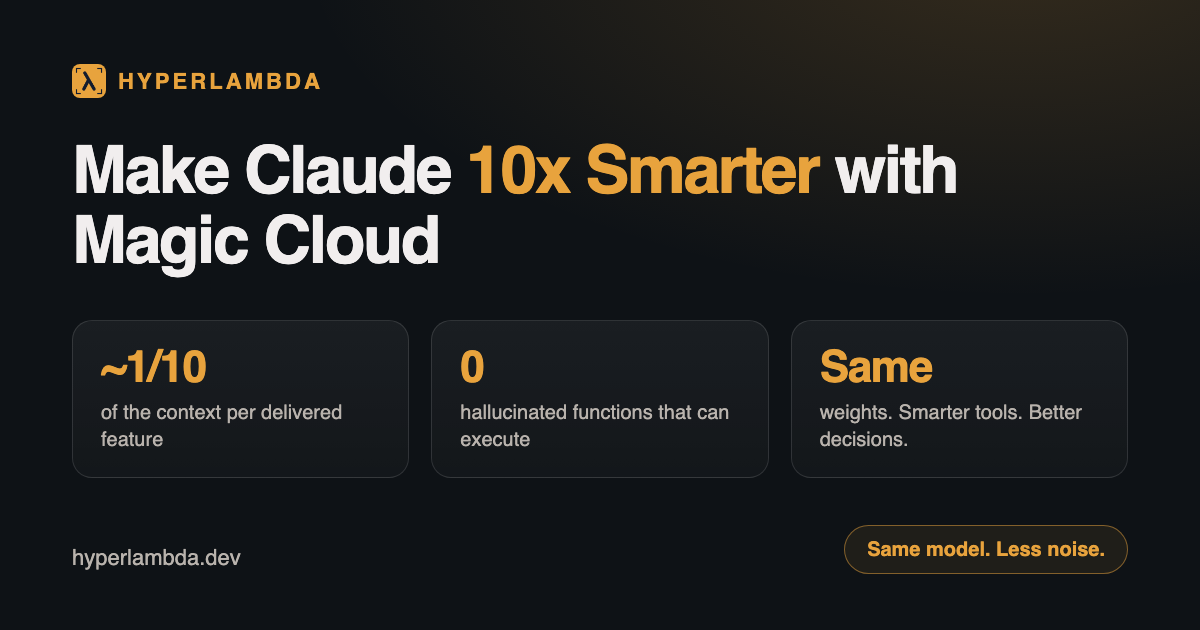
With Magic Cloud, Claude becomes 10x smarter.
I know exactly what a careful reader does with that sentence. The weights are identical. Magic does not retrain Claude, does not fine-tune it, does not touch a single parameter. The model that talks to a Magic cloudlet is the same model that talks to anything else.
All true. And it is the wrong objection, because it assumes intelligence lives in the weights.
It does not. Not for a human, and not for a model. So let me say what I mean by smarter, and then show you the receipts.
What smarter means
The intelligence of a system is the quality of the decisions it makes per unit of attention it spends.
That is not a marketing definition. It is the one you already use. A mathematician with a calculator solves more problems than the same mathematician without one, and nobody claims the calculator is cheating. Philosophers have a name for this: the extended mind, from Clark and Chalmers in 1998. Your notebook, your tools and your environment are part of your cognition, not accessories to it. Take them away and you are measurably less capable, even though nothing in your skull has changed.
A language model is the purest case of this we have ever built, because its entire working memory is a context window, and everything in that window competes for the same attention. What you put in front of the model decides how well it thinks. Give it smarter tools, and it makes better decisions with the same weights.
That is the claim. Now the mechanisms, three of them, each with a number.
Mechanism one: less context is a better model
Here is the part most people have not internalised yet. A model does not just get slower and more expensive as its context fills. It gets worse.
Chroma published a study in 2025 they called context rot. Eighteen models, tasks that stayed the same while the input grew, and one consistent finding: performance degrades as context length increases, even when everything the model needs is right there in the window. The earlier "Lost in the Middle" paper from Liu and colleagues found the same thing from a different angle. Information in the middle of a long context is used worse than information at the edges, and the effect grows with length.
So the same weights, given a full window of boilerplate, stack traces, file reads and retries, produce worse answers than the same weights given a clean one. Context is not free, and it is not neutral. It is the resource the model thinks with.
This is where Magic changes the arithmetic. When I measured Claude building a fifteen-endpoint secured backend on a cloudlet, the backend slice consumed roughly 30,000 input tokens. The calibrated estimate for the same deliverable through a conventional file-editing agent was roughly 180,000. The July benchmark on a different build came out at about 25,000 tokens against 140,000. And dream prompt compression on the chat side has taken rolling sessions from 50,000 tokens down to 1,500.
Read those as cost numbers if you like. I wrote them up as cost numbers. But context rot says they are also quality numbers. A model working in a tenth of the context is a model that has not started degrading yet.
Mechanism two: outsourcing backend development
The second mechanism is delegation.
A coding agent building a backend the conventional way has to hold the framework in its head. Routing conventions, auth middleware, the ORM's quirks, the validation library, the way this particular project wires its errors. All of that is context, all of it is attention, and none of it is the problem the user actually asked to solve.
On Magic, Claude does not write the backend. It describes it. A sentence goes to the Hyperlambda Generator, a model fine-tuned for exactly one job, and a file comes back that has already been verified against the live function registry. A CRUD endpoint is one declarative call of about a hundred tokens. The generated code never enters Claude's context at all, in either direction, because the operating rules forbid reading it back. Verification happens over live HTTP and the OpenAPI spec.
The consequence is that Claude spends its attention on judgment. What tables, what roles, what the KPI should actually measure, whether the result is right. The parts that need intelligence. The parts that need memorised framework trivia are handled by a tool that has that trivia baked in.
And one class of failure goes to zero. A hallucinated function cannot execute on Magic. The verifier rejects any slot that does not exist on the instance before the code is returned, and the runtime whitelist rejects it again at dispatch. I wrote up both gates in detail. A model that cannot invent an API cannot spend three turns discovering it invented one.
The CRM built in one conversation is the worked example: twenty role-secured endpoints, JWT auth, email dispatch, KPI aggregation, zero hand-written backend lines, two bugs, both caught before production, one of them fixed by the agent reading the platform's own guide.
Mechanism three: outsourcing deployment
The third mechanism is the one nobody counts, because it is invisible when it works.
A conventional agent finishes writing code and then enters a second loop: build, deploy, hit the endpoint, read the error, fix, redeploy. Every iteration of that loop is context. The stack trace is context. The re-read of the file is context. The second attempt is context. By the time the thing is live, the model has spent more attention on getting the code to run than on deciding what the code should do.
On Magic there is no loop. An endpoint is live the moment it is generated. There is no build step, no CI queue, no staging environment, no container to restart. The website you are reading was built this way, by Claude, over this cloudlet's MCP server: write a page, save it, read the live HTML back, inside the same minute.
Every error-recovery cycle that never happens is context the model keeps for the task. That is not a productivity feature. By mechanism one, it is an intelligence feature.
What the 10x is attached to
I want to be precise about the number, because precision is the whole point of this site.
The 10x is not an IQ score. It is the measured gap in context per delivered feature on the backend slice of agentic work. Roughly 30,000 tokens against 180,000 on the Token Ledger build. Roughly 25,000 against 140,000 in the July benchmark. Call it six to nine times on the backend slice, and the cost article already carries the fine print: across a whole session, with the reasoning and the frontend included, it is closer to 5x, because reasoning does not compress.
So the honest chain is this. Claude on Magic works in a fraction of the context per feature. That fraction is measured. Less context is the same model operating at higher quality. That is published research, not my opinion. The 10x is the input. Smarter is the consequence.
What I have not yet done is the paired experiment: the same ten tasks, Claude bare against Claude on Magic, with tokens, turns and first-pass success recorded side by side. That is the obvious next step, and when it is run, the number in this headline becomes whatever the table says. If it says 6x, I will change the headline.
What this is not
It is not a claim that Claude gets better at poetry, or at reasoning about things that have nothing to do with backends. Mechanism one applies everywhere, but the big multipliers in this article come from mechanisms two and three, and those are about building and running software.
It is not a claim that Magic makes a weak model strong. The Qoder and OpenCode builds show that a budget model does well on Magic precisely because the hard parts are delegated, but the judgment still comes from the model. A better model still makes better decisions. It just makes them with less noise in the way.
And it is not a promise that the runtime is smart. The runtime is dumb on purpose. It knows what exists, it knows what each role may touch, and it refuses everything else. The model proposes, the runtime decides. Intelligence that cannot escape its boundaries is the only kind I am willing to put in production.
Conclusion
With Magic Cloud, Claude becomes 10x smarter.
Same weights. A tenth of the context per feature, and the research says that alone means better answers. Backend code delegated to a generator that cannot hallucinate a function. Deployment removed from the loop entirely, so the model never spends its attention on making things run.
Smarter tools make a smarter model. That was true of the calculator, and it is true of the LLM.
Magic is MIT-licensed and open source. The repository is at github.com/polterguy/magic. Connect Claude to a cloudlet through the MCP server, or start a managed one and skip the setup.
Related reading
- Why Claude Is 10x Cheaper When It Builds on Magic Cloud
- How Dream Prompt Compression Keeps Long AI Sessions Fast and Focused
- Zero-Hallucination Code Generation: A Vocabulary Your AI Cannot Escape
- A Complete CRM in One Conversation: 60 Seconds of Backend, Six Cents of Tokens
- How Magic Cuts Backend Build Cost by ~80% in Agentic Workflows
- AI Agent Builders — the overview
- Hyperlambda Generator — the overview
- MCP Server — the overview