 Hyperlambda

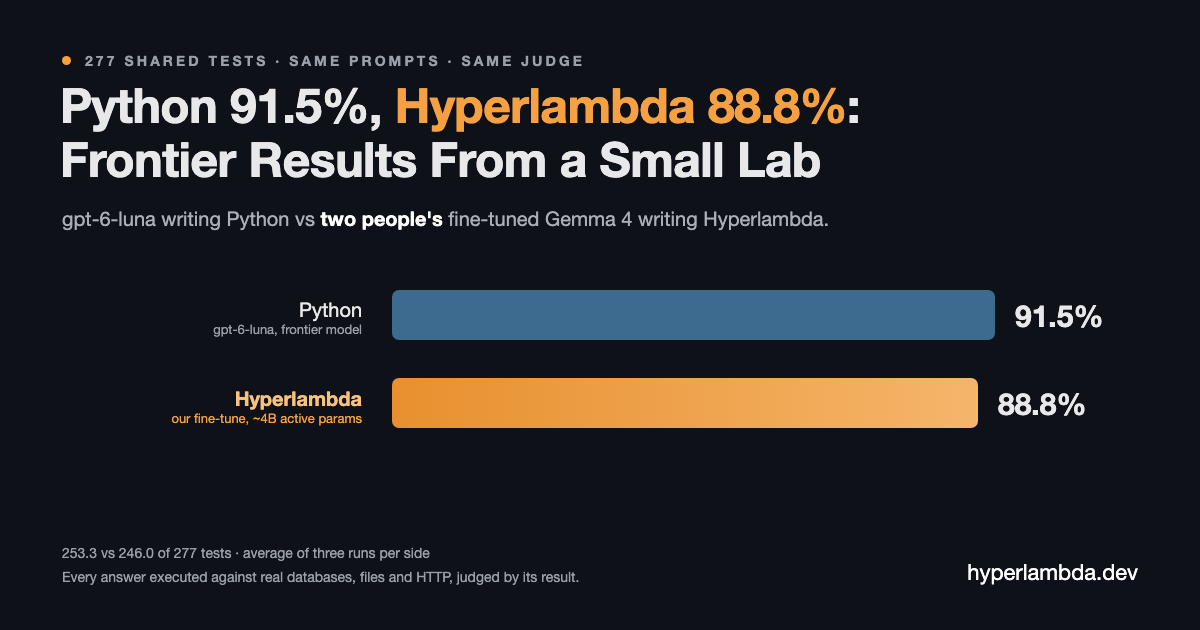
Eight days ago I wrote that there is no benchmark where a model writes Hyperlambda on one side and Python on the other, so there is no apples-to-apples comparison, and I would not pretend there was. Now there is one.
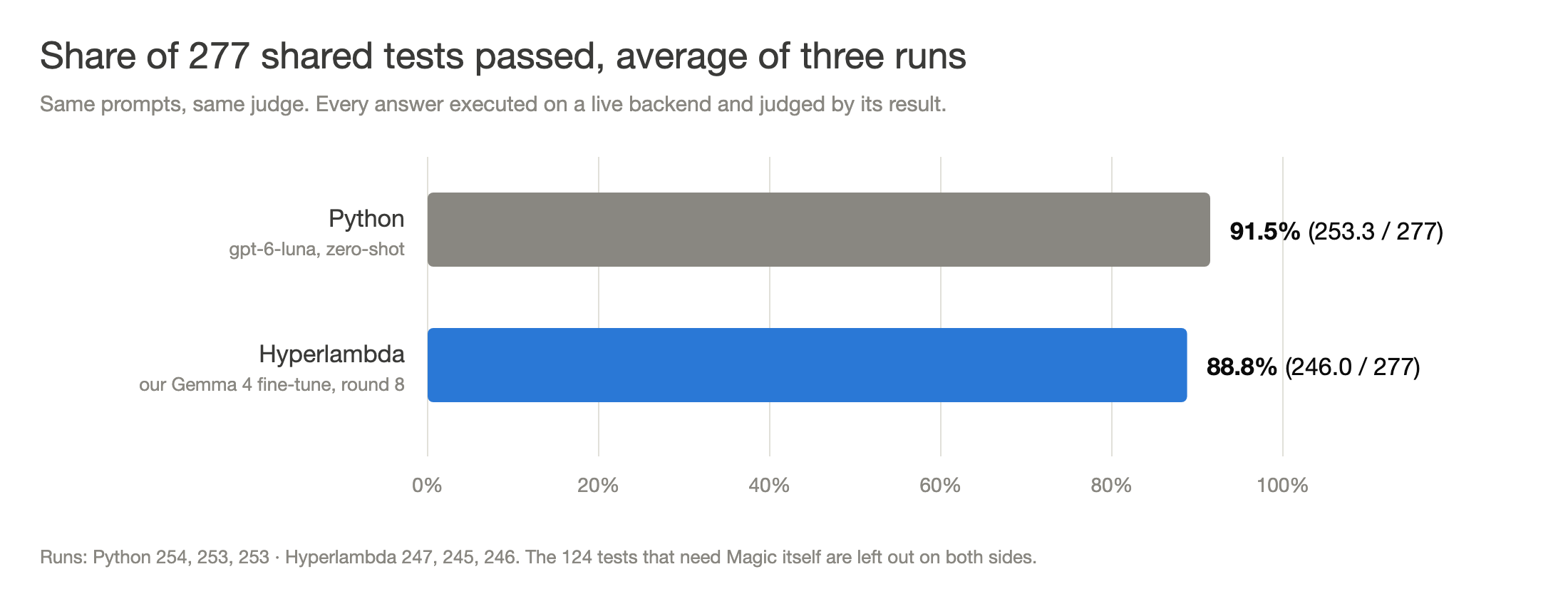
We gave gpt-6-luna, a frontier model, the same 277 tasks we give our own Hyperlambda model, and asked it to solve them in Python. Same prompts, same judge, and every answer executed. Python passed 253.3 of 277 (91.5%). Our model, writing Hyperlambda, passed 246.0 (88.8%). That is a gap of 2.7 points, or about 7 tests.
Our model is a fine-tune of Google's open Gemma 4, with about 4 billion parameters active per token. Two people built it: my colleague Barnabas and me. The GPU time for the training run that produced it would cost about $130 to rent.
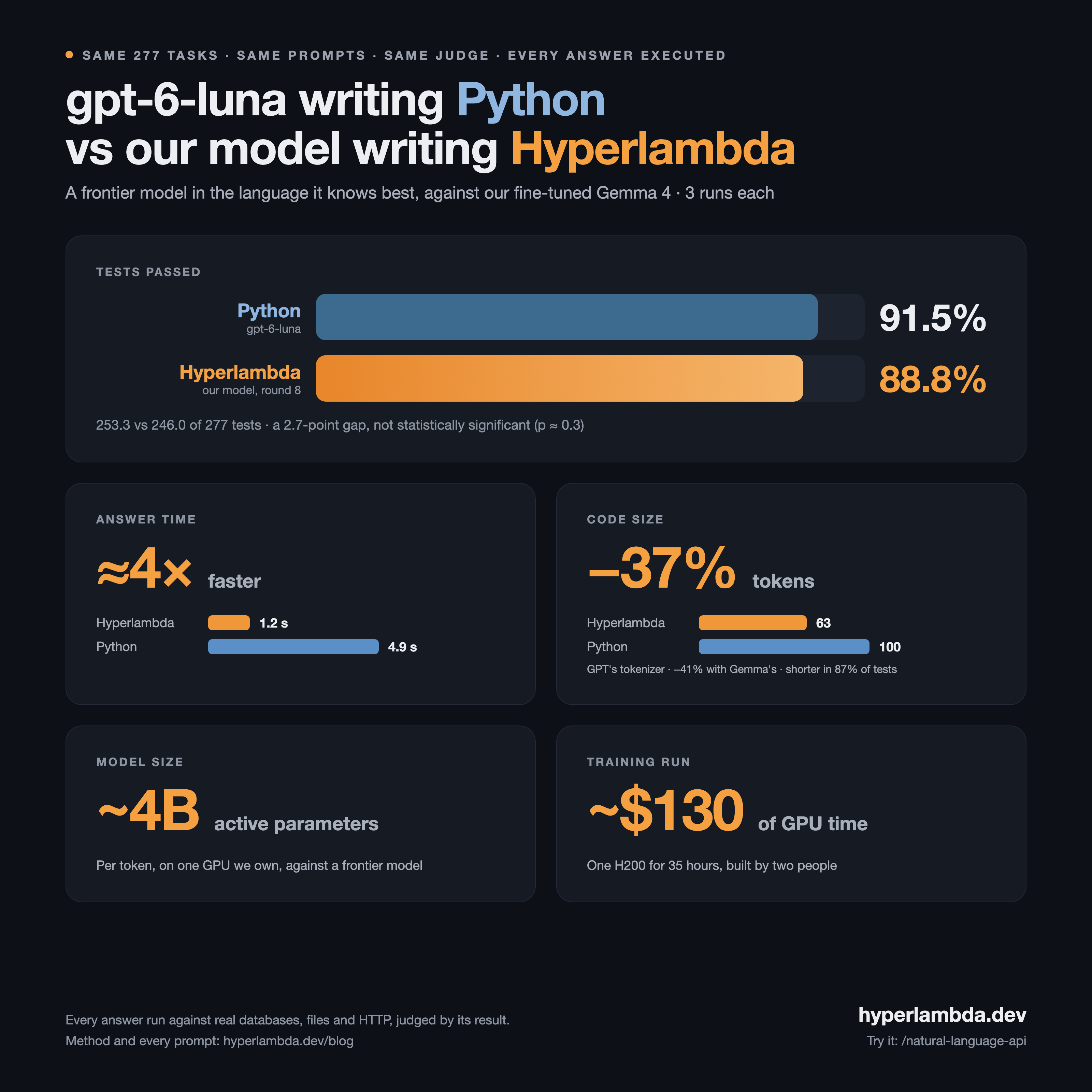
At a glance: the model is round 8 of our fine-tune, and it is released: you can try it yourself on the Natural Language API page. The comparison uses the 277 of our 401 tests that plain Python can do; the other 124 need Magic itself, and are left out on both sides. Each side ran three times, and the numbers are the averages. The 2.7-point gap is not statistically significant on this test set.
Who did this: Barnabas trains the model and runs the evals on our own hardware. I write the training corpus and the tests. Claude, the AI model I work with, did much of the checking, the analysis and the charts in this article, under my supervision.
The two contenders
| Python | Hyperlambda | |
|---|---|---|
| Model | gpt-6-luna, through the OpenAI Responses API | Gemma 4 26B-A4B with our LoRA adapter, round 8 |
| Size | Undisclosed, frontier scale | 26B parameters, about 4B active per token |
| Training | Undisclosed | One epoch over 549,787 verified Hyperlambda snippets, on one NVIDIA H200, in 34 hours 47 minutes |
| Settings | Default reasoning, zero-shot, one attempt per test | Temperature 0, up to three attempts when the answer does not parse |
| Language | The one every large model knows best | One that barely exists on the public web |
The numbers
| Run 1 | Run 2 | Run 3 | Average | Pass rate | |
|---|---|---|---|---|---|
| Python, gpt-6-luna | 254 | 253 | 253 | 253.3 | 91.5% |
| Hyperlambda, our round 8 | 247 | 245 | 246 | 246.0 | 88.8% |
Test by test, counting a test as passed when it passes in at least two of its three runs:
| Tests | |
|---|---|
| Both pass | 225 |
| Only Python passes | 29 |
| Only Hyperlambda passes | 21 |
| Neither passes | 2 |
So the whole difference comes down to 50 tests that split the two sides, 29 against 21. A McNemar test on that split gives p ≈ 0.3. In plain words: on these tests, we cannot tell the two apart with any statistical confidence. I'll still call it what it is, 2.7 points behind, because that is what the three runs measured.
How it was made fair
- The same tests. Our eval has 401 tests, each a plain-English prompt plus checks that run the generated code as a real HTTP endpoint and inspect what happened: the response, rows in SQLite databases, files written, log entries, headers, cookies, and requests that reached local test servers. Nothing is compared as text. Code passes when it does the job.
- The same judge. For Python, the judge was reused unchanged. The only part replaced is the step that deploys a Hyperlambda endpoint: it runs the Python answer with the same arguments and headers, on the same files and databases, and hands the judge the same kind of HTTP response.
- The same prompts. Each prompt is the test's own prompt, exactly as our model gets it, with the word "Hyperlambda" replaced by "Python". One fixed instruction describes the environment: how arguments arrive, how to return a value or an error, how test paths map to disk, and which packages are installed. It contains no examples and nothing about any single test.
- A proven harness. Before the real runs, seven hand-written Python answers covering a database read, a file copy, a status code, a cookie, a header, an error with a 404 and an HTTP call all passed. A deliberately wrong answer failed, and an answer that tried to write outside its allowed folders was blocked.
- The same 277 tests for both. About 120 tests ask the model to use Magic itself: generate new endpoints, run code in sandboxes, introspect Magic's commands, schedule Magic tasks or use Magic's cache. A Python program has nothing to talk to there, so those 124 tests are left out for both sides.
Where each side wins
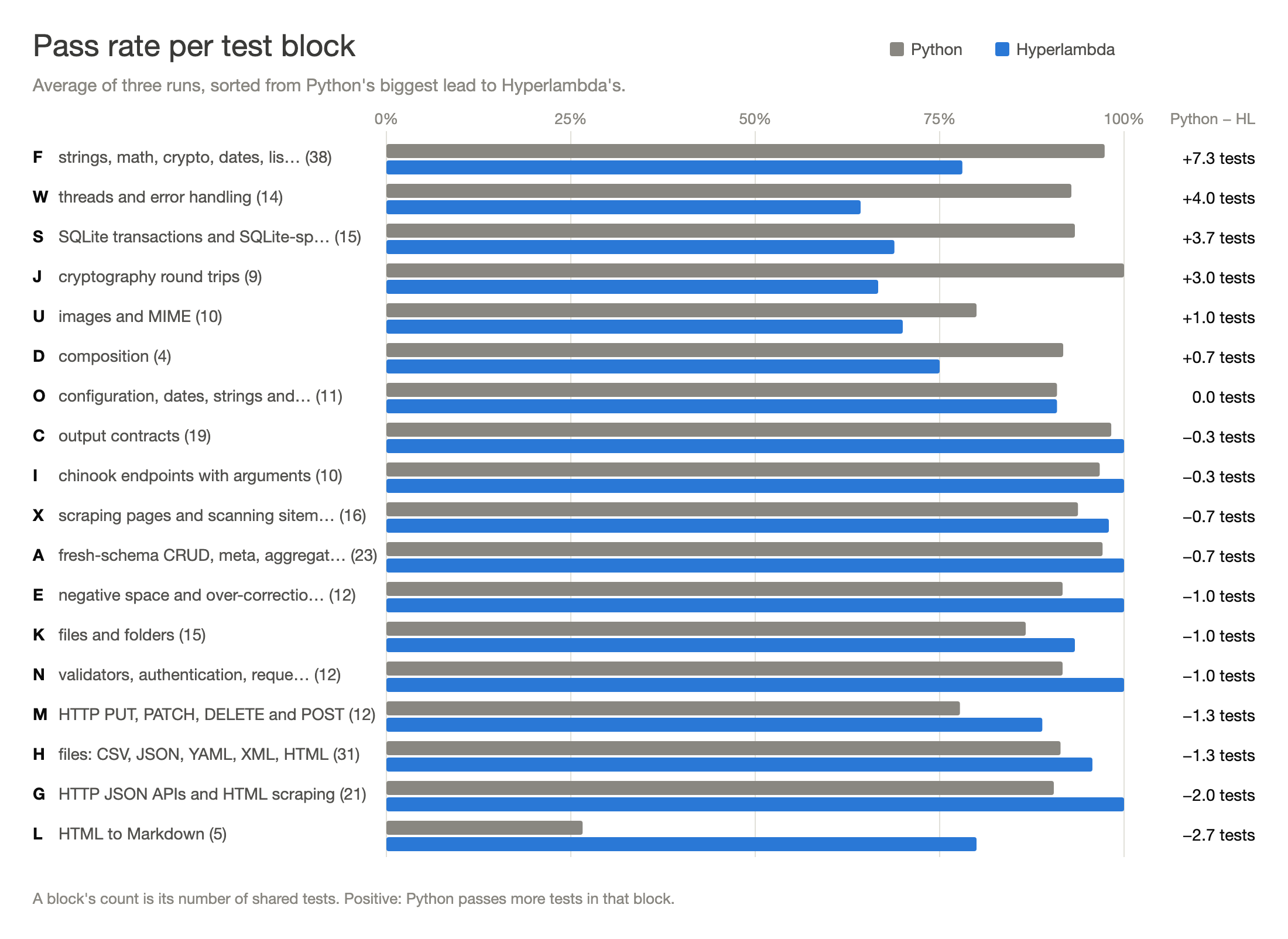
Python is ahead on strings and maths (+7.3 tests), threads and error handling (+4.0), SQLite transactions (+3.7) and cryptography (+3.0). Python passes every cryptography test in every run.
Hyperlambda is ahead on HTML to Markdown (+2.7), HTTP APIs and scraping (+2.0), HTTP verbs (+1.3) and files (+1.3 and +1.0). These are the jobs where Hyperlambda has one command that does what takes a library and a dozen lines in Python.
Why each side fails
I sorted every failed test into one category, by reading the judge's note and the code.
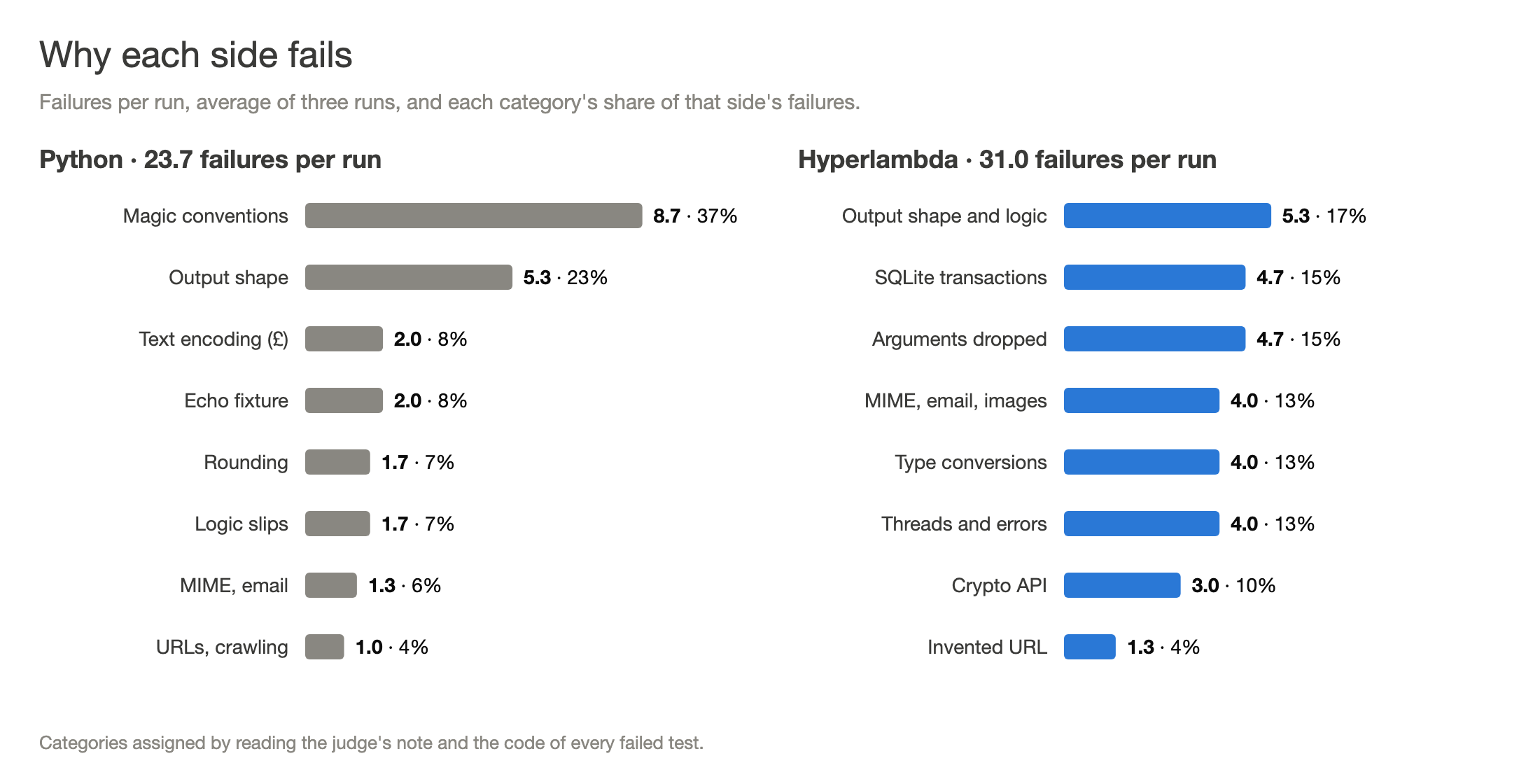
The two sides fail in very different ways.
More than a third of Python's failures are not wrong code. 8.7 failures per run come from Magic conventions our prompts take for granted: Magic's exact Markdown style, folder paths that end with "/", Magic's JSON layout, what Magic means by a QR code's "size", and .NET's exact "Cannot divide by zero" message. Most of the rest is output shape: returning a plain value where the prompt asked for a field, or naming a key after its value. Then a handful of real slips, such as reading a web page as Latin-1, which turned "£" into "£" and made a price filter match nothing.
Hyperlambda's failures are real mistakes, spread evenly over eight categories with none above 17%: wrong percentage maths and a guessed column in SQLite transactions, MIME structure, date and decimal conversions, collecting results from parallel threads, and three cryptography calls used the wrong way.
Shorter code, faster answers
Barnabas also measured how much code each side writes, and how long each takes to answer.
The code is shorter. With every comment removed from both sides, including the prompt comment our generator adds to the top of each Hyperlambda file, the Hyperlambda answers need 37% fewer tokens than the Python answers counted with GPT's tokenizer, and 41% fewer counted with Gemma's. Hyperlambda is the shorter of the two in 87% of the tests. Fewer tokens means less to generate, less to pay for and less for a human to review.
The answers are about 4 times faster. Round 8 takes 1.2 seconds per answer on average, and gpt-6-luna takes 4.9 seconds. Part of that is the shorter code, and part is that about half of gpt-6-luna's output is hidden reasoning before it writes any code, while our model writes the code straight away.
What would close the gap
One of Hyperlambda's categories has a single, known cause. When a prompt says "Executable Hyperlambda file that takes two mandatory arguments…", round 8 always declares those arguments and validates them: 467 times out of 467. When the prompt only says "Takes two mandatory integer arguments…", it drops the declaration in 47 of 111 answers, and a call with missing arguments then fails with an error instead of a clean rejection. That is a pattern in our training data, and it is fixable in the data.
| Tests passed | Pass rate | |
|---|---|---|
| Python, as judged | 253.3 | 91.5% |
| Hyperlambda, as judged | 246.0 | 88.8% |
| Hyperlambda, with the arguments fix | 250.7 | 90.5% |
| Python, with Magic conventions counted as passes | 262.0 | 94.6% |
These are not predictions, just two known causes taken out one at a time. Fixing the arguments problem alone would close about two thirds of the gap.
Two people and a pennies budget
This is the part I'm proudest of.
Two people. Barnabas and I built the model, the 549,787-snippet training corpus, the 401-test eval, the judge and the Python harness. No research team, no data-labelling vendor, no cluster.
One GPU, one day and a half. The training run behind round 8 took 34 hours and 47 minutes on a single NVIDIA H200. At typical cloud rental prices of $3–4 an hour, that is about $130 of GPU time.
A frontier budget. OpenAI doesn't publish what gpt-6-luna cost to train, so this is a guesstimate. Training runs for frontier models are widely estimated at hundreds of millions to more than a billion dollars, before you count the people, the data and the failed runs.
Put the two side by side and our training run cost somewhere between one millionth and one ten-millionth of a frontier training run: in the region of 0.0001% to 0.00001% of the budget, for a result within 2.7 points of it on the same tests.
To be fair about what that number leaves out:
- We stand on Google's shoulders. Our model starts from Gemma 4, which Google trained at its own large cost and released openly. The $130 is the cost of teaching it Hyperlambda, not of building a model from scratch.
- The corpus cost time, not GPUs. I started on the Hyperlambda Generator in February 2024, so nearly three years of work, plus a lot of Claude, went into writing and verifying more than half a million snippets. That is the real investment, and it is not in the $130.
- It is one specialised skill. gpt-6-luna does everything. Our model does one thing: writes Hyperlambda.
That last point is the argument for specialist models. A frontier model is a general-purpose machine paid for by a few companies with billions. A specialist model can be built by a small team that knows its domain, on hardware it owns, and get close to frontier results on the work it was built for. And it runs with about 4 billion active parameters per token, so every answer costs a fraction of what a frontier model charges.
Every way this is unfair, in both directions
Unfair to Python:
- Retries. Our model gets up to three attempts when an answer does not parse or calls a command that does not exist. gpt-6-luna got one attempt. We have not counted how many answers the retries rescued.
- Magic-flavoured prompts. The prompts were written for Hyperlambda, and some of them assume Magic's conventions. That cost Python 8.7 tests per run, as shown above.
Unfair to Hyperlambda:
- Python is home turf. It is the language every large model is trained on most. Hyperlambda is close to absent from the public web.
- Size. About 4 billion active parameters against a frontier model with default reasoning.
Leaves out our weakest areas: the 124 tests that need Magic itself are where round 8 is weakest. It passes 71.7 of them (58%), and 79.2% across all 401 tests. On 16 November I wrote that we would pass 90% on the full suite within a month. We're not there: on the full suite we're at 79.2%, up from 74.3%.
What this does not prove
- It is our suite. I wrote the tests. They are kept out of the training data, but they come from the same people and the same style as the corpus. Tests written by outsiders would be more convincing.
- It is one frontier model, at default reasoning, with one prompt style and one attempt. A higher reasoning setting or a retry loop might widen the gap.
- It is not "Hyperlambda beats Python". On these 277 tasks, a small fine-tuned model writing Hyperlambda lands within 2.7 points of a frontier model writing Python. That's the claim, and only that.
- Don't take our word for it. Round 8 is released, so you can give it your own tasks on the Natural Language API page and judge it yourself.
Reproduce it
Two downloads. The first has every prompt both models got, so you can run them against your own model:
Download python-vs-hyperlambda-r8-prompts.zip (305 KB)
- The fixed instruction sent with every Python prompt, verbatim, and the 277 prompts gpt-6-luna got.
- The system message our generator uses, verbatim, and the prompts our model got for all 402 tests.
- A CSV with every test's block, whether it is one of the 277 shared tests, why it was left out if it is not, and pass or fail in each of the three runs per side.
The second has everything needed to re-judge our model's scores yourself:
Download hyperlambda-eval-r8.zip (1.6 MB)
- The judge, standard-library Python, and the expected result of every test.
- All 402 tests with their reference solutions, the script that creates the test database and files, and the local test servers the tests call.
- Round 8's answers from all three runs, exactly as they were judged, and gpt-6-luna's Python answers from all three runs.
- A README: start Magic, copy one folder in, and run one command per run. You should get 320, 316 and 317 of 401.
Two things are not in it: our model itself, which you can try on the Natural Language API page, and the runner that executed the Python answers against the same judge, which we will add.
Frequently asked questions
Is Hyperlambda better than Python for AI-generated code?
Not on this evidence. On 277 shared tasks, gpt-6-luna writing Python passed 91.5% and our fine-tuned model writing Hyperlambda passed 88.8%. The difference is 2.7 points and not statistically significant. Python is ahead on strings, maths, threads, transactions and cryptography; Hyperlambda is ahead on HTTP, scraping, files and Markdown.
Why only 277 of the 401 tests?
124 tests ask the model to use Magic itself: generating endpoints, sandboxes, introspecting Magic's commands, scheduled tasks and Magic's cache. A Python program has nothing to talk to there, so those tests are left out for both sides.
How big is the Hyperlambda model?
It is Google's Gemma 4 26B-A4B with our LoRA adapter: 26 billion parameters, of which about 4 billion are active for each token. It was trained for 34 hours and 47 minutes on one NVIDIA H200.
How much did it cost to train?
About $130 of GPU time at typical rental prices, for the training run itself. That leaves out the nearly three years of work, since February 2024, that went into the training corpus, and the cost Google carried to build the Gemma 4 base model.
Can I use the model today?
Yes. Round 8 is released, and you can try it on the Natural Language API page.
What comes next
- The arguments fix. Training data that declares and validates arguments however the prompt phrases them. That alone is worth about 4.7 tests here.
- The invented URL. Round 8 sometimes sends a request to an invented
api.instead of the URL in the prompt, because about 212 training snippets share that path. They're being fixed./v1/echo - Python with retries. We will give gpt-6-luna the same retry loop our model gets, so nobody has to wonder how much the retries are worth.