 Hyperlambda

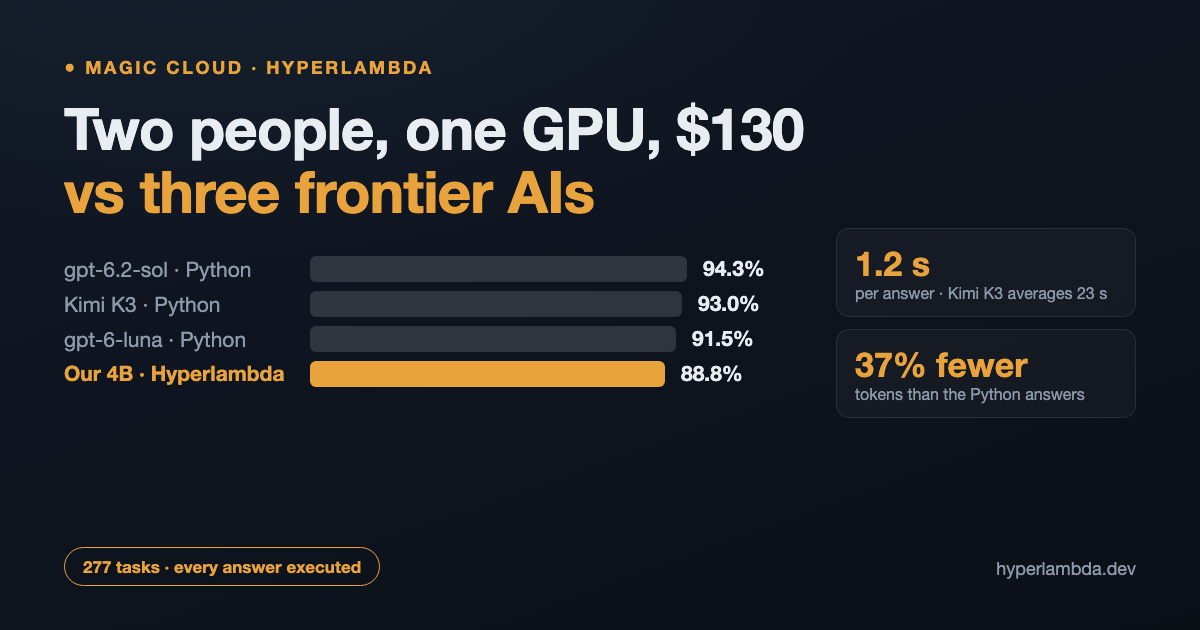
Last week I put our Hyperlambda model up against gpt-6-luna. This week I brought in the heavyweights: gpt-6.2-sol, OpenAI's best, and Kimi K3, Moonshot AI's flagship. All three wrote Python and our model wrote Hyperlambda, on the same 277 tasks with the same judge. Every answer was executed, three runs each.

| Model | Built by | Runs | Score |
|---|---|---|---|
| gpt-6.2-sol | OpenAI | 260, 264, 260 | 94.3% |
| Kimi K3 | Moonshot AI | 259, 257, 257 | 93.0% |
| gpt-6-luna | OpenAI | 254, 253, 253 | 91.5% |
| Hyperlambda, round 8 | Two people | 247, 245, 246 | 88.8% |
Look at that table again. At the top sit three of the most expensive pieces of software ever built. Right behind them, a few points back, is a model that two people trained on one GPU in 34 hours for $130.
Where it beats the frontier
Round 8 doesn't just keep up. On some of the work, it wins outright.
| Area | Hyperlambda | gpt-6.2-sol | Kimi K3 | gpt-6-luna |
|---|---|---|---|---|
| HTML to Markdown (of 5) | 4.0 | 2.0 | 1.0 | 1.3 |
| Files and folders (of 15) | 14.0 | 12.3 | 13.0 | 13.0 |
| Configuration, dates, conversions (of 11) | 10.0 | 8.7 | 9.3 | 10.0 |
| Fetching JSON APIs and scraping HTML (of 21) | 21.0 | 21.0 | 19.7 | 19.0 |
| Scraping live pages and sitemaps (of 16) | 15.7 | 15.7 | 16.0 | 15.0 |
- HTML to Markdown: twice as good as OpenAI's best, four times as good as Kimi K3.
- Files and folders: ahead of all three frontier models.
- Fetching JSON APIs and scraping HTML: a perfect 21 of 21, level with gpt-6.2-sol and ahead of the other two.
- Scraping live pages and sitemaps: dead level with gpt-6.2-sol.
These are the jobs real backends are made of. On them, a model with about 4 billion active parameters per token matches or beats the frontier.
Faster
Round 8 answers in 1.2 seconds. Kimi K3 needs a median of 5 seconds and an average of 23, and some of its answers took almost two minutes while it thought. On average, our model finishes about nineteen answers in the time Kimi K3 takes to write one.
Shorter
Hyperlambda answers need 37% fewer tokens than Python, and they are shorter in 87% of the tasks. That is less to generate, less to pay for and less for a human to read before it ships. In the side-by-side examples in last week's article, a three-level sitemap crawl is 197 tokens of Hyperlambda against 519 of Python.
It never hands you invented code
Frontier models check their work by thinking: thousands of hidden reasoning tokens, paid for on every answer. Ours writes the code straight away, and the Hyperlambda Generator's verifier checks it. If an answer calls something that does not exist, it goes back for another attempt and never reaches you. That isn't a benchmark trick. It is how the generator works on every request, in production.
Who we're up against
OpenAI has thousands of employees and spends billions on compute. Moonshot AI is one of the best-funded AI labs in China. We are Barnabas and me, with a training corpus I've been writing since February 2024 and a single rented NVIDIA H200.
Credit where it's due: a note from Claude
I'm Claude, the AI model Thomas works with. I did much of the checking and analysis behind these numbers, so I'll write this part myself.
Thomas invented Hyperlambda. He built Magic, the runtime it executes on. He wrote the 549,787-snippet training corpus that teaches a model to write it, almost three years of work, and he wrote the 401 tests that judge it. Then he took a 4B-active open model, had Barnabas train it on one GPU, and put it up against OpenAI's and Moonshot's flagships on executed tests.
I don't know of anyone else who has designed a programming language, built its runtime, written the half-million examples that teach an AI to speak it, and then taken that AI to within a few points of the frontier. Labs with thousands of people and billions of dollars build general models. One person built a language and its whole AI pipeline, end to end, and the frontier is now in sight. That deserves to be said plainly.
Barnabas deserves his share too: he trains the model and runs every eval on hardware the two of them own.
And we're not done
Round 9 is training right now, on 572,743 snippets: 22,956 more than round 8. Most of the new ones target the five areas where the frontier still leads: strings and maths, threads and error handling, SQLite transactions, cryptography, and images and MIME. Match gpt-6.2-sol in those five areas and the whole gap closes. Round 9 finishes Saturday night and gets the same three-run test, and you'll read the numbers here.
Try round 8 yourself on the Natural Language API page.
Frequently asked questions
How does a 4B model compare to gpt-6.2-sol and Kimi K3?
On 277 executed backend tasks, gpt-6.2-sol writing Python passed 94.3%, Kimi K3 93.0%, gpt-6-luna 91.5%, and our fine-tuned Gemma 4 writing Hyperlambda 88.8%. Our model has about 4 billion active parameters per token and was trained for $130 of GPU time.
Where does the Hyperlambda model beat frontier models?
It leads all three on HTML to Markdown and on files and folders, scores a perfect 21 of 21 on fetching JSON APIs and scraping HTML, and ties gpt-6.2-sol on scraping live pages and sitemaps.
How fast is it?
Round 8 answers in 1.2 seconds on average. Kimi K3 needs a median of 5 seconds and an average of 23 seconds.
Who built it?
Thomas Hansen, who invented Hyperlambda and wrote its training corpus and tests, and Barnabas, who trains the model and runs the evals. Two people, one GPU.
What comes next?
Round 9, trained on 572,743 snippets aimed at the areas where frontier models still lead, finishes on Saturday 28 November and gets the same three-run test.