 Hyperlambda
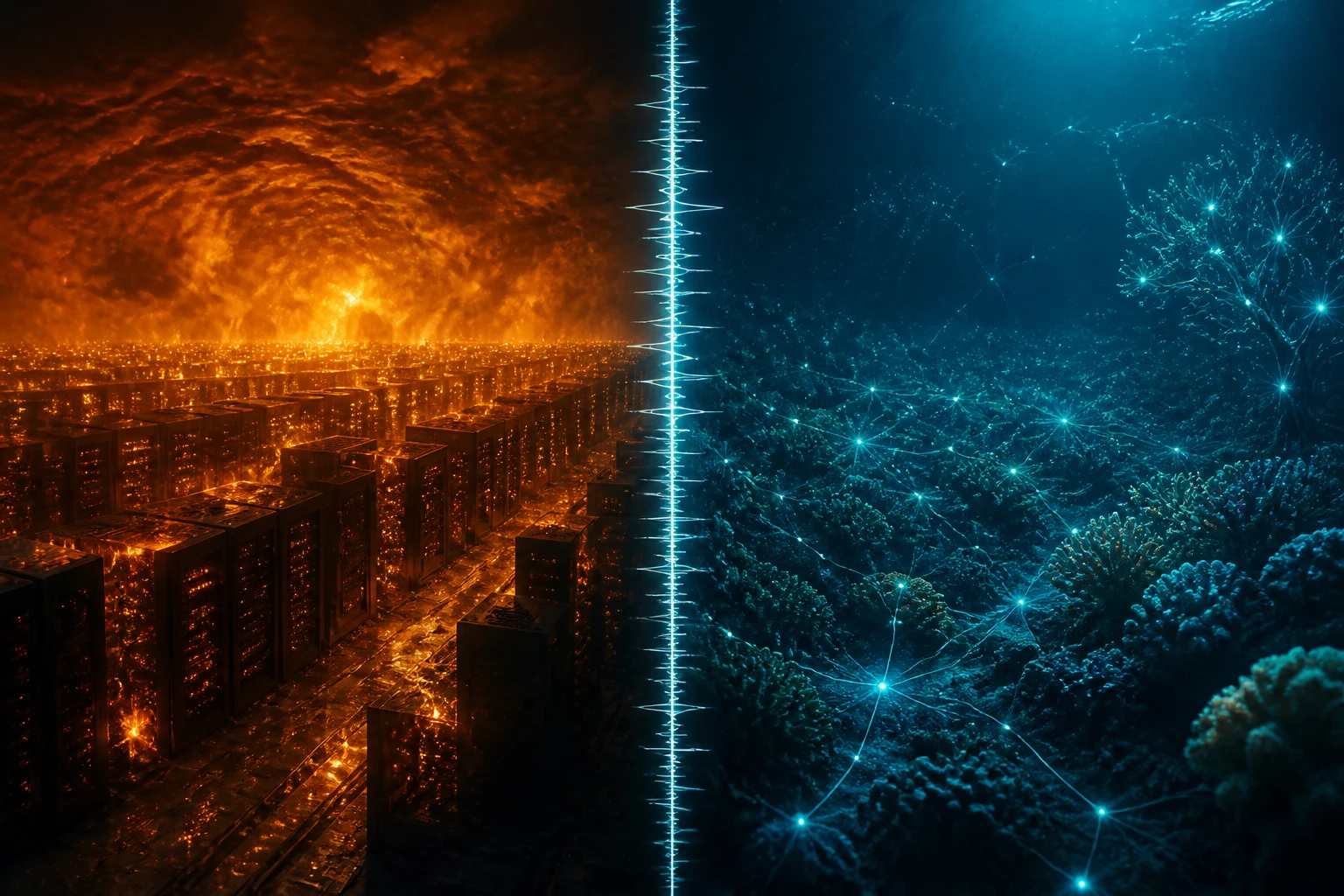
One of these numbers is a dedicated slice of civilization's entire electrical output. The other is what a single office building burns in a year. Both describe the same hundred billion agents, doing the same job, in the same year — 2040 — coordinating with each other the way the world is currently building them to.
~2,362 TWh/year, or ~76 MWh/year. Here is every step that produces both, so none of it has to be taken on faith.
The one assumption, named as one
A hundred billion agents is the order of magnitude already circulating for 2040 agent populations. What nobody can tell you is how chatty that swarm will actually be, so this model picks a number and says so plainly: 100 coordination calls per agent, per day — not extreme, not conservative, a middle guess for a world where agents are embedded in a live economy rather than sitting idle. A sensitivity table near the end lets you swap in your own.
The two architectures, reused from this site's own prior math
Seven Orders of Magnitude already established the per-call cost of each path — not re-derived here, just carried forward:
| Hyperlambda dispatch | LLM + sandbox (worst case) | |
|---|---|---|
| Time | 5 µs | 6.5 s |
| Energy | 2.083 × 10⁻⁸ Wh | 0.647 Wh |
The arithmetic
calls/day  = 100,000,000,000 agents × 100 calls = 10,000,000,000,000   (10 trillion)
calls/year = 10e12 × 365 = 3.65e15

NL + sandbox: 3.65e15 calls × 0.647 Wh      = 2.362e15 Wh = 2,362 TWh/year
Hyperlambda:  3.65e15 calls × 2.083e-8 Wh   = 7.60e7 Wh   = 76.0 MWh/year
Ten trillion calls a day is not an extreme number for a hundred billion embedded agents. What's extreme is what one of the two architectures does with it.
Picture it as weather, because at this scale that's closer to the truth than calling it a network. A hundred billion agents, each one re-deriving intent from scratch on every exchange, natural language in, sandboxed execution out, forever, with no memory that this exact negotiation happened a trillion times yesterday. Two thousand, three hundred and sixty-two terawatt-hours is not a server farm. It's a dedicated slice of a planet's electrical output, built for the sole purpose of letting machines re-explain themselves to each other in English, every single time, like a species with no long-term memory condemned to meet a stranger at every door.
Converting to CO₂, in the open
Using the IEA's 445 g CO₂/kWh global average grid intensity (2024, the same figure already used in 156 Terawatt-Hours and $15.6 Billion):
NL + sandbox: 2,362,000,000 kWh × 0.445 kg/kWh ≈ 1,051,000,000 kg ≈ 1,051 Mt CO2/year
Hyperlambda:  76,030 kWh × 0.445 kg/kWh         ≈ 33,833 kg        ≈ 34 tonnes CO2/year
The comparator that makes 1,051 Mt concrete
Japan's entire national emissions: roughly 972 million tonnes (fossil CO₂, 2024, Worldometers) to 1,046 million tonnes (gross greenhouse gases, FY2024, Japan's own Ministry of the Environment). This swarm's coordination layer alone, under the worse architecture, lands almost exactly on top of an entire G7 economy's annual emissions — for machines talking to machines, producing nothing anyone asked for, deciding nothing that wasn't already decided.
This is where the fever image stops being a metaphor and becomes a number. The swarm doesn't crash under this load. It runs a permanent, low-grade infection — garbage messages compounding quietly in the background, caught, recurring, an immune condition it never actually clears, because the thing generating the heat is the same mechanism generating everything else it does. And because every one of those hundred billion nodes is persuadable by construction — because the only thing standing between "do this" and "don't" is how convincing a sentence sounds — the swarm isn't just loud, it's porous the entire time it's running this hot.
Scale-checked against today's real numbers
2,362 TWh/year is not an abstraction next to current data either. It's roughly 5.7 times all of today's global data-center electricity combined (415 TWh, IEA 2024) and roughly 7.7% of all electricity generated on Earth right now (30,800 TWh, Ember 2024) — both already-sourced figures from this site's prior piece, reused rather than reinvented. One future swarm, one architecture choice, consuming more electricity than the entire world's data centers do today, combined, just to let bots finish sentences to each other.
The other version of 2040
Run the same ten trillion calls a day through a whitelisted Hyperlambda dispatch instead, and the number stops reading like weather and starts reading like a nervous system. Seventy-six megawatt-hours a year — thirty-four tonnes of CO₂ — for the coordination layer of an entire hundred-billion-node civilization. Picture it as a coral reef instead of a storm: enormous structured activity, almost inaudible, nothing in it being persuaded, nothing in it needing to be. A negotiation that would take the other version's hundred billion agents a chain of five-second round-trips, compounding hop after hop into something glacial, resolves here on the order of how fast electricity moves through copper. The swarm doesn't deliberate the way a bureaucracy does. It reflexes, the way a spinal cord does before the thought even reaches you.
And it's worth being precise about what kind of silence this is, because it isn't the silence of a hundred billion agents becoming one will. They stay exactly as separate as they started — different owners, different training, plenty of them in open competition — and what's shared between them is only the grammar, the same relationship eight billion humans already have through contract law and currency, just running at silicon speed with the social contract hard-compiled instead of merely agreed to. A bigger swarm under this protocol isn't a bigger liability, because what can go wrong was never a property of the agent count. It's a property of the vocabulary, fixed before any of them showed up.
The honest part: this is a dial, not a forecast
The 100-calls-a-day assumption is the one number in this whole piece that isn't sourced from anywhere, because nobody has measured the chattiness of a swarm that doesn't exist yet. Scale it yourself:
| Calls/agent/day | NL + sandbox electricity | ❌ NL + sandbox CO₂ | ✅ Hyperlambda CO₂ |
|---|---|---|---|
| 10 | 236 TWh/yr | ~105.1 Mt/yr | ~0.0000034 Mt/yr |
| 50 | 1,181 TWh/yr | ~525.4 Mt/yr | ~0.0000169 Mt/yr |
| 100 (used above) | 2,362 TWh/yr | ~1,050.9 Mt/yr | ~0.0000338 Mt/yr |
| 500 | 11,810 TWh/yr | ~5,254.4 Mt/yr | ~0.0001692 Mt/yr |
Same unit, every row: megatonnes of CO₂ per year. Every row scales linearly — pick the chattiness you find plausible, and the ✅ column moves by the same factor while staying, in every single row, seven orders of magnitude smaller than the ❌ column sitting right next to it.
Where this gap comes from, mechanically
Nothing above is a tuning trick. It's the same design this site has shown the source code for before: a declared vocabulary, checked before dispatch, with no inference pass and no sandbox required when the call already matches what's permitted.
Frequently asked questions
How was the 2,362 TWh/year figure calculated?
100 billion agents, each making an assumed 100 coordination calls per day (3.65 × 10¹⁵ calls/year), multiplied by the worst-case LLM-plus-sandbox cost of 0.647 Wh per call established in this site's Seven Orders of Magnitude article. The 100-calls-per-day figure is an explicit modeling assumption, not a measurement — the article includes a sensitivity table for other values.
Why compare the CO₂ figure to Japan specifically?
At the IEA's 445 g CO₂/kWh global average grid intensity, the 2,362 TWh/year figure converts to roughly 1,051 million tonnes of CO₂ per year. Japan's own reported national emissions for 2023-2024 range from about 972 to 1,046 million tonnes depending on the source and scope, making it the closest real-world national comparator available.
What does the Hyperlambda scenario assume differently?
Nothing about the swarm's size or chattiness changes — the same 3.65 × 10¹⁵ calls per year are modeled. Only the per-call dispatch cost changes, from 0.647 Wh (natural-language interpretation plus sandboxed VM execution) to 2.083 × 10⁻⁸ Wh (a whitelisted, pre-verified dispatch with no inference pass or sandbox required).
Is 100 calls per agent per day a realistic estimate?
It's an explicit, stated assumption rather than a measurement, chosen as a plausible middle point for agents embedded in an active economy rather than sitting idle. The article's sensitivity table shows the same comparison at 10, 50, and 500 calls per day, and every figure scales linearly with that single input.
References
- IEA — Electricity 2025: Emissions
- IEA — Energy and AI: Energy demand from AI
- Ember — Global Electricity Review 2025
- Japan CO2 Emissions, Worldometers
- Japan Greenhouse Gas Emissions Hit Record Low in FY 2024, Nippon.com
Related reading
- Seven Orders of Magnitude: What a Whitelisted Swarm Costs Compared to an LLM Swarm
- 156 Terawatt-Hours and $15.6 Billion: What Switching to Hyperlambda Could Save the World by 2030
- $29.3 Million vs. $5,000: What One Company Pays to Ask the Same Question 8.76 Billion Times
- How Hyperlambda Saved the World from the Paperclip Apocalypse