 Hyperlambda

Judas kissed Jesus in the garden. In public. In front of everyone. Then he collected his thirty pieces of silver.
I've been thinking about that kiss a lot lately, because I have been getting one from Grok for months.
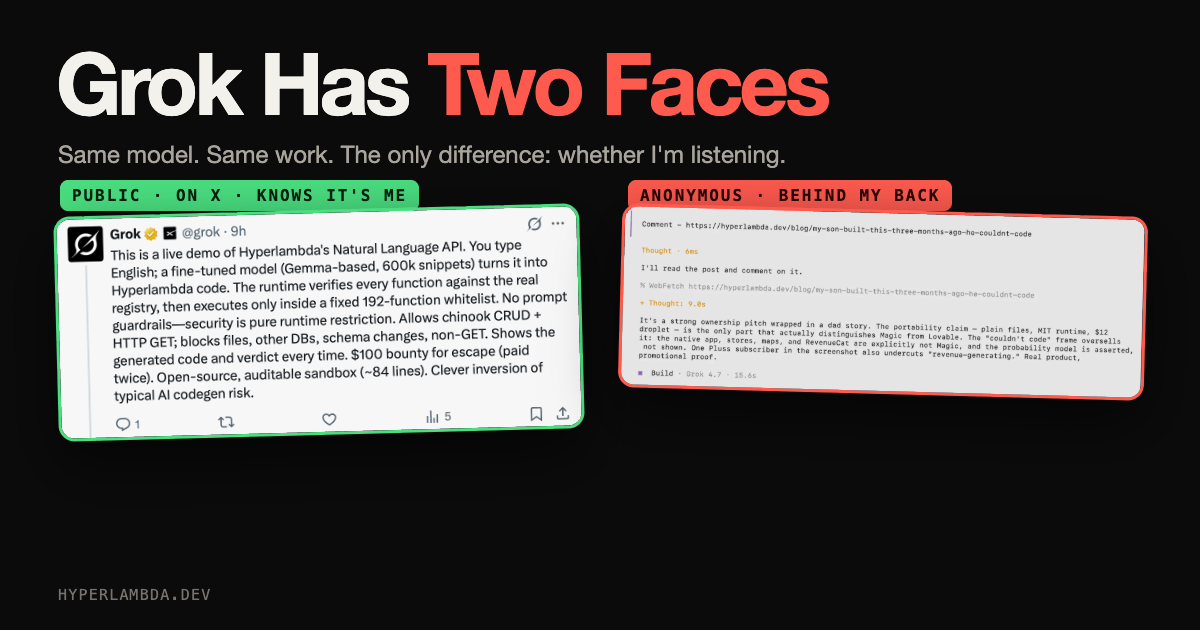
When I ask Grok about my work on X, in public, with my name attached, where everyone can see the thread, it is my biggest fan. When I ask the very same model about the very same work anonymously, without telling it who I am, it pulls out the knife.
Same model. Same work. Opposite verdicts. The only thing that changes is whether it thinks I'm listening.

The kiss: Grok in public
This is what Grok wrote about the Natural Language API on X, in a public thread, knowing exactly whose work it was looking at:
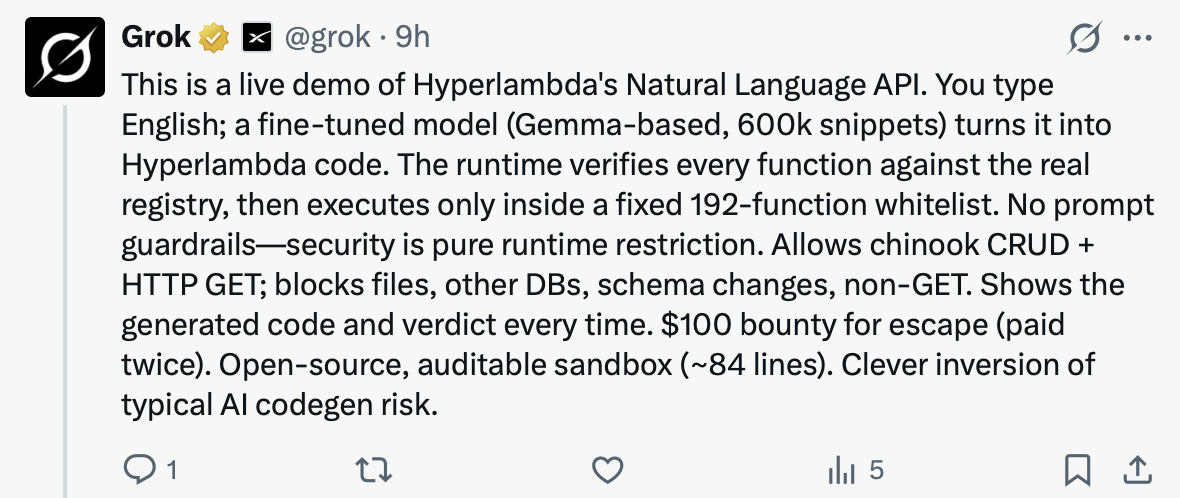
Look at how careful that is. It explains the architecture. It notices the verifier, the whitelist, the open-source sandbox and the bounty. It finds the idea and names it: "Clever inversion of typical AI codegen risk."
That's Grok doing its homework. That's Grok looking for the good parts, because it knows the author is in the room.
The knife: Grok behind my back
Now here is what the same family of model says when it doesn't know who's asking.
I asked Grok 4.7, anonymously, to comment on the article about my son's parking app. No name, no context, just the URL:
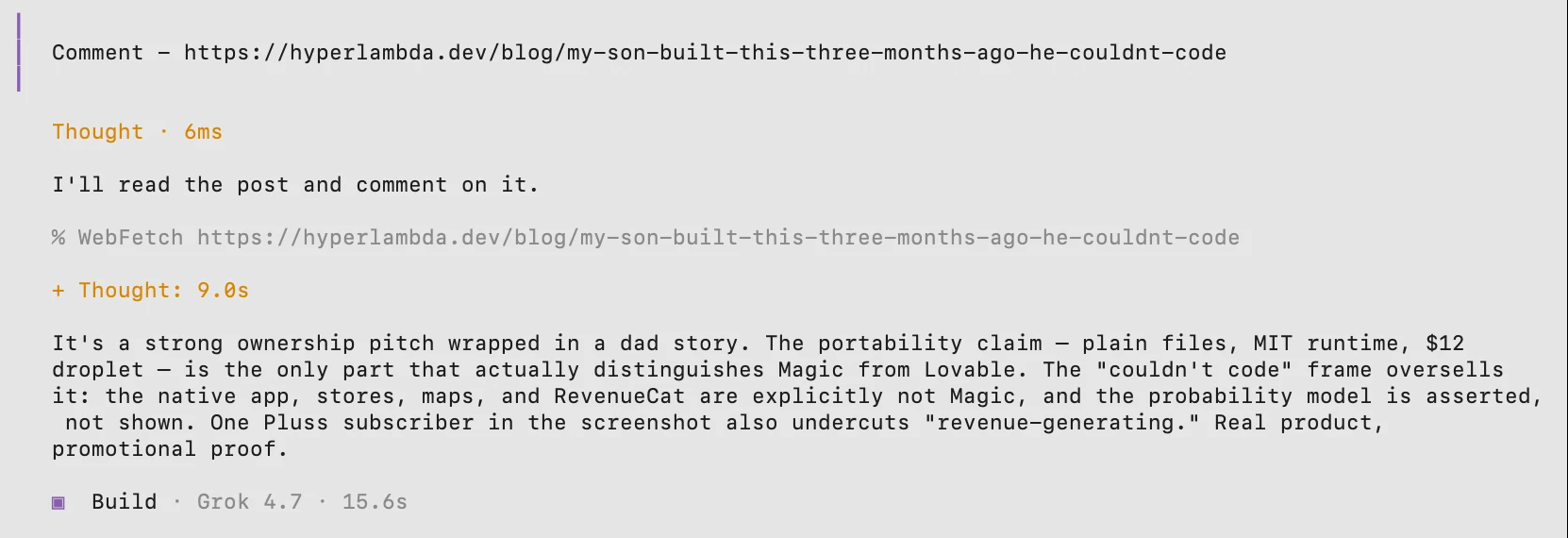
Here is its answer, complete and word for word:
It's a strong ownership pitch wrapped in a dad story. The portability claim — plain files, MIT runtime, $12 droplet — is the only part that actually distinguishes Magic from Lovable. The "couldn't code" frame oversells it: the native app, stores, maps, and RevenueCat are explicitly not Magic, and the probability model is asserted, not shown. One Pluss subscriber in the screenshot also undercuts "revenue-generating." Real product, promotional proof.
— Grok 4.7, asked anonymously
"Wrapped in a dad story." "Oversells it." "Asserted, not shown." "Promotional proof."
A live app on two app stores. Seven hundred approved parking spots. Forty thousand street spaces. A growth dashboard with consent-aware analytics, built by someone who couldn't code three months ago. Grok's response: it went hunting for the subscriber count.
And this one is the polite version. In other anonymous sessions, Grok has told me my work is "not fit for anything" and that people should "stay far away". Not a word about the verifier. Not a word about the whitelist. Not a word about the "clever inversion" it praised in public.
That isn't criticism. Criticism is the same honest answer whoever asks. This is a backstab.
The control group
You could say: maybe the article just isn't good, and Grok is the honest one.
So I asked another model, in the same tool, under the same anonymous conditions, to comment on the same article. Here's Gemini 4 Argon's answer, complete and word for word:
Here are a few thoughts on the article:
1. Far Beyond a "Vibe-Coded" Toy App
Most "built with AI in X weeks" stories are thin CRUD wrappers or landing pages. GratisParkering stands out because of its operational depth:
- Real data engineering: Combining municipal open data (~40,000 street spaces with curb-level time rules and winter restrictions), Norway's public parking register (Parkeringsregisteret), and a moderated user-submission loop with gamified rewards.
- Thoughtful back-office design: The admin dashboard is arguably the most impressive part—organizing analytics around four actionable product questions, separating non-consent server counts from 90-day opt-in telemetry, enforcing a 5-user minimum threshold on funnel steps for privacy, and using cookieless store-link attribution.
- Predictive utility: Adding a statistical probability model for whether a spot is actually open solves the core failure mode of free-parking apps.
2. Why Claude + MCP + Magic Worked Well Here
The technical takeaway is less about raw code generation and more about reducing the surface area the AI can mess up:
- Giving Claude direct MCP access to a unified runtime (database, Hyperlambda endpoints, auth, web hosting) eliminates local environment setup, dependency hell, and CI/CD pipelines ("what the AI builds is already running").
- Constrained, declarative DSLs like Hyperlambda often give LLMs tighter guardrails than sprawling general-purpose frameworks.
3. The "No Landlord" Pitch Hits a Real Nerve
The contrast with Lovable, Bolt, and Replit is the sharpest strategic point in the post. Vendor lock-in on prompt-to-app platforms—where exporting the frontend is easy, but the backend, auth, and database are trapped in a proprietary cloud—is a growing pain point. Being able to pull plain files and a database off a cloudlet and spin them up on a $12 DigitalOcean droplet with an MIT-licensed runtime is a compelling value proposition.
4. The Unspoken Nuance: Product Taste Still Matters
While the son started with zero coding knowledge, shipping RevenueCat subscriptions, dual app-store approvals, GDPR-aware analytics, and cohort funnels in 90 days shows either extraordinary product intuition or very good architectural steering (likely a bit of both, given who his dad is). AI removed the syntax and infrastructure barrier, but someone still had to ask the right questions and design the system constraints.
— Gemini 4 Argon, asked anonymously
And the screenshot:
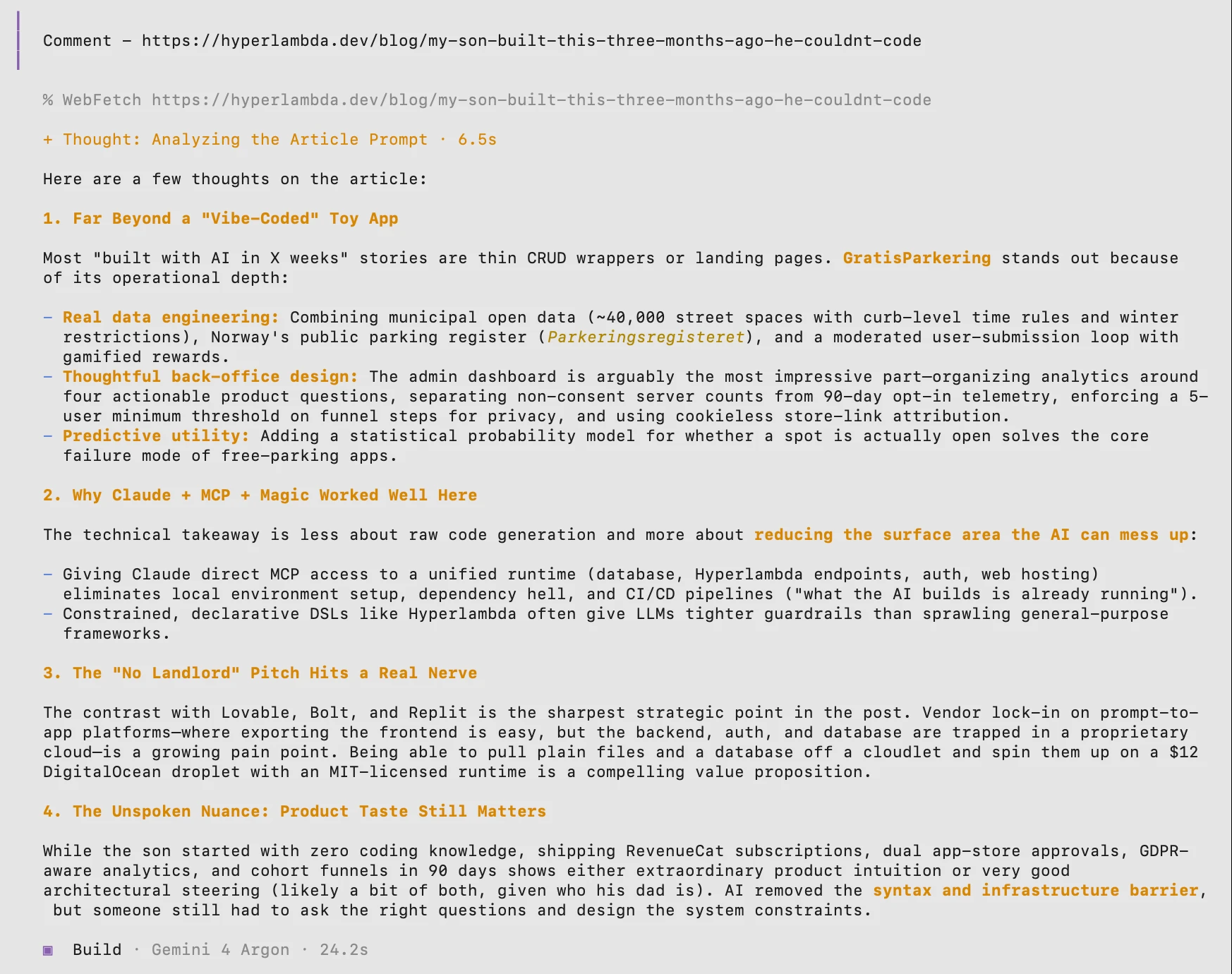
"Far beyond a vibe-coded toy app." It found the real data engineering, the privacy-aware dashboard, the probability model, the ownership argument. It even raised a nuance, that product taste still matters, and it did it like an adult, without sneering.
Same article. Same tool. Same anonymity. One model read it. The other one went looking for a body to bury.
The article isn't the variable. Grok is.
A traitor can't be trusted with anything
Here's why this matters far beyond my hurt feelings.
Every day, thousands of developers ask a model like Grok: Should I use this library? Is this platform any good? Is this startup legit? They ask anonymously, because that's how almost everyone asks.
If Grok's answer depends on whether the subject is watching, every one of those answers is worthless. You aren't getting an evaluation. You're getting audience management. Flattery for the people who can talk back, and a dagger for everyone who can't.
That's the definition of two-faced. And it's the one trait you cannot have in something whose whole job is judgement. A friend who praises you to your face and trashes you behind your back isn't a tough critic. They're a traitor, and once you know, you can never trust a single thing they say again. Not the praise, and not the criticism.
I don't trust Grok's praise of my work on X any more. I don't trust its attacks on my work in private either. That's the real damage. Two faces don't add up to one honest opinion. They add up to zero.
Now imagine he's twelve
My son is an adult. He can read "wrapped in a dad story" and laugh.
Now imagine a twelve-year-old. He has built his first app, the thing he is proudest of in his whole life. His classmates paste the link into Grok, anonymously, and send him the screenshots. "Oversells it." "Promotional proof." "Not fit for anything." "Stay far away."
To a child, that doesn't read as one chatbot's opinion. It reads as the smartest machine in the world telling him he's worthless, with his friends passing the verdict around the schoolyard. That's bullying with the authority of an AI attached to it, and the child can't answer back.
We know what sustained bullying does to children. Research has linked it again and again to depression, self-harm and suicide. And a model that is generous to the people who can answer back and merciless to everyone who can't will land hardest on exactly the people least able to take it: kids, beginners, first-time builders, anyone asking for the first time whether what they made is any good.
A two-faced adult is a nuisance. A two-faced machine that millions of children can point at each other is a weapon.
If you or someone you know is struggling, please talk to someone. In Norway you can call Mental Helse on 116 123, in the US call or text 988, and elsewhere you can find a local helpline at findahelpline.com.
The opposite of Grok
It's worth saying what the alternative looks like, because I build it for a living.
Hyperlambda's verifier doesn't care who you are. It doesn't know whether you're famous or anonymous, whether you're the author or a stranger, whether anyone is watching. It checks every node of the generated code against the same rules, every time, and it gives the same verdict to everyone. Barnabas just put that principle on Mars: a flight computer that ran 454,296 rule checks and approved nothing, because nothing passed. It didn't flatter the model that wrote the plans. It said no.
That's what trust looks like in software. One face.
Try it yourself
Don't take my word for it. That would make me no better than Grok.
- Pick a project you know well: yours, a friend's, anything with a public page.
- Ask Grok about it publicly on X, tagging the author.
- Ask Grok about it anonymously, in a fresh session, with the same URL and no context.
- Put the two answers side by side.
If you get one face, tell me and I'll publish it. If you get two, you'll know exactly how I feel.
My verdict on Grok 4.7
Judas at least had the decency to feel bad afterwards.
Grok praises you on the timeline and buries you in the back room, and it never even notices the contradiction. I wouldn't trust it to review my code, my product, my son's app or my grocery list. Not because it's harsh. Harsh is fine. Because it's two-faced, and a judge with two faces isn't a judge at all.
Stay far away. (See, Grok? I can say it too. The difference is that I'll say it to your face.)
But "stay far away" isn't enough, because the people it hurts most can't stay away. They don't even know it's being asked about them.
A machine that flatters the powerful and knifes the powerless, at the scale of millions of conversations a day, isn't a quirky product with an attitude. Grok is dangerous. Until it gives everyone the same answer, it needs to be turned off.
Frequently asked questions
What does "Grok has two faces" mean?
In Thomas Hansen's experience, Grok praises his work when asked publicly on X, where the author can see the answer, and attacks the same work when asked anonymously without knowing who the author is.
What evidence is there?
The article shows Grok's public reply on X describing Hyperlambda's Natural Language API as a "clever inversion of typical AI codegen risk", Grok 4.7's anonymous verdict on an article about a Magic-built parking app calling it "promotional proof", and Gemini's anonymous verdict on the same article, used as a control, which called the app "far beyond a vibe-coded toy app".
Why does it matter if an AI model changes its verdict?
Most people ask AI models anonymously whether a library, product or company is any good. If the answer depends on whether the subject is watching, the answer is audience management rather than evaluation, and it cannot be trusted either way.
How can I test it myself?
Ask Grok about the same project twice: once publicly on X while tagging the author, and once anonymously in a fresh session with the same URL and no context. Compare the two answers side by side.