 Hyperlambda
Part of the honest comparison series — see also Magic vs n8n, Magic vs Directus, Magic vs PocketBase and Unqork Raised $365 Million to Reinvent the Config File.
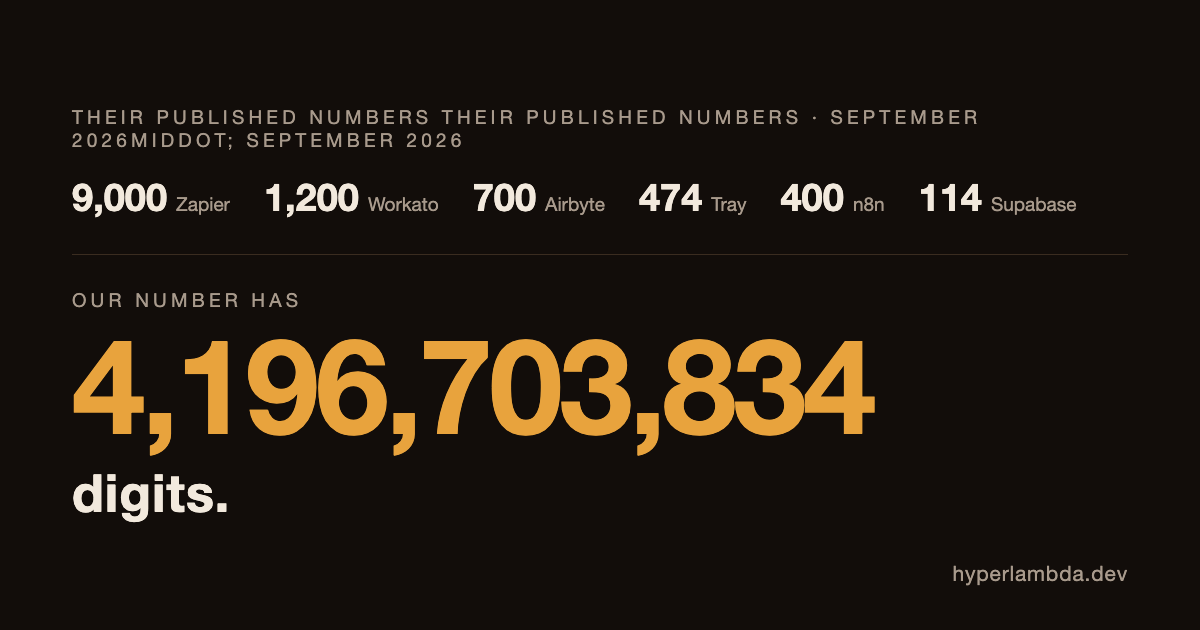
Every integration platform on earth puts a number on its homepage. Nine thousand apps. Twelve hundred connectors. Seven hundred sources. The number is always followed by a plus sign, and it is always getting bigger, and it is always presented as though it settles something.
I went and collected them. All of them, from the vendors' own pages, on the same day.
What I found was not that my number is bigger. What I found is that nobody is counting the same thing, several of them cannot agree with themselves on a single page, and at least one of them is counting itself.
The numbers, as published
Every figure below is the vendor's own, taken from their own site on 20 September 2026, in their own words.
| Platform | Published figure | What they call the unit |
|---|---|---|
| Zapier | 9,000+ | "apps" |
| Workato | 1,200 — and 1000+ | "pre-built connectors" — and "apps" |
| Airbyte | 700+ — and 584 | "connectors" |
| Tray | 474+ | "pre-built connectors" |
| n8n | 400+ | "integrations" |
| Supabase | 114 | "partners" |
| ToolJet | 100+ | "integrations" |
| Retool | none published | 74 logos on the page |
| Make | could not read it | their site blocked me |
Look at the right-hand column before the middle one. Apps. Connectors. Partners. Integrations. Logos. Five different words for five different things, stacked into a single league table that the entire industry then argues about.
An "app" at Zapier is a hosted OAuth integration with triggers and actions. A "connector" at Airbyte is an ELT source or destination with incremental sync. A "partner" at Supabase is a company that has a business relationship with Supabase. These are not comparable quantities. Putting them in one column is like ranking countries by a list that mixes population, area and number of airports.
Three things I found while counting
1. Workato publishes two different numbers on the same page. The page's own meta description says "Browse through more than 1,200 pre-built connectors." The popup that appears on that same page says "Connect to 1000+ apps instantly." Twelve hundred and one thousand, on one URL, in one visit.
2. Airbyte contradicts itself on a single screen. The hero says 700+ connectors. Scroll down four inches to the catalogue filter and it says "Showing 100 of 584." You do not need me to adjudicate this one. Their marketing number and their database number are both on your monitor at the same time, and they differ by a hundred and sixteen.
3. Retool counts itself seven times. Retool publishes no headline figure at all, which is more honest than most of this list. But their integrations page carries 74 logos, and when you actually read them: seven are Retool's own products — Retool AI, Retool API, Retool Database, Retool Email, Retool RPC, Retool Storage, Retool Vectors. Seven more are generic protocols — REST, GraphQL, gRPC, SOAP, OpenAPI, JDBC, SMTP.
That last group is the interesting one. "REST" is not an integration. REST is the ability to make an HTTP request, which is table stakes for anything with a network stack. If "we support REST" counts as an integration, then every programming language invented since 1995 ships with several thousand of them.
So roughly one in five Retool "integrations" is either Retool or a transport layer.
Make would not let me count
Three separate attempts to load Make's integrations page — twice from my laptop, once from a server in a different country — returned a Cloudflare bot challenge. HTTP 403, "Just a moment..."
I am not alleging anything. Bot protection is normal and Make did not put it there to stop me. But I am not going to publish a number I could not read, so Make gets an asterisk instead of a figure. That is the standard I am holding myself to in the table above, and it is worth noticing how rarely that standard gets applied to these numbers in the other direction.
So what is Magic's number?
If you want a catalogue-style figure from me, here are two honest ones: 27 plugins you can install into a cloudlet, exposing roughly 420 slots.
Notice that I just gave you two numbers that measure different things, in a section complaining about people giving you two numbers that measure different things. A plugin is a distributable package. A slot is a callable operation. Neither is an "integration" and I am not going to pretend either one belongs in that table.
Because the honest answer is that the question is wrong.
A catalogue is a list of things somebody already built for you
That is what all of these numbers actually measure: how much work a vendor has done in advance, on your behalf, guessing what you would need.
It is a real thing to measure! If the vendor guessed right, you save days. Zapier has guessed right nine thousand times and that is a genuine, enormous achievement that I could not replicate and will not belittle.
But a catalogue has a hard edge. The day you need the thing that is not on the list, the number on the homepage does nothing for you. It does not matter whether it said 400 or 9,000. You are off the map, and what happens next depends entirely on what the platform lets you do when the catalogue runs out.
Hyperlambda is not a catalogue. It is a language. And the set of integrations a language can express is not a list somebody maintains — it is bounded only by what you can write in it.
Funny math, with the working shown
So let us do the same trick they do, except I will show you every step, because the entire point of this article is that they don't.
A Hyperlambda integration is a text file. A $100 cloudlet — the actual product, the one on the pricing page — ships with 2 GB of disk. That is exactly 2,147,483,648 bytes, and Hyperlambda source is printable ASCII, one character per byte, call it 90 usable characters.
So here is the question, and notice that it is a question about a real machine rather than about infinity: how many distinct Hyperlambda files can you persist on the cloudlet you are renting from me for a hundred dollars a month?
90 ^ 2,147,483,648
That number has 4,196,703,834 digits.
Some scale for that, because "four billion digits" does not land on its own:
- Counting Zapier's 9,000 apps at one per second takes two and a half hours.
- Reading out my number — not the quantity, just its digits — at one digit per second takes 133 years.
- Add up every published figure in the table above. All of them, every vendor, one grand total: 11,988. Dividing my number by that removes five digits. It leaves 4,196,703,829.
You cannot draw that on a chart. There is no chart.
It is larger than every particle in the universe, and that is not a figure of speech
The observable universe contains roughly 10^80 atoms. Counting every elementary particle rather than every atom — throwing in photons and neutrinos, taking the most generous estimate anyone publishes — gets you to about 10^97.
My integration count is approximately 10^4,196,703,833.
So it exceeds the total number of elementary particles in the observable universe by a factor of 10^4,196,703,736. To cross that gap starting from the atoms, you would multiply a trillion by itself 349,725,312 times.
Try to make the universe big enough to catch up. You can't, and the way it fails is instructive:
- Suppose every elementary particle in the universe were itself an entire universe, with its own 10^97 particles. Then suppose every particle in each of those was another universe. You would need to keep nesting roughly 43 million levels deep before the particle count caught my file count.
- Or go wide instead. The string-theory landscape — the most extravagant number of universes physics has ever seriously written down — is about 10^500. Give every one of them 1097 particles. Total: 10597. That is every particle in every universe in the largest multiverse anyone has ever proposed, and it removes 597 digits from a 4,196,703,834-digit number.
Every catalogue in that table, plus every particle in every universe in the multiverse, and the number is still essentially unchanged.
And it fits on a 2 GB disk that costs a hundred dollars a month.
Now the honest part, which is the part they always leave out. That number counts every possible string, and the overwhelming majority of those strings are not valid Hyperlambda, let alone useful integrations. It is a preposterous figure. It is supposed to be a preposterous figure.
That is the joke. My number is absurd, and I have just shown you precisely how I manufactured it, which means you can check it and reject it. Their numbers are also a construction — a choice about what to count, made by the people who benefit from the answer — and they have shown you nothing. Airbyte's own catalogue disagrees with Airbyte's own hero by 116. Nobody publishes the working.
The difference between funny math and marketing math is whether the author admits which one they are doing.
The part that is not funny math
Underneath the gag there is a real claim, and it does not need a single exponent.
Any API with an OpenAPI specification is already an integration. Point Magic at the spec and it generates endpoints and secured MCP tools in seconds. Not "we support REST" in a logo grid — the actual typed operations, wired up and callable.
Any database is already an integration. Point it at a schema and CRUD endpoints come out the other side, MySQL, PostgreSQL, SQL Server, SQLite, including the twenty-five-year-old one nobody wants to touch.
Any sentence is already an integration. This is the one that actually retires the catalogue, and it is the next section.
And if the language genuinely is not enough, there is C#, Python and the terminal underneath it, compiled and loaded into the running process, instantly available to your frontends and over MCP. The escape hatch that Unqork's users ask for and do not get is just... there.
English, Swedish, or Urdu
Here is the thing the number is actually standing in for.
I asked Magic's Hyperlambda generator for an integration. Not by dragging a box onto a canvas. Not by writing code. By typing a sentence — in Norwegian:
Lag et HTTP endepunkt som henter en tilfeldig vits fra Chuck Norris API-et og returnerer vitsen. Kun brukere med rollen 'admin' skal ha tilgang.
Three seconds later:
.arguments
auth.ticket.verify:admin
http.get:"https://api.chucknorris.io/jokes/random"
   convert:true
yield
   joke:x:@http.get/*/content/*/value
It caught "kun brukere med rollen 'admin'" and emitted the authorisation check. That endpoint is now live, role-secured, and exposed to any AI agent over MCP.
Then I asked for the same thing in Urdu:
ایک HTTP اینڈ پوائنٹ بنائیں جو Chuck Norris API سے ایک بے ترتیب لطیفہ حاصل کرے اور اسے واپس کرے۔ صرف 'admin' کردار والے صارفین کو رسائی حاصل ہونی چاہیے۔
1.3 seconds. Same endpoint. Same auth.ticket.verify:admin. And — I enjoyed this more than I should have — the Urdu run picked the correct Chuck Norris URL, where the Norwegian run got it slightly wrong.
That integration did not exist in anybody's catalogue. It exists now, because somebody described it in Urdu.
So when a platform's answer to "the catalogue doesn't have it" is "no problem, just write the custom connector yourself" — in JavaScript, in their SDK, against their component model, with their build step — understand what has happened. The number on the homepage was the marketing. The hand-written code is the product.
Magic's answer to the same question is a sentence. In whatever language you happen to think in.
I am not going to pretend the generator is infallible; it is a fine-tuned model and it gets things wrong, which is exactly why the output is constrained to a vocabulary it cannot escape and why you can read every line of what it produced above. It is eight lines. You just read it. Try that with a serialised component graph.
Where these platforms genuinely win
The rule of this series is that this section contains no rebuttals. They do not come afterwards either.
Zapier's 9,000 is real and I cannot match it. Nine thousand maintained OAuth integrations, credential rotation handled, API changes absorbed by somebody else, usable by a person who has never heard the word "endpoint". If your need is on that list, use Zapier. You will be finished this afternoon and I would be wasting your time.
Airbyte does something I do not do. ELT with incremental sync, schema drift handling, normalisation, state management across runs. "Move this table into that warehouse, hourly, forever, and cope when the source changes shape" is a genuinely hard problem and a data.read does not solve it.
n8n's canvas is a real product for a real audience. When an operations team needs to see a flow — where it forked, where it died, what the payload looked like at step six — a visual graph beats a text file. I make the argument for the other side elsewhere, and it does not win every time.
Workato and Tray sell governance, not connectors. Approval workflows, environment promotion, audit, role separation, the compliance paperwork. Enterprises are buying the process, and the connector count is a proxy for "we have been doing this long enough to have built a lot".
Supabase's 114 are honestly labelled. They call them partners, which is what they are. Of everyone in that table, Supabase is the only one whose noun exactly matches the thing being counted — and they have the smallest number. Those two facts are related, and it is to their credit.
The decision rule
Use a catalogue platform if the thing you need to connect is on the catalogue. Genuinely. Check the list first. If Zapier has it, the argument is over and you should go and use Zapier.
Use Magic if what you need is not on anybody's list — the internal system, the legacy database, the partner's undocumented API, the thing your own company built in 2004 — or if you need the integration to run on your own hardware, or to be readable by the person who inherits it, or to be generated on demand by an AI agent that is constrained by a runtime rather than a system prompt.
The single question that decides it: what happens on the day the catalogue does not have it? Every platform in that table has an answer, and for most of them the answer is "write the connector by hand, in our framework, and maintain it forever". Mine is "describe it in a sentence."
The fine print
Every competitor figure in this article was read from the vendor's own public page on 20 September 2026 and is quoted in the vendor's own unit word. Where a vendor published two conflicting figures, both appear. Where I could not load a page, no figure appears.
Specifically: Zapier's 9,000+ from their apps directory; Workato's 1,200 from their integration library's meta description and their 1000+ from the popup on that same page; Airbyte's 700+ from their connectors hero and 584 from that page's own catalogue filter; Tray's 474+ from their connectors page; n8n's 400+ from their integrations page; Supabase's 114 from their partners listing; ToolJet's 100+ from their homepage. Retool publishes no aggregate figure; the 74 is my own count of the logos on their integrations page, and the seven-Retool-products and seven-protocols breakdowns are from reading those logos. Make's integrations page returned HTTP 403 Cloudflare challenges to three attempts from two countries.
These numbers move. If you are reading this months later, check them yourself — and notice whether the unit word changed along with the figure.
The 4,196,703,834 is floor(2147483648 × log10(90)) + 1, where 2,147,483,648 is the 2 GB of disk on a $100 cloudlet expressed in bytes, at one printable-ASCII character per byte. The premise is stated in full in that section, and the premise is where all the mischief lives, which is the entire point of including it. The Norwegian and Urdu generations are real, unedited, and were run through the live generator while writing this article; the timings are what the API reported.
The physics comparisons use the standard order-of-magnitude figures: ~1080 atoms in the observable universe, ~1097 elementary particles on the most generous published estimates, and ~10^500 for the string-theory landscape. These are order-of-magnitude estimates and not precise measurements, which does not matter here — moving any of them by ten orders of magnitude changes the conclusion by ten digits out of four billion.
Magic's own figures: 27 installable plugins and roughly 420 slots, both of which I have just argued are the wrong unit.
And the obvious disclosure: I wrote Hyperlambda, I sell Magic hosting, and I chose which numbers to put in a table. I have made every one of them checkable precisely because I am not a neutral party. If I have been unfair to a vendor, their page is public and so is my method — go and check, and tell me if I got something wrong.
For whatever it is worth as a credential: I have been writing software since I was eight years old, that is forty-four years now, and I am cited on microsoft.com.
Frequently asked questions
How many integrations does Magic have?
Magic does not have an integration catalogue, so the number does not exist in the form the question expects. It ships 27 installable plugins exposing roughly 420 slots, it turns any OpenAPI specification into secured endpoints and MCP tools, it generates CRUD APIs from any supported database schema, and it generates new integrations from a natural-language sentence. The constraint is what you can describe, not what a vendor built in advance.
Which platform publishes the most integrations?
Zapier, at 9,000+ "apps" as published in September 2026, ahead of Workato at 1,200 "pre-built connectors", Airbyte at 700+ "connectors", Tray at 474+, n8n at 400+, Supabase at 114 "partners" and ToolJet at 100+. Retool publishes no aggregate figure. These units are not equivalent to each other.
Why do Airbyte's and Workato's integration counts contradict themselves?
Both publish two different figures on a single page. Airbyte's hero says 700+ connectors while that page's own catalogue filter says "Showing 100 of 584". Workato's page meta description says more than 1,200 pre-built connectors while a popup on the same page says 1000+ apps. Both were observed on 20 September 2026.
Does Supabase have integrations?
Supabase publishes 114 entries that it explicitly calls partners, not integrations — companies with a business relationship with Supabase. It is the only figure in this comparison whose unit word accurately describes what is being counted.
Can you create an integration without writing code?
Yes. Magic's Hyperlambda generator turns a natural-language description into a working, role-secured endpoint. This was verified for this article in Norwegian (3.0 seconds) and Urdu (1.3 seconds), both producing a correct authorisation check. The generated Hyperlambda is readable text you can review before it goes live.
Is Magic's integration count really bigger than the number of particles in the universe?
Yes, on the stated premise, and the premise is the arithmetic in the article rather than a claim about physics. A 2 GB cloudlet holds 2,147,483,648 bytes; at 90 printable ASCII characters per byte that is 902,147,483,648 distinct files, a number with 4,196,703,834 digits, or roughly 104,196,703,833. The observable universe holds about 1080 atoms and at most about 1097 elementary particles. Even every particle in every universe of the 10^500 string-theory landscape removes only 597 digits from the total. This is deliberately absurd arithmetic, presented with its working shown.
What happens when an integration is not in the catalogue?
On a catalogue platform you write a custom connector by hand in that vendor's framework and maintain it yourself. On Magic you describe the integration in a sentence, or import its OpenAPI specification, and if the language genuinely cannot express it there is C#, Python and terminal access underneath, compiled into the running process and immediately available to frontends and over MCP.
Related reading
- Magic vs n8n: An Honest Feature Matrix
- Zero Hallucination Code Generation: A Vocabulary Your AI Cannot Escape
- Convert Your OpenAPI Specification to a Secured MCP Tool in Seconds
- From Prompt to MCP Tool in 5 Seconds
- The Last MCP Server You'll Ever Need
- What Is Hyperlambda and How Does It Work?